AML vs KYC: What Is the Difference and Why They Get Your Crypto Frozen
AML and KYC are usually mentioned together, and many people treat them as synonyms. While everything goes smoothly, the difference seems irrelevant. But the moment an exchanger freezes your transfer "based on an AML check" and asks for a passport, a selfie and a video, it becomes clear these are two different procedures. One checks your money, the other checks you.
Let's break down in plain words what AML and KYC are, how they differ, how they are connected and why they lead to frozen funds when exchanging crypto. At the end, we'll show how to find an exchanger that doesn't freeze money.
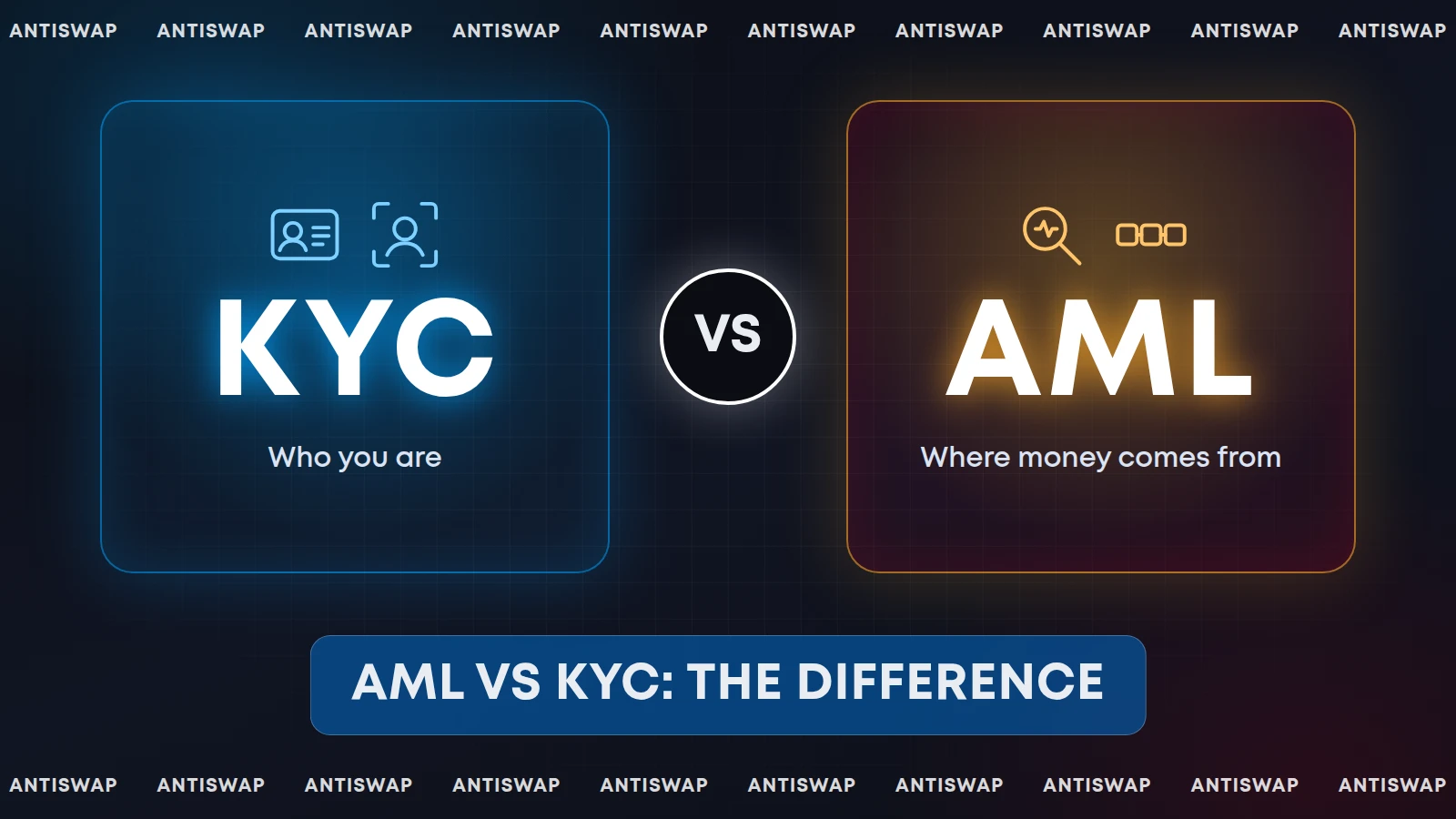
What KYC is
KYC (Know Your Customer) is the procedure a company uses to establish a customer's identity. The term comes from banking regulation: before carrying out a financial operation, an organization must understand who it is dealing with.
KYC answers the question "who are you?". Verification usually comes in levels:
- basic: name, phone, email;
- documentary: a photo of your passport or ID card plus a selfie, sometimes holding the document;
- enhanced: proof of address, a video call, proof of source of funds, bank statements.
On exchanges, KYC is usually completed at sign-up or when raising limits. That is predictable: you know in advance what data you hand over and why. With exchangers it's different: KYC most often pops up out of nowhere, after you have already sent your money.
What AML is
AML (Anti-Money Laundering) is the set of measures against money laundering. If KYC is about the person, AML is about the money. It answers the question "where do these funds come from, and are they linked to crime?".
In crypto, an AML check usually looks like this: a wallet address or a specific transaction is run through a blockchain analytics service. The service studies the coins' history and returns a risk score: the "dirt" percentage, meaning the share of funds it believes is linked to the darknet, mixers, hacks, fraud or sanctioned addresses.
The rest is up to the exchanger: it picks the AML service and sets the threshold above which a transaction counts as "risky". Customers are usually told neither the service nor the threshold.
AML vs KYC: the difference
In short: KYC checks the person, AML checks the money. The other differences are shown in the chart.
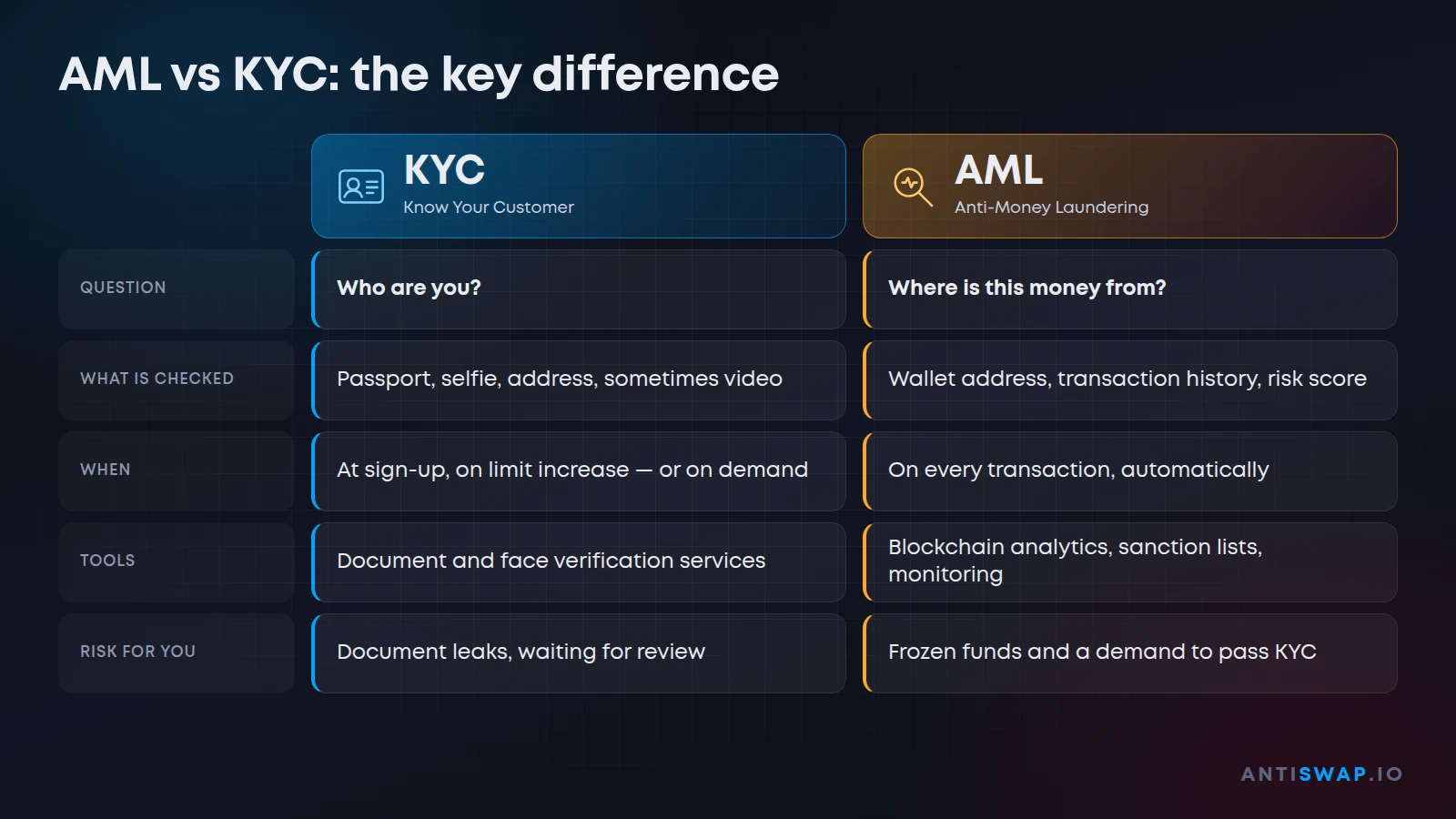
| KYC | AML | |
| Main question | Who are you? | Where is this money from? |
| What is checked | Documents, face, address | Wallet, transaction history, risk score |
| When | At sign-up, on limit increase, or on demand | On every transaction, automatically |
| Tools | Document and face verification services | Blockchain analytics, sanction lists, transaction monitoring |
| Risk for the customer | Personal data leaks, long waits | Frozen funds and a demand to pass KYC |
KYC is part of AML, not a synonym
The confusion exists because the two really are connected. Formally, KYC is one element of an AML program. First a company gets to know the customer, then it watches their operations: it scores address risk, monitors transactions, screens parties against sanction lists and reports suspicious activity when needed.
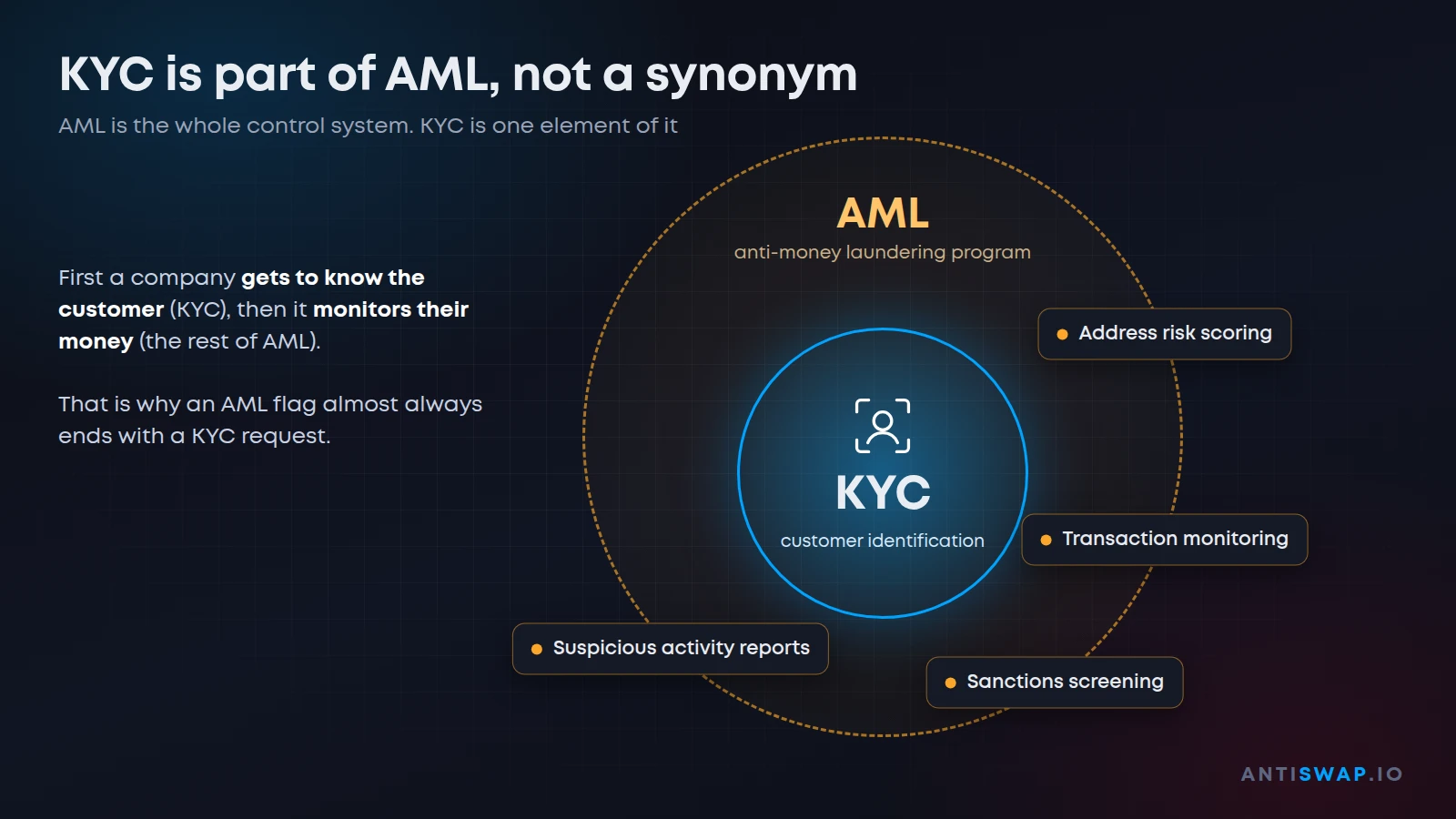
The key practical consequence: if an AML check "finds" something, the next step is almost always a KYC request. Most stories about money frozen during an exchange are built on exactly this combination.
How an AML check turns into a KYC trap
The typical scenario we see in user reviews looks like this:
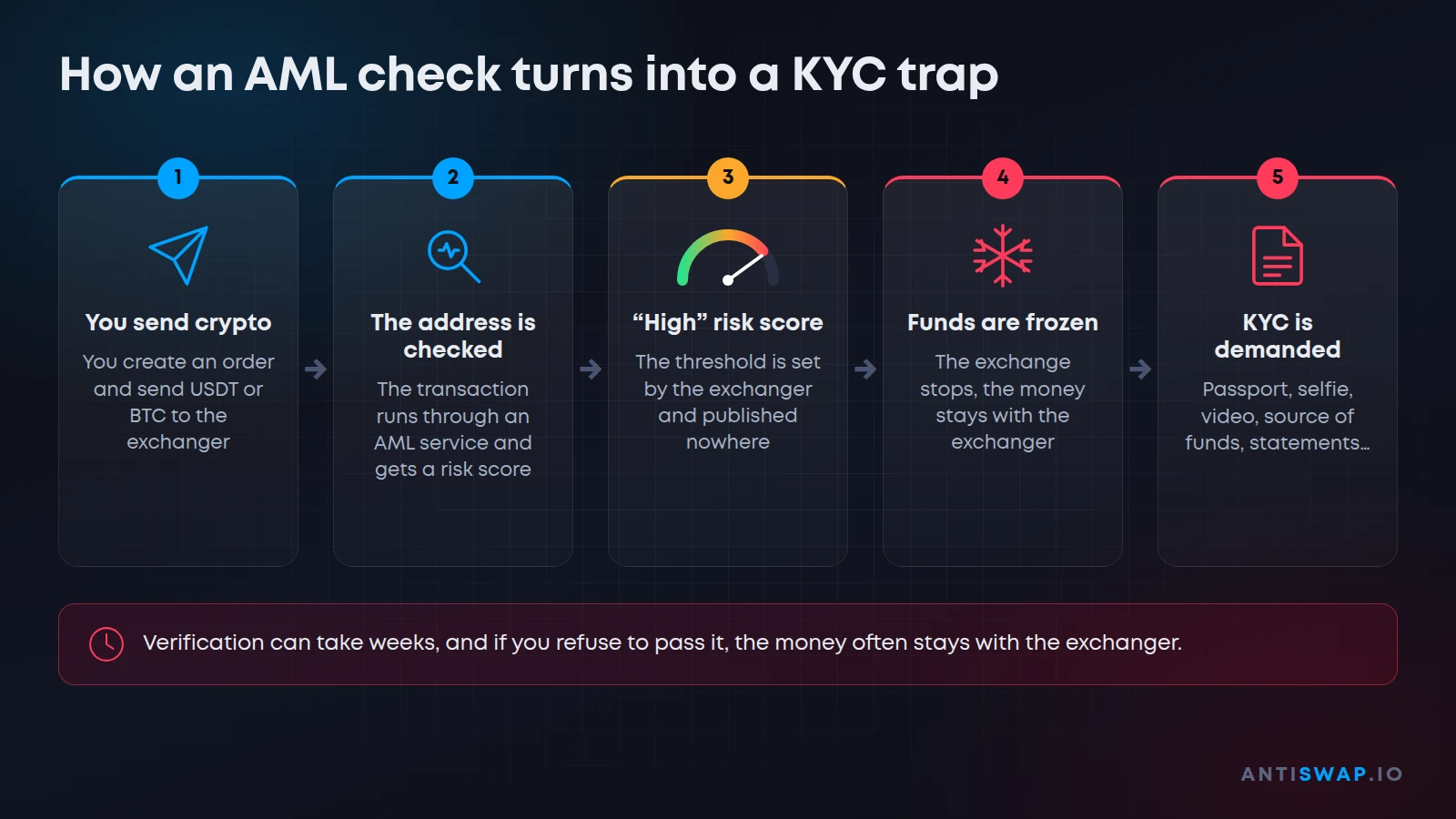
- You create an order and send crypto to the exchanger's address.
- The exchanger checks the incoming transaction with an AML service.
- The risk score exceeds the threshold the exchanger set itself.
- The exchange stops and the funds are frozen.
- You are required to pass verification: documents, a selfie, a video with explanations, proof of source of funds.
The problem is that this "AML/KYC policy" is usually written in fine print in the service's terms, which nobody reads before an exchange. And in practice, verification often becomes just an excuse to stall. We wrote more about how exchangers use AML to hold on to money on the About page.
Why any crypto can turn out "dirty"
Many people think: "I'm an honest person, my coins are clean, this won't affect me." Unfortunately, that's not true. The risk score is calculated across the whole chain of transfers, not just your own actions.
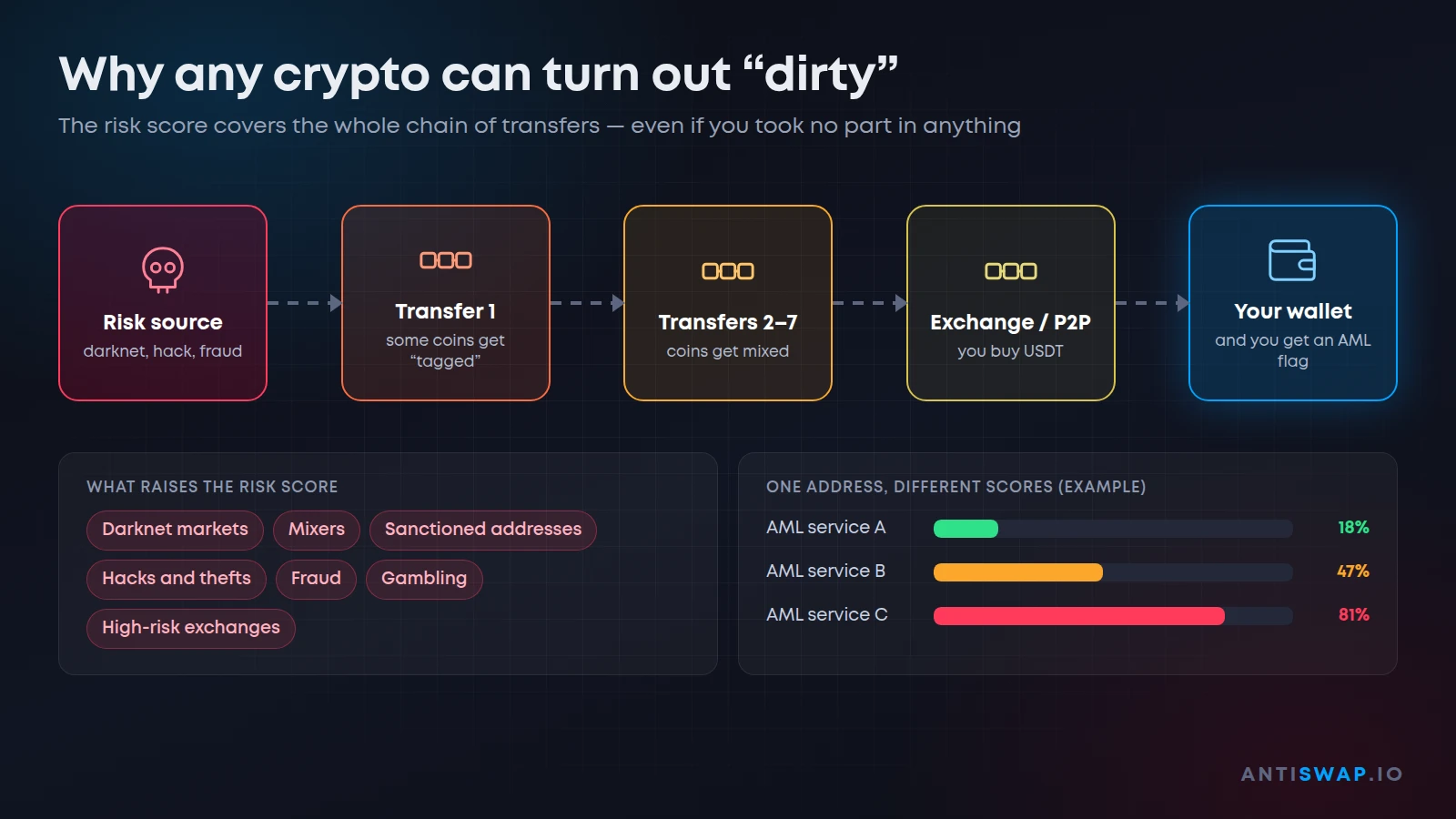
Coins could have passed through a questionable address five, ten or twenty transactions before they reached you. You bought USDT on P2P or got paid by a client, and you already have an AML flag. Practically no one is insured against such "dirty" crypto.
On top of that, different AML services use different databases and algorithms: the same address can get a low risk score in one service and a high one in another. We analyzed such a case in detail in "How the AML bot helps steal its users' money".
A separate story is blocking by stablecoin issuers. It isn't the same as an exchanger's AML check, but it also leads to frozen funds. Read about it in "USDT and USDC blacklists", and check any address with our free Blacklist Check.
The risks of KYC on an exchanger's demand
"I have nothing to hide, I'll pass verification and get my money back," many people reason. Sometimes it really works. But you should understand the risks:
- Your documents go to an unknown company. Often it's an anonymous service with no jurisdiction and no clear responsibility for storing personal data.
- Demands can grow. Today it's a selfie, tomorrow a video with your passport, the day after an explanation of where your funds came from over several years.
- There is no deadline. Review can take weeks while support gradually goes silent.
- The outcome isn't guaranteed. Even after KYC, the exchanger may refuse a refund citing its terms.
So the best strategy is to avoid this situation altogether and choose services that don't freeze money under the pretext of AML from the start.
How to exchange crypto without AML and KYC
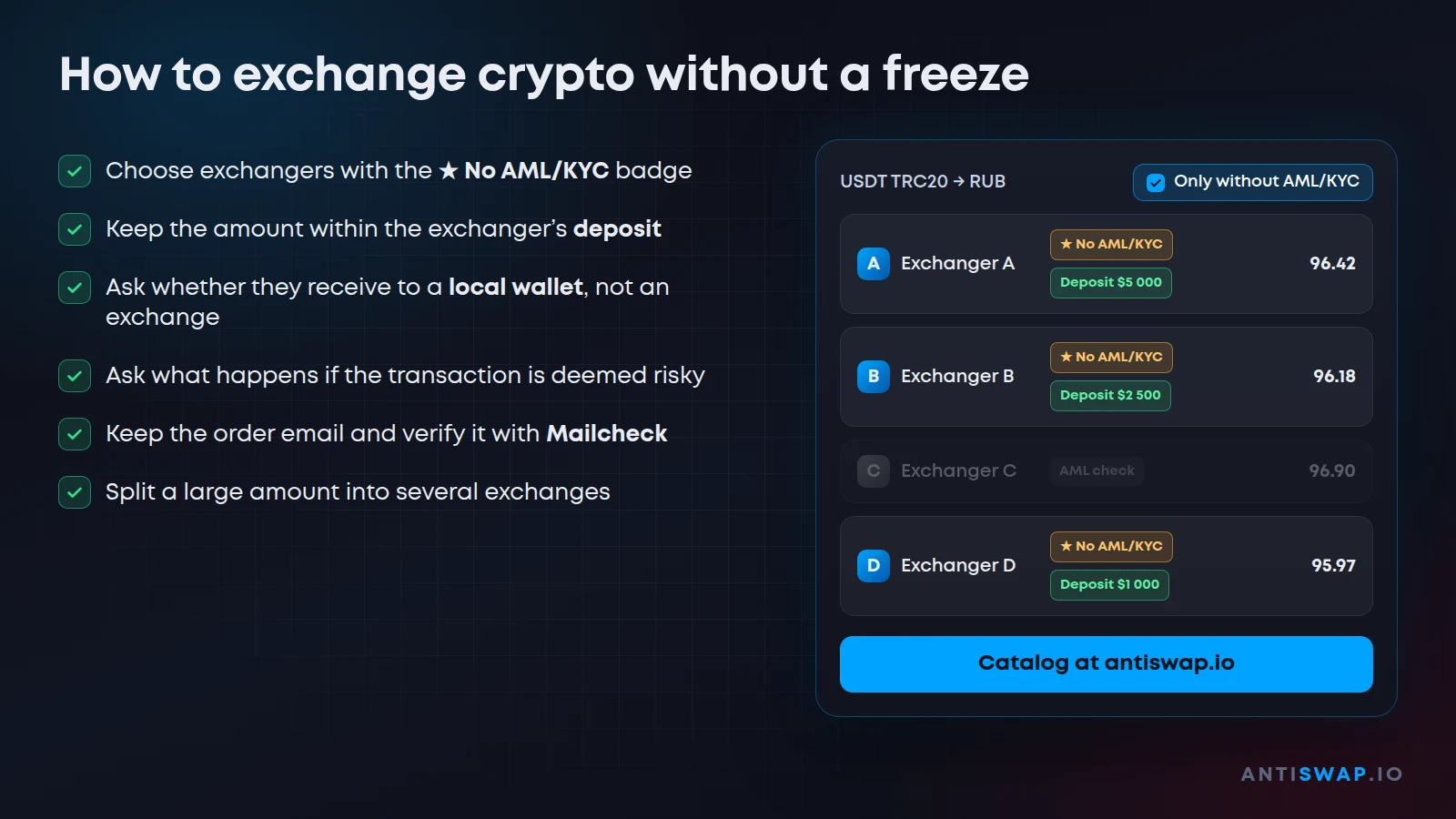
You can find exchangers without AML and KYC in our AntiSwap catalog. Look for the "★ No AML/KYC" badge next to the name: it marks services that commit not to block money under the pretext of AML checks. The badge is only given to exchangers that have made an insurance deposit of at least $1,000. If an exchanger fails to fulfill its side of the deal, the customer can be compensated from the deposit.
On any exchange direction page, turn on the "Only without AML/KYC" filter and only such exchangers will remain in the list. For example, USDT TRC20 → Sberbank RUB without AML/KYC.
What else lowers the risk of a freeze:
- keep the exchange amount within the exchanger's deposit, so the deal is fully insured;
- before the exchange, ask whether the exchanger receives funds to a local wallet or straight to an exchange account: in the second case the risk of a freeze is noticeably higher;
- ask what will happen to your crypto if the transaction is deemed risky, and whether it will be returned to the original address;
- keep the confirmation email with the order details and verify the sender with our email check service: it's your main evidence in a dispute;
- split a large amount into several exchanges;
- use new addresses to receive crypto;
- read reviews: we check new reviews daily and mark exchangers caught freezing funds as SCAM.
The full list of tips is on the Recommendations for users page.
FAQ
Are AML and KYC the same thing?
No. KYC is customer identity verification: name, documents, a selfie, sometimes proof of address and a video call. AML is a broader anti-money laundering system, and KYC is only one part of it.
Besides identity checks, AML includes transaction monitoring, wallet risk scoring, sanctions screening and reporting suspicious operations. Put simply, KYC answers "who are you?", while AML answers "where does the money come from and where is it going?".
Which comes first, AML or KYC?
It depends on the service. On exchanges, you usually pass KYC at sign-up, and AML monitoring then runs in the background on every operation.
With exchangers it's more often the reverse: first an automatic AML check of the incoming transaction, and KYC is demanded only if the exchanger considers the risk score too high. That's why exchanger clients learn about verification only after they have already sent their money.
Can an exchanger freeze my money through no fault of mine?
Yes. The risk score depends on the coins' history before they reached you, so even crypto you honestly bought on an exchange, on P2P or received as payment can get flagged.
On top of that, the exchanger picks the AML service and decides what level of "risk" is unacceptable. The same transfer can go through without questions at one exchanger and get frozen at another.
That's why it pays to choose an exchanger in advance: one with clear refund rules and a deposit you can be compensated from.
What should I do if my money is already frozen?
Don't panic and don't rush to send documents. Keep all correspondence with support, the order email and the transaction hash: they are your main evidence in a dispute.
Ask the exchanger in writing to name the AML service and the risk score it got, and offer to have the funds returned to the original address. Leave a review about the situation on AntiSwap: public attention often speeds things up.
Where can I find an exchanger without AML and KYC?
In the AntiSwap catalog. Look for the "★ No AML/KYC" badge next to the exchanger's name or turn on the "Only without AML/KYC" filter on the exchange direction page you need.
Only exchangers that have put up an insurance deposit get this badge. For the deal to be fully covered, make sure the exchange amount doesn't exceed the deposit.
Bottom line
KYC checks who you are. AML checks where your money comes from. At exchangers they work together: an AML service finds a "risk", the funds are frozen, and then you're asked for KYC. It's easier to protect yourself in advance: choose exchangers with the "★ No AML/KYC" badge and a deposit in the AntiSwap catalog, and share this article with anyone else who exchanges crypto.