What Is a Bitcoin Wallet Address? Types of Bitcoin Addresses Explained
A Bitcoin wallet address looks like a random set of characters. But in reality, this string represents the entire logic of the network: transaction type, commission size, support for new technologies, and compatibility with various services.
The same Bitcoin can be sent to different address formats. And in each case, the commission and ease of use will vary. Therefore, before the first transaction, it is worth understanding what each character at the beginning of the address means and which format is best suited for everyday use.
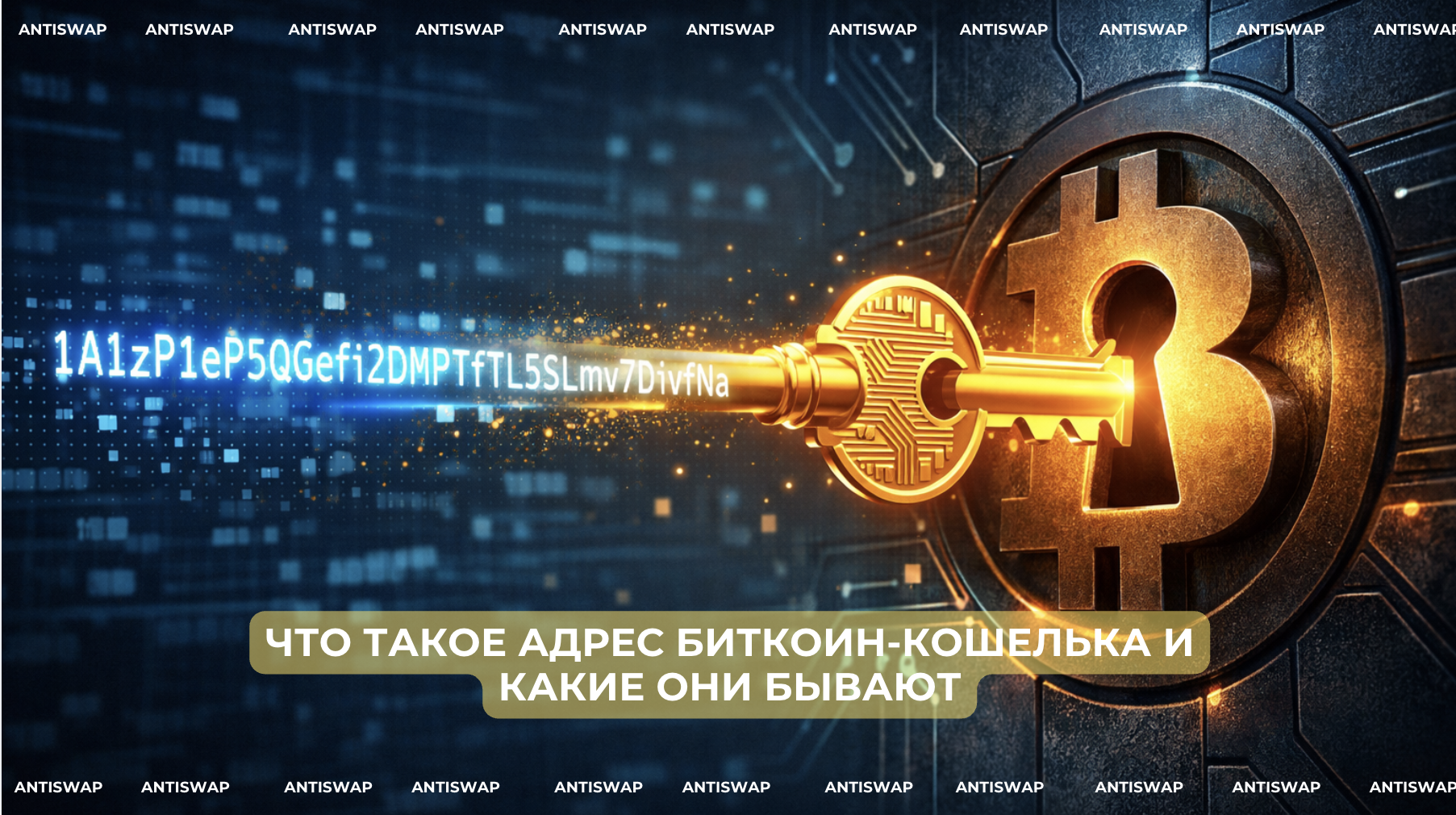
In this article:
- What is a Bitcoin Wallet Address
1.1 What a Bitcoin Address Looks Like
1.2 How Many Addresses Can One Wallet Have - How a Bitcoin Address Works on a Technical Level
- Main Types of Bitcoin Addresses
3.1 Brief Comparison of Formats - Why One Wallet Has Many Addresses
- How to Use Addresses Correctly: Simple Security Rules
- Conclusion
What is a Bitcoin Wallet Address
A Bitcoin wallet address is a unique string of characters to which BTC can be sent. Essentially, it is a public identifier created from the user's public key. It works on the same logic as a bank account number:
- it can be safely shared with other people
- it is only needed to receive funds
- access to the money is granted not by the address, but by the private key
Technically, the address is formed in several steps:
- First, a private key is generated
- A public key is created from it
- The public key is hashed
- The address itself is formed based on this hash
The result is a string ranging from 26 to 62 characters in length, depending on the format.
What a Bitcoin Address Looks Like
You can immediately determine the type of address by the first characters of the address. Here are examples of real formats:
- 1A1zP1eP5QGefi2DMPTfTL5SLmv7DivfNa — old format, starts with "1"
- 3J98t1WpEZ73CNmQviecrnyiWrnqRhWNLy — address with script support, starts with "3"
- bc1qw508d6qejxtdg4y5r3zarvary0c5xw7kygt080 — modern SegWit address, starts with "bc1q"
The first address in the list is historical: Satoshi Nakamoto received 50 BTC for mining the very first Bitcoin block in January 2009.
How Many Addresses Can One Wallet Have
A Bitcoin wallet is not limited to one address. It can create them endlessly. Modern models use HD architecture (Hierarchical Deterministic):
- all addresses are generated from one seed phrase
- the user does not need to store dozens of keys
- a new address is created for each new BTC receipt
This dramatically increases privacy. If you use the same address all the time, anyone can track the entire transaction history through the blockchain.
How a Bitcoin Address Works on a Technical Level
A Bitcoin address looks like a random set of characters, but there is a specific mathematical logic behind it. In essence, an address is a compressed and encoded version of a public key. And the public key, in turn, is mathematically calculated from the private key.
The entire chain looks like this:
Step 1. A private key is generated
This is a random number 256 bits long. In technical terms, it can be represented as a sequence of 256 zeros and ones or as a string of 64 hexadecimal characters. In wallet interfaces, the private key is often shown not in "raw" form, but in encoded form. One of the most common options is WIF (Wallet Import Format). In this format, the key usually starts with 5 and may look like this: 5KJvsngHeMpm884wtkq2E8b4V4G9D9u2Z1n1b5a6X7Y8Z9A1B2C. The number of possible private keys is approximately 2²⁵⁶ combinations. It is practically impossible to guess someone else's key by brute force.
Whoever owns the private key owns the coins at that address. It cannot be shared with anyone or stored in the open.
Step 2. A public key is calculated from the private key
The elliptic curve cryptography algorithm is used. The operation is one-way: it is easy to get a public key from a private key, but not vice versa. The public key can be safely shared with others.
Step 3. The public key is hashed
First through SHA-256, then through RIPEMD-160. These hashing algorithms compress data into a fixed-length string. The output is the basis for the future address.
Step 4. Service information is added to the hash and everything is encoded into an address
The following is added to the hash:
- network version (main or test)
- checksum to check for input errors
After that, the data is encoded in Base58Check format (for Legacy and P2SH) or Bech32 (for SegWit and Taproot). This is how the familiar string 1A1zP1eP5QGefi2DMPTfTL5SLmv7DivfNa appears — this is the Bitcoin address to which funds can be sent.
Why is an address not the wallet itself?
- Address is just a string of characters to which bitcoins come. The coins themselves are stored in the blockchain, not in the address. It can be compared to a bank account address.
- Wallet is a program or device that stores private keys. It is through the wallet that the user confirms the right to spend funds at the address. Similarly with online banking.
Main Types of Bitcoin Addresses
Over the years of Bitcoin's existence, the address format has changed several times: developers have reduced commissions, improved security, and added new features. There are currently four types of addresses.
① Legacy Addresses (P2PKH) — start with "1"
Address Example: 1BoatSLRHtKNngkdXEeobR76b53LETtpyT
- The oldest format, has existed since 2009
- Supported by all wallets and services
- The heaviest and most expensive transactions
- New wallets do not create such addresses by default
② SegWit Addresses (P2SH) — start with "3"
Address Example: 3J98t1WpEZ73CNmQviecrnyiWrnqRhWNLy
- Transitional format after the SegWit update in 2017
- Compatible with old wallets
- Commissions are usually lower than Legacy
- Today it is considered obsolete
③ Native SegWit Addresses (Bech32) — start with "bc1q"
Address Example: bc1qw508d6qejxtdg4y5r3zarvary0c5xw7kygt080
- Modern standard
- Commissions are 35% or more lower than Legacy
- Uses only lowercase letters without visually similar characters, which makes much fewer errors when manually entering an address
- Supported by most wallets and exchanges by default
④ Taproot Addresses (P2TR) — start with "bc1p"
Address Example: bc1p5cyxnuxmeuwuvkwfem96lxyepd6l0f6r4x6q3c
- Appeared after the network update in 2021
- The lowest commissions of all formats
- Not supported by all services, but usage is growing
Brief Comparison of Formats
Address Type | Start | Commissions | Compatibility | Status |
|---|---|---|---|---|
| Legacy (P2PKH) | 1… | highest | maximum | obsolete |
| SegWit (P2SH) | 3… | lower | high | transitional |
| Native SegWit (Bech32) | bc1q… | low | modern | default standard |
| Taproot (P2TR) | bc1p… | low for complex operations, for simple ones comparable to Bech32 | growing | newest format |
Why One Wallet Has Many Addresses
Received Bitcoin — the wallet already shows a new address for the next transfer. This is not a bug, it is intended to be so.
Modern wallets work on HD architecture (Hierarchical Deterministic) according to the BIP-32 standard. From one seed phrase (12 or 24 words), the wallet generates an almost infinite number of addresses. There is no need to store dozens of separate keys: one phrase restores everything completely.
The main reason for this approach is privacy. The Bitcoin network is public, and any transaction remains in the blockchain forever. A new address for each payment breaks the chain and makes tracking more difficult.
Why you shouldn't use one address all the time:
- Anyone will see the entire balance and transaction history through the block explorer
- The more transactions on one address, the easier it is to link them together and establish the identity of the owner
In practice: you received 0.1 BTC to address A, 0.05 BTC to address B, and 0.2 BTC to address C. All three belong to your wallet, but from the outside it looks like three different recipients.
How to Use Addresses Correctly: Simple Security Rules
Bitcoin does not forgive carelessness. If the funds went to the wrong place, the transaction cannot be canceled. Therefore, working with addresses requires simple but strict discipline.
Here are the rules that really save money ⬇️
- Checking the first and last characters. Malicious programs can replace the address in the clipboard. The user copies one, pastes — but inside there is already another. After pasting, it is worth comparing the first and last 4–6 characters, and for large amounts — check the address completely.
- Test transfer. If the transfer is large, you should first send a small amount to make sure that everything is in order. Yes, this is an additional commission. but it is negligible compared to the risk of losing the entire volume.
- Attention to the address format. BTC is sent only in the Bitcoin network. You cannot send Bitcoin to the Tron or Ethereum network and vice versa.
Regarding the compatibility of formats:
✅ Legacy (1...) and Nested SegWit (3...) are accepted by almost everyone without exception
✅ Native SegWit (bc1q) is supported by most modern wallets and exchanges
⚠️ Taproot (bc1p) is supported by large exchanges, but small platforms may not accept such an address - Checking the network when withdrawing from the exchange. A common mistake: a person copies a BTC address, but accidentally selects a different network on the exchange. The funds go to an incompatible infrastructure and it is extremely difficult to recover them through support.
- Offline storage of the seed phrase. The seed phrase is access to all your funds. It is better to write it down on paper and store it in a safe place.
Not allowed:
– store in phone notes;
– send to yourself by mail;
– take screenshots. - Careful selection of a crypto exchanger. Some platforms block funds under the pretext of AML verification. After that, the user is offered to pass KYC to return their own funds. In this case, it will be necessary to upload documents, confirm identity and prove the origin of the cryptocurrency. Even if the user is not guilty of anything, unscrupulous services can hold coins for months, and sometimes the proceedings last for several years. Before exchanging, it is better to check the status of the service on AntiSwap. There is a rating of exchangers with real user reviews and a separate list of scam sites that block funds and set conditions for return.
Conclusion
A Bitcoin address looks simple, but there is a whole system behind it: the type of format affects commissions, speed, and compatibility with services. Understanding this once means avoiding most typical mistakes.
In short: for everyday transfers, it is better to use Native SegWit (bc1q), for complex operations and maximum privacy — Taproot (bc1p). Legacy and Nested SegWit work everywhere, but are more expensive.