How to Send Money from Russia to Kyrgyzstan in 2026
Transferring funds from Russia to Kyrgyzstan in 2026 has become significantly more complicated than it was just a couple of years ago. Banks are removing available routes, services are updating their terms, and many standard transfer methods are no longer accessible. According to data from the National Bank of Kyrgyzstan, $1.367 billion entered the country in the first five months of 2025 alone. More than 98% of these transfers came from Russia.
The need for transfers exists, and Russians are the primary senders. However, not all platforms are operational, and conditions change rapidly. In such an environment, choosing a transfer method becomes a matter of security and peace of mind. In this article, we will cover several genuinely working methods available to Russian users that offer a chance to send currency without unnecessary risks.
In this article:
- Which money transfer methods from Russia to Kyrgyzstan are relevant in 2026
1.1 Bank transfers
1.2 Money transfer systems
1.3 E-wallets
1.4 Online exchangers - Online transfers require attention to detail
Which money transfer methods from Russia to Kyrgyzstan are relevant in 2026
Bank transfers
Bank transfers remain one of the key channels today. For example, the MIR payment system can be helpful if both the sending and receiving banks officially support this option. In such cases, funds arrive quickly and without extra steps. According to reports, MIR used to operate in Kyrgyzstan. Since 2024, restrictions have been introduced, so the service's availability depends on the specific bank.
Russian banks, such as Sberbank, VTB, MTS Bank, and T-Bank, may provide international transfer services either via cards or bank accounts. If the sender's bank client has a card or account, and the receiving bank in Kyrgyzstan is connected to the correspondent account system, a transfer may be possible.
What to consider: The commission for a ruble transfer can range from 2–4% or more, depending on the bank. You need to look at the conversion rate and account for potential delays due to payment processing. Additionally, some banks in Kyrgyzstan reduced their operations with MIR cards and other Russian payment services in 2025.
Money transfer systems
When bank transfers become expensive or inconvenient, people turn to money transfer systems. These have long been used by Russians to send funds to CIS countries, including Kyrgyzstan.
3 services available to Russian users:
➜ Zolotaya Korona (Golden Crown). Transfers from Russia to Kyrgyzstan are possible both online and through service points. The service is actively operating in Kyrgyzstan and allows you to choose to receive funds in soms, rubles, or dollars.
➜ Unistream. An international transfer system with instant crediting. For the Russia → Kyrgyzstan route, a service with specific limits and tariffs is in effect: online commission starts from 1.1%.
➜ Elecsnet. Given the limitations of traditional channels, agent services like Elecsnet offer cash transfers or transfers via agent networks (availability must be checked individually for the Kyrgyzstan route).
What to keep in mind:
- Commission. For example, when using Unistream, the online transfer commission starts from ~1.1% for CIS destinations.
- Crediting times. Most systems promise "instant or within an hour" crediting, provided all data is entered correctly.
- Choice of currency and withdrawal country. Ensure the recipient can receive funds in soms or another convenient currency at a local agent bank.
- Pickup locations. This is especially important if the recipient plans to withdraw cash. Check if the service has a partner bank or pickup point in the recipient's city.
Imagine you work in Moscow and want to send 60,000 ₽ to a relative in Bishkek. You open the Zolotaya Korona app, enter the recipient's details, and pay for the transfer. The commission is usually between 1 and 3 percent. Within fifteen to thirty minutes, the recipient receives a notification. They can pick up the cash at a collection point or wait for the funds to be credited to a local bank card. Usually, only a passport is required for documentation.
E-wallets
E-wallets remain one of the most flexible and fast ways to transfer funds from Russia to Kyrgyzstan in 2026. These are services where a user has a balance, which they can top up via card or bank transfer, and then send money to another person. Unlike a classic bank transfer, the operation is faster and does not require visiting a branch.
Example service: YuMoney ↓
- The service supports international transfers to cards and accounts. For example, in the "Abroad" section, you can select Kyrgyzstan and transfer funds to an Elcart, Visa, or Mastercard card.
- The commission is about 3% plus an additional 45 ₽ for transfers to a foreign card.
- User limits: with an identified wallet, up to 75,000 ₽ per transaction, 100,000 ₽ per day, and 600,000 ₽ per month.
Method features:
- Wallet status. An identified wallet is required for international transfers. Anonymous wallets have limited access.
- Currency conversion. It is important to check the exchange rate and commission.
- Limits and documentation. International transfers may be subject to mandatory reporting if they exceed a certain threshold.
- Service stability. Some users have reported wallet blocks during their first international transfer.
| Pros | Cons |
| Online operation without visiting a bank. | Commission is higher than some bank schemes. |
| Fast transfer to the recipient's card. | Possible temporary blocks during verification. |
| Less paperwork than a SWIFT transfer. | Not all wallets or routes are supported. |
Online exchangers
When neither banks nor standard payment systems provide the necessary flexibility, online exchangers come to the rescue. Such platforms allow users to convert currency (including rubles, dollars, cryptocurrency, and soms) directly, without the involvement of major banks.
How it works:
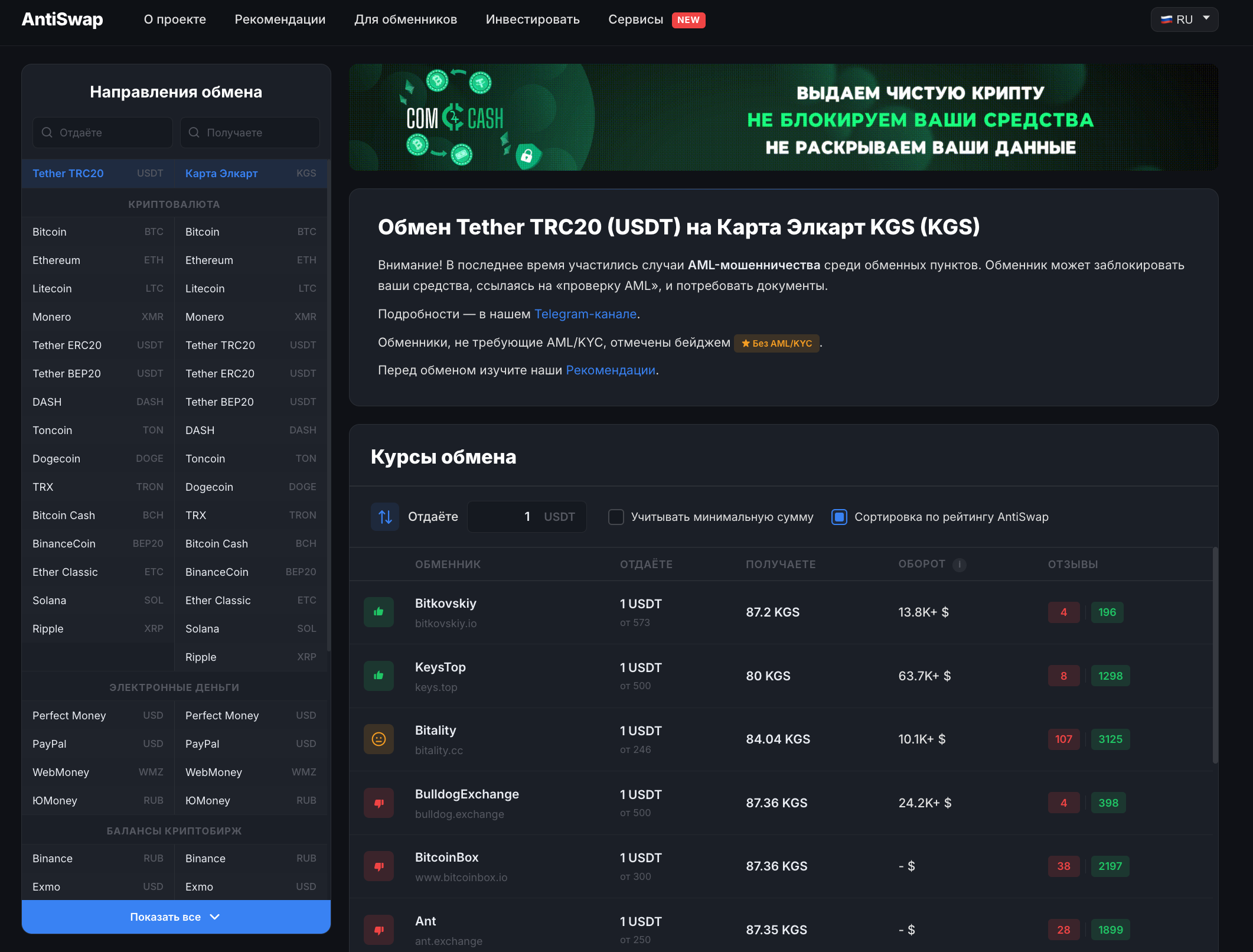
- The user selects an exchange route on a monitoring site. For example, "SBP → SomonBank" or "USDT TRC-20 → Elcart card."
- Then, they proceed to the exchange service and follow the instructions.
- After confirming the transfer, the funds are credited to the recipient. This usually takes less than an hour, though delays can occur.
Why has this become popular? Since 2022, the share of transfers through independent fintech platforms and exchangers has grown more than 2.5 times.
What to pay attention to:
- AML checks and blocks. Some exchangers may "freeze" cryptocurrency, citing AML (anti-money laundering) checks. This is often used as a way to delay or withhold funds entirely.
- Reputation check. To avoid scammers, use an exchange monitoring service, such as Antiswap.io — it displays the status of exchange points and reviews. The most reliable services are highlighted in green and have a star icon.
- Commissions. These vary across platforms from 1% to 5%, and sometimes more when converting via cryptocurrency.
Important! Do not trust "super-profitable" exchangers with new domains or promises of zero commission. Check the platform, its status, reviews, and how long it has been in operation.
Online transfers require attention to detail
None of the described methods is universal: banks operate with restrictions, transfer systems change their tariffs, e-wallets may block accounts for unusual transactions, and exchangers require thorough verification.
The transfer market continues to evolve. What worked six months ago may be unavailable today. The key is not to act out of habit, but to verify current conditions every time. That way, your transfer will go through quickly, safely, and without unpleasant surprises.