DAI Stablecoin in 2026: What It Is and How It Works
DAI is often called one of the primary decentralized stablecoins. Its goal is to maintain a value near $1 and serve as a convenient tool for DeFi, transfers, loans, and storing funds within the crypto market. However, DAI cannot be considered a completely risk-free asset. Its stability depends on its collateral, the mechanisms of MakerDAO/Sky, and the overall market situation. Therefore, in this article, we will break down how DAI works, where it is used, and what risks are important to consider.


In this article:
- What is Dai and what is its place in the market
1.1. Features of the Dai cryptocurrency
1.2. Advantages and disadvantages of Dai - How to use DAI
- Main platforms for exchanging Dai
- Dai: where users store their assets
- Conclusion
What is Dai and what is its place in the market
Dai is a decentralized stablecoin on the Ethereum blockchain, backed by other crypto assets. It appeared in 2017 within the MakerDAO ecosystem, which later became part of Sky. Unlike USDT and USDC, DAI is not issued by a company with bank reserves, but by a protocol: a user locks crypto assets into a smart contract and receives DAI as a loan against that collateral.
Simply put, DAI is similar to a loan secured by cryptocurrency. To issue 100 DAI, you need to deposit more than $100 worth of assets into the system. If the price of the collateral drops significantly, the system can automatically sell a portion of it to cover the debt and maintain the coin's stability. This makes DAI more transparent, but not risk-free: its stability depends on the quality of the collateral, the operation of smart contracts, and the governance decisions of MakerDAO/Sky.
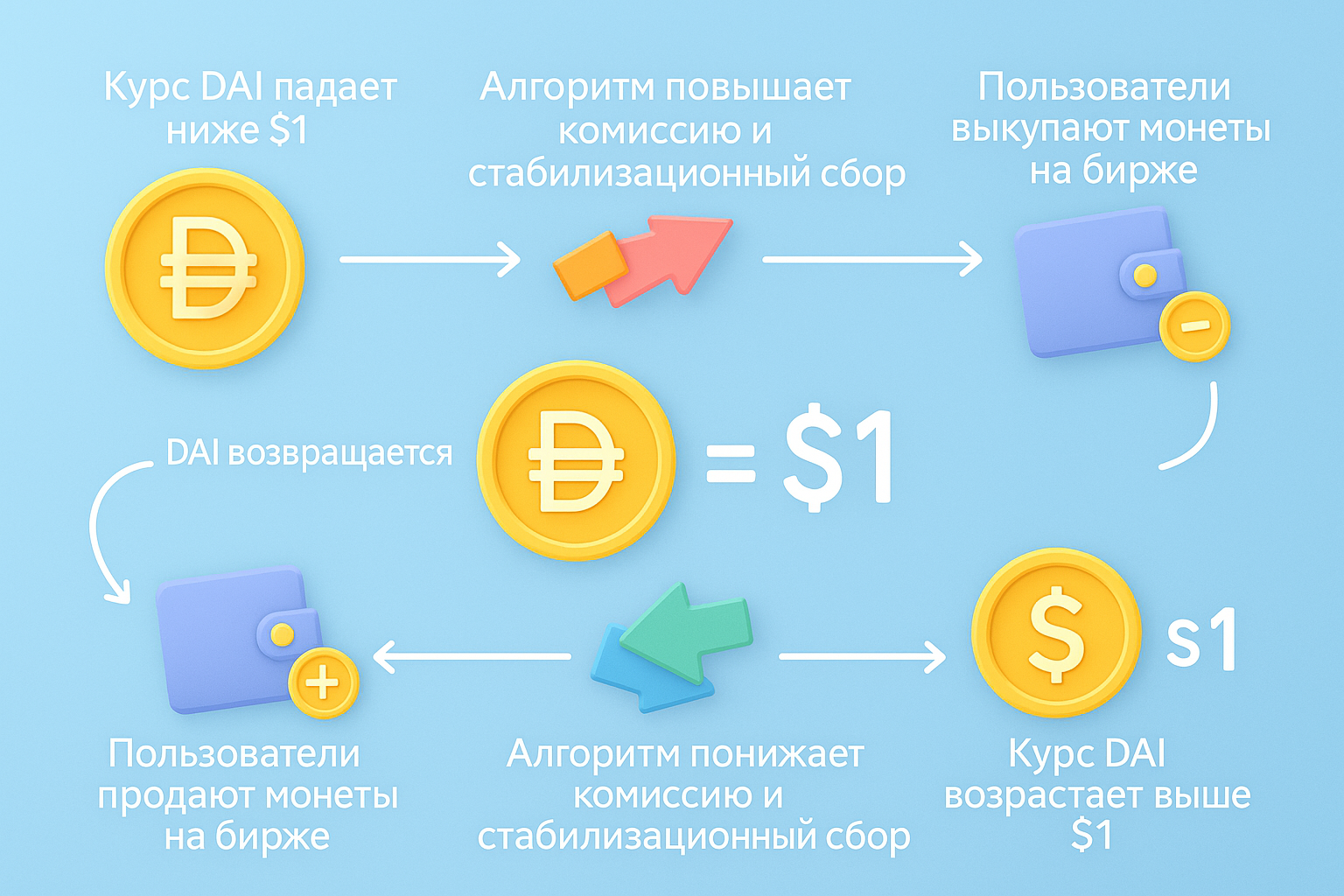
In 2026, DAI is used not only on Ethereum but also on other networks, such as Arbitrum, Optimism, Polygon, and BNB Smart Chain. This is called a multichain approach: the token can be used across different blockchains rather than being tied to just one network. Typically, DAI enters these networks via bridges or Layer 2 solutions, which help perform operations faster and cheaper.
For a beginner, this means one simple thing: before transferring, it is important to check which specific network the DAI is on and whether your wallet or exchange supports that network. Fees on networks like Arbitrum, Optimism, or Polygon are usually lower than on Ethereum, but they are not fixed and depend on network load. Bridges also require caution: a mistake with the network or address can lead to a loss of funds.
By the end of the first quarter of 2025, there were approximately 5.4 billion DAI in circulation. This makes it one of the largest stablecoins on the market, although it is significantly smaller in scale than USDT and USDC. The daily trading volume of DAI varies from day to day, so it is better to evaluate it using current data on CoinMarketCap, CoinGecko, or other trackers rather than a single fixed figure.
The history of its development confirms the project's viability — MakerDAO successfully survived the "Black Thursday" of the crypto industry. In March 2020, when the price of Ether plummeted and many users lost funds, the system faced a serious test. There were many urgent sales of collateralized assets to cover losses. The project team learned from this: they overhauled the reserve system and added new types of collateral.
Now, you can use not only Ether as collateral but also other assets — for example, stablecoins (which always cost about $1), liquid tokens, and even "wrapped" versions of Bitcoin (such as WBTC). This has made the platform more resilient and flexible, allowing it to operate reliably in any market situation.
Features of the Dai cryptocurrency
- Guaranteed decentralization. There are no central administrators in the management of the MakerDAO protocol. All important decisions are made by community members who hold special tokens called MKR. These tokens grant the right to vote on protocol changes — for example, which assets to accept as collateral or how to adjust system parameters. Voting takes place openly directly on the blockchain, and anyone can verify the result.
- Algorithmic price stabilization. To maintain the DAI rate at $1, sophisticated smart-contract mechanisms are used, including a system of liquidations, auctions, and interchangeable collateral.
- Integration into 1500+ applications. DAI is accepted in most popular DeFi protocols: from Aave and Uniswap to Compound, Curve, and hundreds of niche services.
- Transparency of reserves. At any moment, you can verify that every issued DAI is truly backed by collateral. All information about the state of the system is open and published on the blockchain. Data can be viewed through special services or directly on the MakerDAO website.
- Over-collateralization. To issue each DAI, collateral is required in an amount ranging from 120% (for the most reliable assets) to 160% (for riskier ones).
- Automated collateral liquidation. If the value of the collateral falls below the limit, the system automatically sells the asset and burns the DAI, regardless of the holder's "wishes."
- Integration with Web3 wallets and dApps. In the rapidly growing Web3 ecosystem, a wallet without DAI support is a rarity: the token is compatible with MetaMask, TrustWallet, Ledger, Trezor, and dozens of mobile services.
Advantages and disadvantages of Dai
| Pros: | Cons: |
| Decentralization. DAI does not depend on a central authority, which reduces the risk of funds being frozen or interference from banks or companies. | Dependence on the volatility of collateral assets. The stability of DAI is maintained by collateral in cryptocurrencies like ETH. These are subject to sharp price changes, which creates risks. |
| Resistance to market volatility. Even during sharp price drops, the liquidation mechanism works automatically. According to DeFiLlama, the deviation of the DAI rate from $1 has rarely exceeded ±2% and lasted only a few minutes. | Complexity of issuance for beginners. Not everyone understands the mechanics of opening a "CDP vault" to receive DAI, and the price of mistakes (insufficient collateral, sharp price drops) is the liquidation of the asset. |
| Absence of centralized risk of blocking or freezing. DAI users do not have "frozen accounts" — unlike centralized stablecoins like USDT. | Restrictions on issuing "fiat" pairs. DAI cannot simply be printed against real dollars or euros: only crypto collateral is accepted. |
| Passive income. DAI can be placed in DeFi services to earn a variable interest rate. | Risks related to regulation. The DAI stablecoin may be subject to the influence of government agencies seeking to control the digital currency sphere. |
How to use DAI
DAI is used where a dollar-denominated asset is needed within the crypto market, but without direct dependence on a single issuing company. This does not make the token risk-free, but in DeFi and Web3, it remains a convenient tool for settlements, loans, and storing funds between trades.
- Profit taking: you can exit volatile coins into DAI and wait out a market downturn without withdrawing money into fiat.
- DeFi loans: DAI is often used on platforms like Aave and Spark to take out loans, lend assets, or work with collateral.
- Passive income: DAI can be placed in DeFi protocols to earn variable yields, though the rate is not guaranteed and depends on the market.
- Liquidity pools: the token is used in Uniswap, Curve, and other protocols where users add liquidity and earn fees.
- Transfers between wallets: DAI is convenient to send on networks with low fees, such as Arbitrum, Optimism, or Polygon.
- Web3 payments: DAI is suitable for paying for services, working with DAOs, NFT projects, subscriptions, and other on-chain services.
- Volatility protection: the token can be used temporarily as a more stable form of storage within crypto, but it is important to remember the risks of smart contracts, bridges, and the DAI collateral itself.
Main platforms for exchanging Dai
Via cryptocurrency exchanges. Some major platforms like Bybit, HTX, Gate.io, MEXC, and Bitget allow you to work with DAI using standard trading tools. Everything is set up simply and clearly: the user registers and completes identity verification. After that, they select the necessary trading pair with DAI to create a buy order. The interface of most platforms is intuitive, so the process does not cause difficulties.
Using P2P platforms. Here, transactions are made directly between users, which provides more flexibility. Platforms like MEXC P2P, HTX P2P, and Bybit P2P offer a transparent mechanism where the asset is reserved until the operation is completed. The purchase algorithm is roughly as follows: registration, verification (if required), searching for a suitable offer, choosing a favorable deal, and completing the purchase.
Via online exchangers. These are special internet services that allow you to exchange virtual assets for one another. They are accessible from anywhere in the world with internet access. Exchangers work on a clear principle and do not require complex actions — interfaces are usually intuitive even for beginners. Most exchanges are performed automatically. After the transaction is confirmed, the tokens arrive in the wallet within about a day.
Be careful! Each purchase method involves certain risks. For example, crypto exchanges can block your account for political or legal reasons. On P2P platforms, you may encounter scammers who lure inexperienced users into scams. And exchangers sometimes freeze funds due to AML policies and delay operations due to the need for KYC identity verification.
If you cannot change the difficulties of working with exchanges and P2P services, you can protect yourself in advance when using exchangers. To do this, you should choose only verified resources with a good reputation — for example, use the Antiswap monitoring service, where exchange points are sorted by rating and divided into: honest, neutral, and scam.
Dai: where users store their assets
There is nothing more reliable for storing cryptocurrency than cold wallets. They store private keys offline, making them less susceptible to hacks. Even if a resource is compromised, hackers will not be able to intercept the internet connection or transmit a virus to the computer. Thus, they will not be able to gain access to the assets.
Here are a few wallets that are compatible with DAI:
- Ledger. Integrates with many "hot" services.
- MyEtherWallet. A web application for convenient access to various Ethereum-based tokens. It does not store your data and provides a high level of security when working with cryptocurrency.
- Atomic Wallet. A multi-currency wallet that allows you to buy cryptocurrency. It also supports atomic swaps — a feature that allows you to exchange tokens directly, without the participation of centralized exchanges.
- Exodus. A multi-currency wallet. Users can also exchange DAI directly within Exodus.
- MetaMask. Installed as a browser extension and can be integrated with Chrome, Firefox, and Brave.
Conclusion: how promising is the Dai coin
Experts believe that the potential of the Dai token has not yet been exhausted. Prospects are open in areas such as cross-border transfers, risk hedging, and the online gaming industry. Developers strive to make Dai a stable coin and a global currency. And judging by how things are going with the stablecoin now, they will succeed.
⚠️ Important: the use of cryptocurrencies is always associated with risks. This material is not financial advice and does not encourage buying, selling, or holding DAI. There are many scammers in the crypto sphere, so before taking any action, it is important to check the services, terms, and reputation of the platforms.