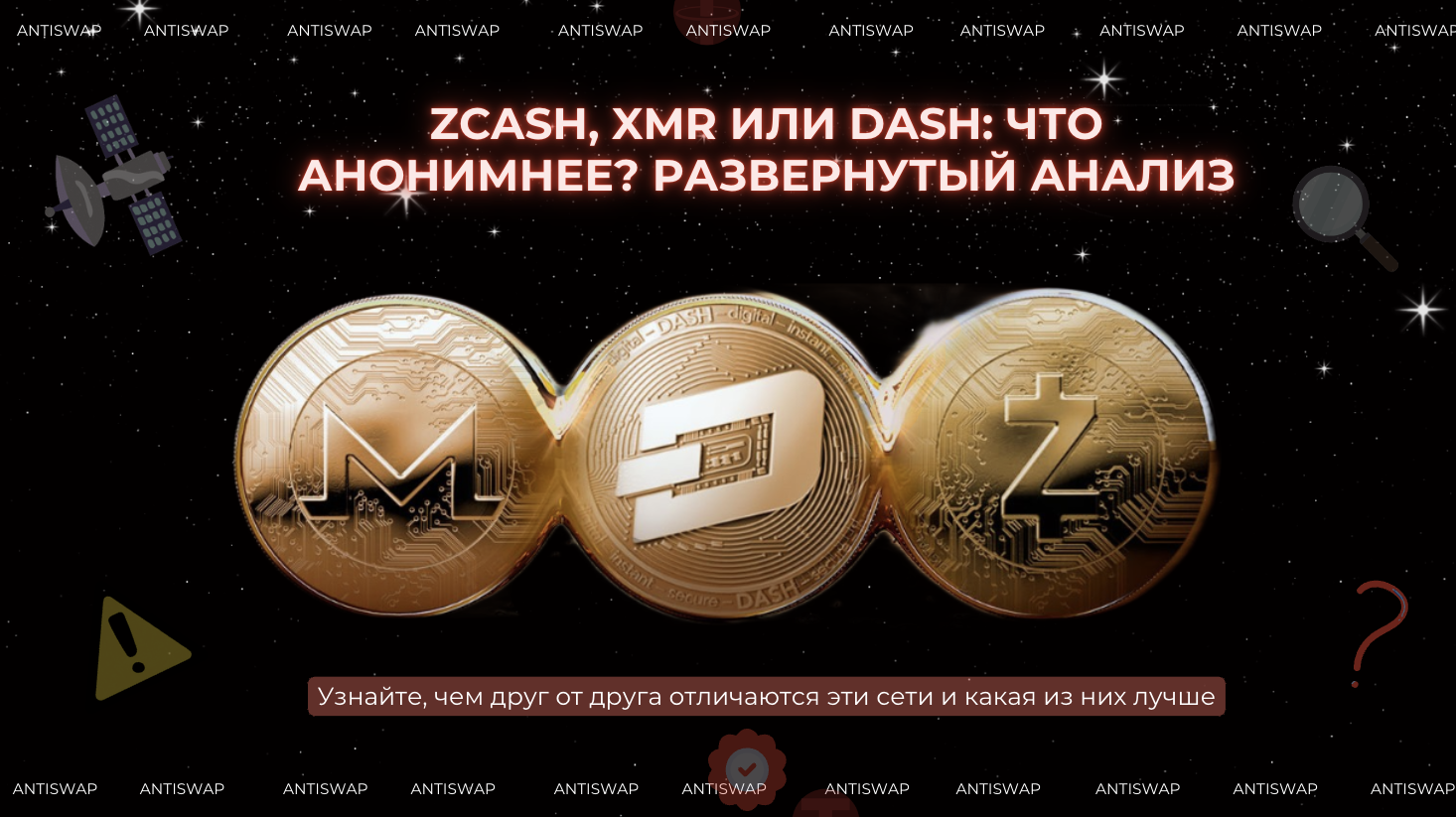
Zcash, XMR, or Dash: Which Is More Anonymous? A Detailed Analysis
When it comes to privacy in the world of cryptocurrencies, three coins are mentioned most often: Zcash, Monero, and Dash. These projects emerged as alternatives to Bitcoin—a transparent system where every transaction remains in the public blockchain forever. While this approach is convenient for analysis, it is not suitable for those who value financial privacy.
This is precisely why Zcash, Monero, and Dash have focused on protecting user personal data. All three share a common goal: to provide enhanced privacy. However, they implement it in different ways. In this article, we will break everything down: what these projects are, how they work, and which coin truly provides anonymity.
In this article:
- Zcash (ZEC): Anonymity by choice
- Monero (XMR): Privacy by default
- Dash: Optional privacy
- Advantages and disadvantages of the cryptocurrencies
- Key differences between Zcash, XMR, and Dash
- Where to exchange Zcash, XMR, and Dash coins
6.1 Cryptocurrency exchanges
6.2 P2P services
6.3 Online exchangers - Where it is safer to store Zcash, XMR, and Dash coins
- Conclusion
Zcash (ZEC): Anonymity by choice
- Launch: October 2016
- Blockchain: Zcash Protocol
- Algorithm: Proof-of-Work (Equihash)
- Maximum supply: 21 million
- Market cap: ~$5.5 billion (as of May 2026)
Zcash is built on a public blockchain, like Bitcoin, but with the addition of zk-SNARKs—zero-knowledge proof technology. It allows for transaction verification without revealing the amount, addresses, or other data.
There are two types of addresses in the network:
- t-addresses — public, like Bitcoin's.
- z-addresses — fully shielded, with all data encrypted.
Transactions between z-addresses are not visible on the blockchain at all: neither the recipient, the sender, nor the amount. However, by default, the vast majority of transactions in Zcash are transparent because:
- exchanges do not support z-addresses,
- interfaces are often limited,
- private transactions require more computational power.
ZEC is considered the most technically advanced in terms of cryptography, but in practice, its privacy is limited—almost no one uses it.
Monero (XMR): Privacy by default
- Launch: April 2014
- Basis: Bytecoin fork, using the CryptoNote protocol
- Algorithm: RandomX (ASIC-resistant)
- Maximum supply: None
- Market cap: ~$6.9 billion (May 2026)
Monero is the recognized leader among anonymous cryptocurrencies. Unlike Zcash, privacy here is not an option but a mandatory requirement: all transactions are hidden by default.
This is achieved through several technologies:
- ring signatures mask the sender.
- stealth addresses hide the recipient.
- confidential transactions (RingCT) hide the transfer volume.
Monero does not allow for a "public mode"—the blockchain is fully encrypted. Even with deep analysis, it is impossible to determine who sent how much to whom. XMR is not favored by governments or large centralized exchanges. Nevertheless, the currency is widely used on platforms where full transaction privacy is important, including independent online marketplaces.
Dash: Optional privacy
- Launch: January 2014
- Basis: Bitcoin fork
- Algorithm: X11 (with ASIC support)
- Maximum supply: 18.9 million
- Market cap: ~$434.5 million (May 2026)
Dash started as Darkcoin—a coin focused on anonymity. However, over time, the project shifted its focus to speed and payment convenience. Privacy remained, but it is now optional and implemented through the PrivateSend feature.
PrivateSend is a coin-mixing mechanism. It works as follows:
- The user enables PrivateSend.
- Coins are automatically divided into equal parts.
- These parts go through a series of exchanges with other network participants.
As a result, the user receives the same funds, but mixed with others', which makes it difficult to trace their source.
It is important to understand: this is not true cryptographic anonymity like Monero or Zcash. In Dash:
- there are no zero-knowledge proofs,
- there are no stealth addresses,
- and the mixing itself can be analyzed, especially with large volumes of data.
Furthermore, PrivateSend is used extremely rarely—less than 1% of all transactions in the network go through it. In practice, Dash is closer to ordinary fast cryptocurrencies than to anonymous ones.
Advantages and disadvantages of the cryptocurrencies
| Cryptocurrency | Advantages | Disadvantages |
| ZCash | + Possibility of full anonymity via z-addresses + Support for zk-SNARKs + Compatibility with transparent blockchains + Low transaction fees | − Complexity of using private features − Most transactions remain public − Limited support from exchanges and wallets |
XMR
| + Privacy by default + Blockchain transparency is excluded + Mining available on standard CPUs | − Low support on major exchanges − Usage is associated with illegal activity − May attract increased attention from financial monitoring services |
| Dash | + Fast transaction processing + Availability of the PrivateSend feature + Simple integration with services + Decentralized governance | − Privacy not by default − Mixing is less reliable than cryptography − Often used without privacy (rare application of PrivateSend) |
Key differences between Zcash, XMR, and Dash
The dry numbers and bare facts speak for themselves. Monero is the undisputed leader and remains a recognizable brand among those for whom privacy is a vital necessity. A fully private blockchain, every movement hidden from prying eyes: 100% of transactions are anonymous. The downsides? Limited liquidity on major exchanges and close scrutiny from regulators.
Zcash is technologically one of the most advanced projects. zk-SNARKs provide the highest level of cryptographic protection, but only if the user enables the private mode themselves. The problem is that most choose transparent transfers: they are faster, simpler, and more familiar. Zcash is suitable for those who value choice and are willing to learn. The mass user is not always that person.
Dash is a compromise option. It offers fast and inexpensive transactions with the ability to increase privacy via PrivateSend. But this is just a mixing mechanism that can be analyzed if desired. Chainalysis, for example, has successfully deanonymized a significant portion of such transactions. The plus side of Dash is its user-friendly interfaces and wide retail support. The downside is that it is an unsuitable alternative for those who want full transaction confidentiality.
Where to exchange Zcash, XMR, and Dash coins
Cryptocurrency exchanges
All 3 cryptocurrencies are supported by many platforms. For example, MEXC, Gate.io, HTX, Bybit, etc. To purchase coins, you need to go to the "Buy Crypto" section. But keep in mind that 90% of exchanges now only conduct operations after passing KYC verification.
Risks! Your assets may be frozen if an exchange restricts operations for users from certain countries or requires verification that is difficult to pass. In such situations, withdrawing funds can be extremely difficult. Furthermore, it is not recommended to store large amounts on an exchange: even well-known and stable platforms occasionally fall victim to hackers.
P2P services
Here, the transaction occurs directly between users, bypassing centralized exchanges. On such sites, the cryptocurrency is locked in an escrow service until payment confirmation is received.
The buyer chooses a suitable seller, determines the payment method (most often a bank card or electronic payment systems), and sends the payment. As soon as the seller confirms receipt of funds, the currency is transferred to the wallet.
Risks! Sometimes unscrupulous sellers intentionally delay fulfilling their obligations or do not fulfill them at all. Scammers may insist that your payment was not received.
Online exchangers
Through online exchangers, you can buy or sell private coins in the desired direction, for example, USDT → XMR, Sber → Zcash, or cash USD → DASH. Usually, the scheme is simple: choose the direction, create an order, get the details, and pay according to the exchanger's instructions.
Before paying, it is important to verify that the details actually came from the exchanger and that the email was not spoofed by scammers. For this, you can use MailCheck: the service checks the authenticity of the email and helps you understand whether you can trust the message with the payment details.
Risks! Some exchange services may suspend a transaction due to AML policy. To unblock funds, users often have to provide an extensive package of personal data—from screenshots of correspondence to utility bills. To protect yourself, study reviews of services, and to find reliable exchange points, it is most convenient to use monitors like Antiswap: it indicates the status of each exchanger—"honest," "neutral," or "scam," which allows you to quickly separate reputable sites from suspicious ones.
Where it is safer to store Zcash, XMR, and Dash coins
For the secure storage of any cryptocurrency, it is recommended to use special wallets with enhanced privacy.
- For Zcash, wallets like Zecwallet and Nighthawk are suitable. When working with exchanges, it is worth studying the privacy policy of the chosen exchange. It is recommended not to store large amounts in exchange wallets, but to transfer coins to your own wallet immediately after purchase.
- For XMR, you can use both hardware (cold) wallets and software (hot) wallets. Cold wallets include the popular Ledger and Trezor, while hot wallets include versions of the classic Monero GUI Wallet ("heavy version") and lighter, mobile ones—Feather, Monerujo, Cake Wallet.
- For Dash, the Matbi platform is suitable. The service allows you to store and exchange coins without involving an intermediary. Client funds are stored in "cold" wallets not connected to the internet, which eliminates the theft of coins in the event of a hacker attack.
Conclusion
All three cryptocurrencies are focused on protecting user data, but they use different approaches and provide different levels of confidentiality.
If a user values full anonymity, they most often choose Monero. If it is necessary to flexibly manage the transparency of transfers, Zcash is suitable. And if fast transactions and convenience are the priority, it is worth paying attention to Dash.
⚠️ All information is provided for informational purposes only. We do not encourage the use of cryptocurrencies to bypass restrictions or violate the law.