Crypto and Rubles in Russia: Card Transfer, SBP QR Code or Cash — What Is Safer
Buying or selling USDT for rubles in Russia is easy. Doing it so that you don’t later have to unblock your card, explain yourself to an investigator or return money by court order is harder. Almost everything depends on one choice — how exactly the rubles change hands.
This guide is a traffic light of methods: where the risk is a lottery, where we haven’t seen problems so far, and why cash at an office or via the exchanger’s courier is the best way to sell crypto.
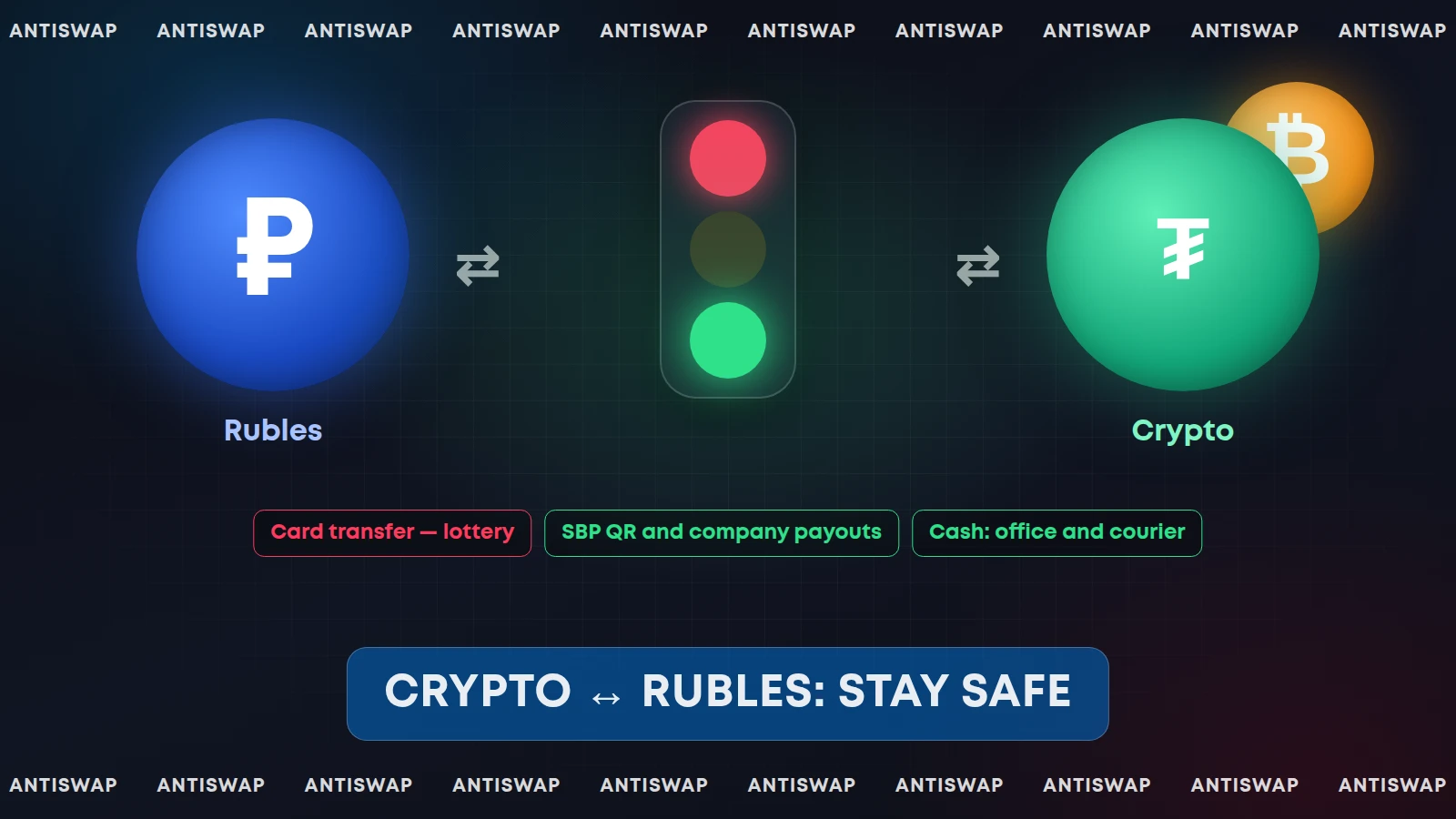
In short: the traffic light
At AntiSwap we read exchanger reviews and client complaints every day. The picture is stable: problems almost always start where rubles go from a private person’s card to a private person’s card. These are the transfers banks examine under law 115-FZ, the cards that end up in the Bank of Russia database under law 161-FZ, and the basis of the “triangle” fraud scheme.
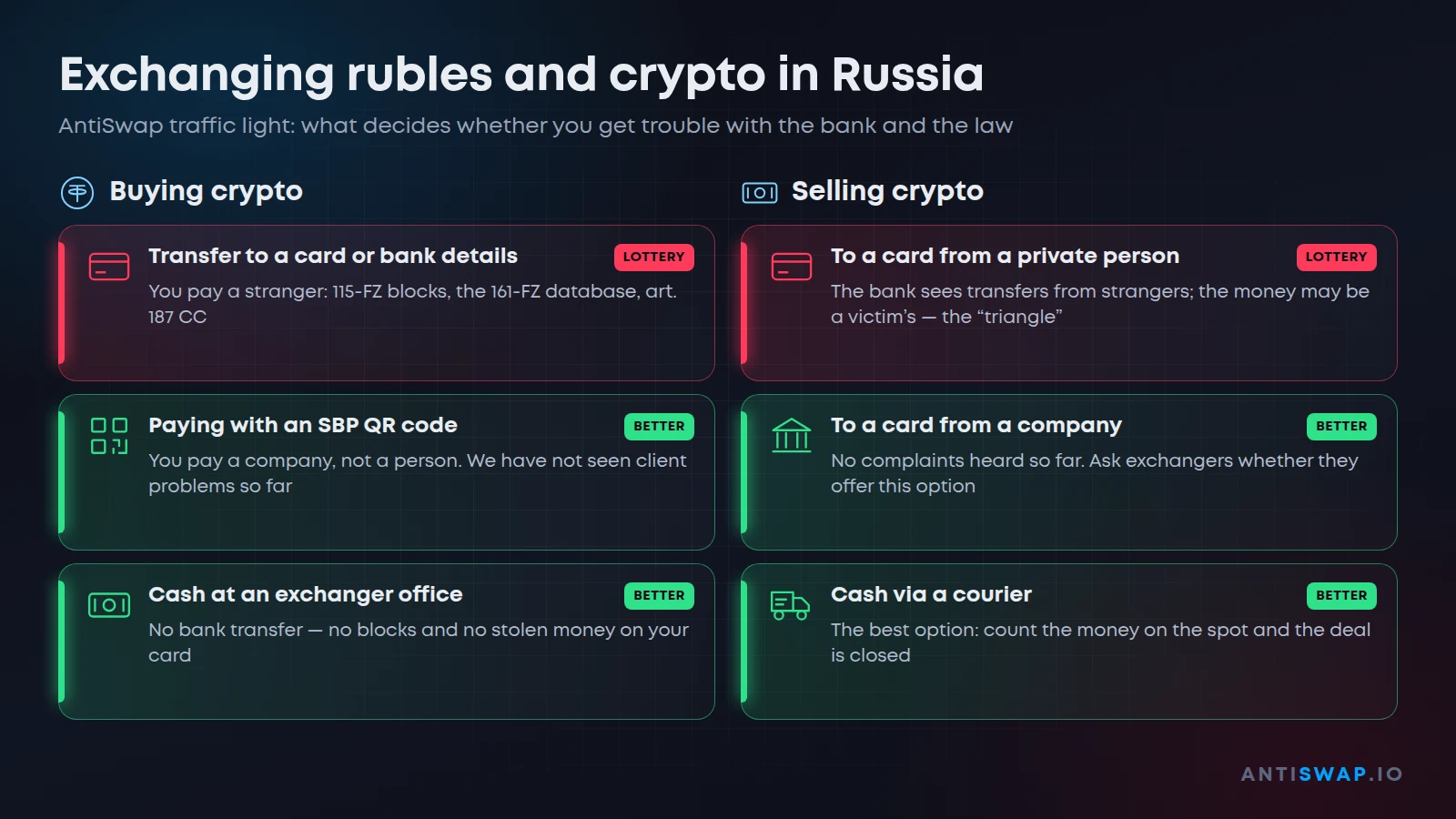
- Buying USDT: a transfer to a card or bank details is a lottery; paying with an SBP QR code — we haven’t seen client complaints so far; cash at an office is reliable.
- Selling USDT: a payout to your card from a private person is the same lottery; a payout from a company or sole proprietor — we haven’t heard complaints so far, ask exchangers whether they offer it; cash at an office or via the exchanger’s courier is the best option.
Why a card transfer is a lottery
When you buy USDT “by card transfer”, you send rubles to a stranger. Whether it is an honest exchanger employee, a hired “drop” or a fraudsters’ middleman, you don’t know. Sometimes everything goes smoothly for months. Then one deal triggers several mechanisms at once.
Law 115-FZ (anti-money laundering). In its recommendations 16-MR the Bank of Russia listed signs of a “drop”: more than 10 individual counterparties a day or 50 a month, more than 30 operations a day, turnover from 100,000 rubles a day or 1 million a month, money leaving almost immediately after it arrives. If two signs match, the bank may refuse an operation and restrict online banking. You can lift the restriction with documents: the bank must answer within 7 business days, then you can complain to the interagency commission at the Bank of Russia. More in the article Card blocks under 115-FZ and 161-FZ in P2P.
Law 161-FZ (national payment system). If the recipient of your transfer — or you — gets into the Bank of Russia database of transfers made without the client’s consent, the bank may suspend cards and online banking for as long as the record stays. If the information came from the police, suspension is mandatory. The record has no fixed term: in spring 2026 the head of the Bank of Russia said people stay in the database “virtually indefinitely”. You can get out by applying to the Bank of Russia, which reviews the application within 15 business days.
Criminal Code. Since 5 July 2025 article 187 of the Criminal Code punishes “droppers”: handing over your card or access to it for unlawful operations, or carrying out such operations on someone’s instructions, carries up to 3 years in prison, and up to 6 years for organisers and card buyers. By February 2026 more than 800 cases had been opened under the new rule. An ordinary USDT buyer is not a dropper, but their transfer ends up in the same chain, and they will have to explain it.
In 2026 control keeps tightening. On 11 November a bill was submitted to the State Duma to limit people the Bank of Russia classifies as “drops” to 30,000 rubles a month of transfers from other individuals. The Ministry of Finance proposes passing data on people who systematically receive transfers from individuals to the tax service. These are not laws yet, but the direction is clear.
The “triangle” scheme: how people end up in criminal cases
The “triangle” is the worst scenario for someone who sells USDT and receives rubles to a card. A scammer simultaneously “sells” something to a victim (a car, a rental flat, electronics) and “buys” USDT from you. Instead of his own money, he gives the victim your card details. The victim transfers money to you, you honestly send USDT to the scammer, and he disappears.
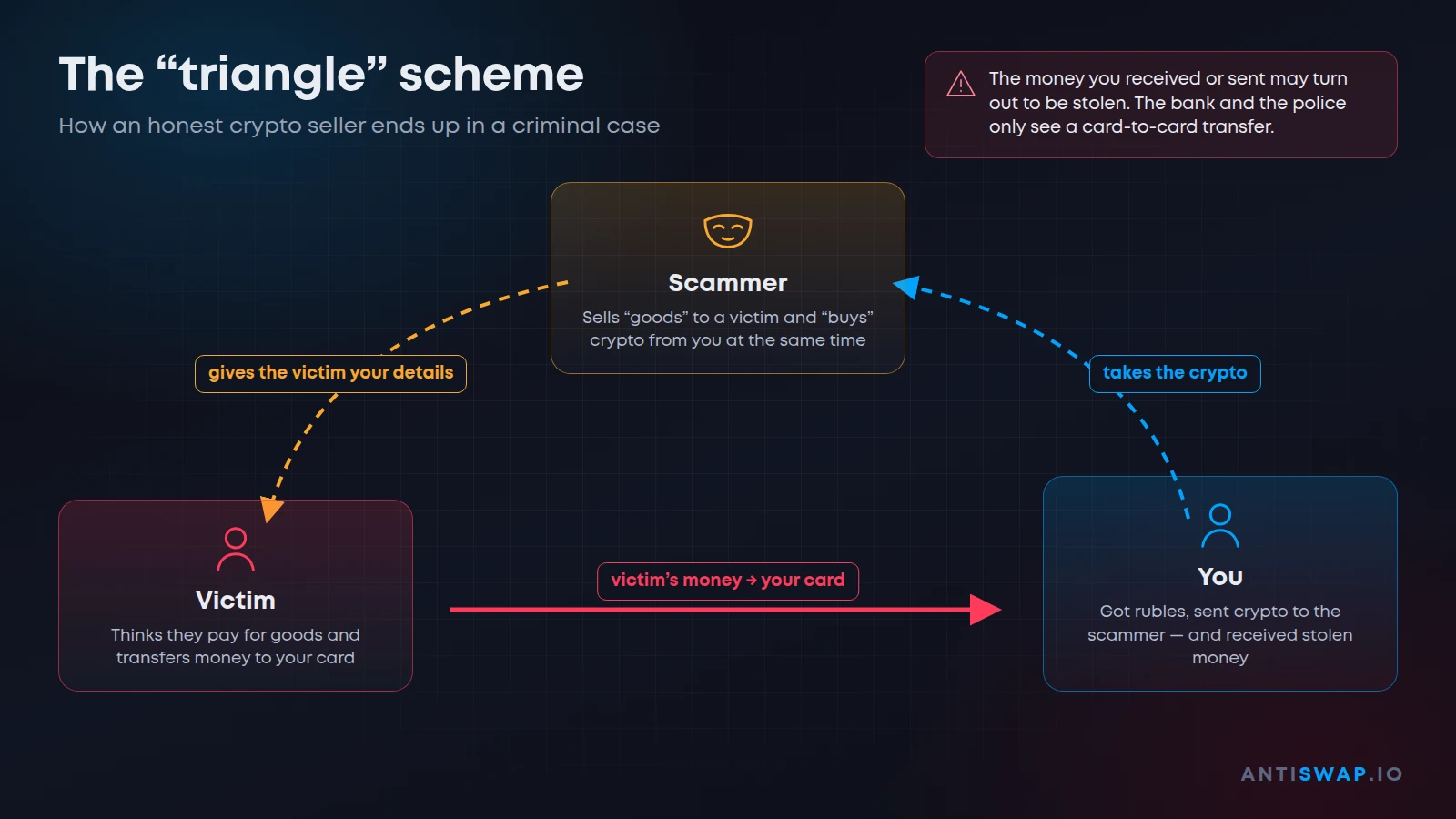
A few days later the victim files a police report. For the bank and the investigators it looks simple: the victim’s money landed on your card. The card is blocked, you are called for questioning, and the victim may sue for unjust enrichment. Courts decide such suits differently: in 2025 a cassation court rejected the victim because the defendant received the money as payment for crypto he sold, but there are also rulings for victims. There are convictions too: a P2P seller who received 900,000 rubles from a fraud victim was found an accomplice and got a 2-year suspended sentence.
In June 2025 the Bank of Russia separately warned that illegal exchangers pair a crypto buyer with a seller who may be linked to criminals and ask to pay directly to a card. This way the buyer risks becoming a party to financing criminal activity.
Buying USDT with an SBP QR code
When you pay with an SBP QR code, you pay a company, not a person — as in a shop. The exchanger creates an order, you scan the QR code in your banking app and see an organisation as the recipient. The money doesn’t pass through a random individual’s card, and you confirm the amount and purpose yourself. This closes the main hole of the “triangle”: your payment can’t turn out to be “victim’s money” on someone else’s card.
We haven’t seen complaints about blocks after buying USDT with a QR code so far — neither in reviews on AntiSwap nor in client requests. This is an observation, not a guarantee: since 2025 the Bank of Russia has been identifying companies and sole proprietors that accept QR payments on behalf of illegal casinos. So pay only with the QR code from the order on the exchanger’s website, check the recipient’s name in your banking app and don’t scan codes sent in private messages.
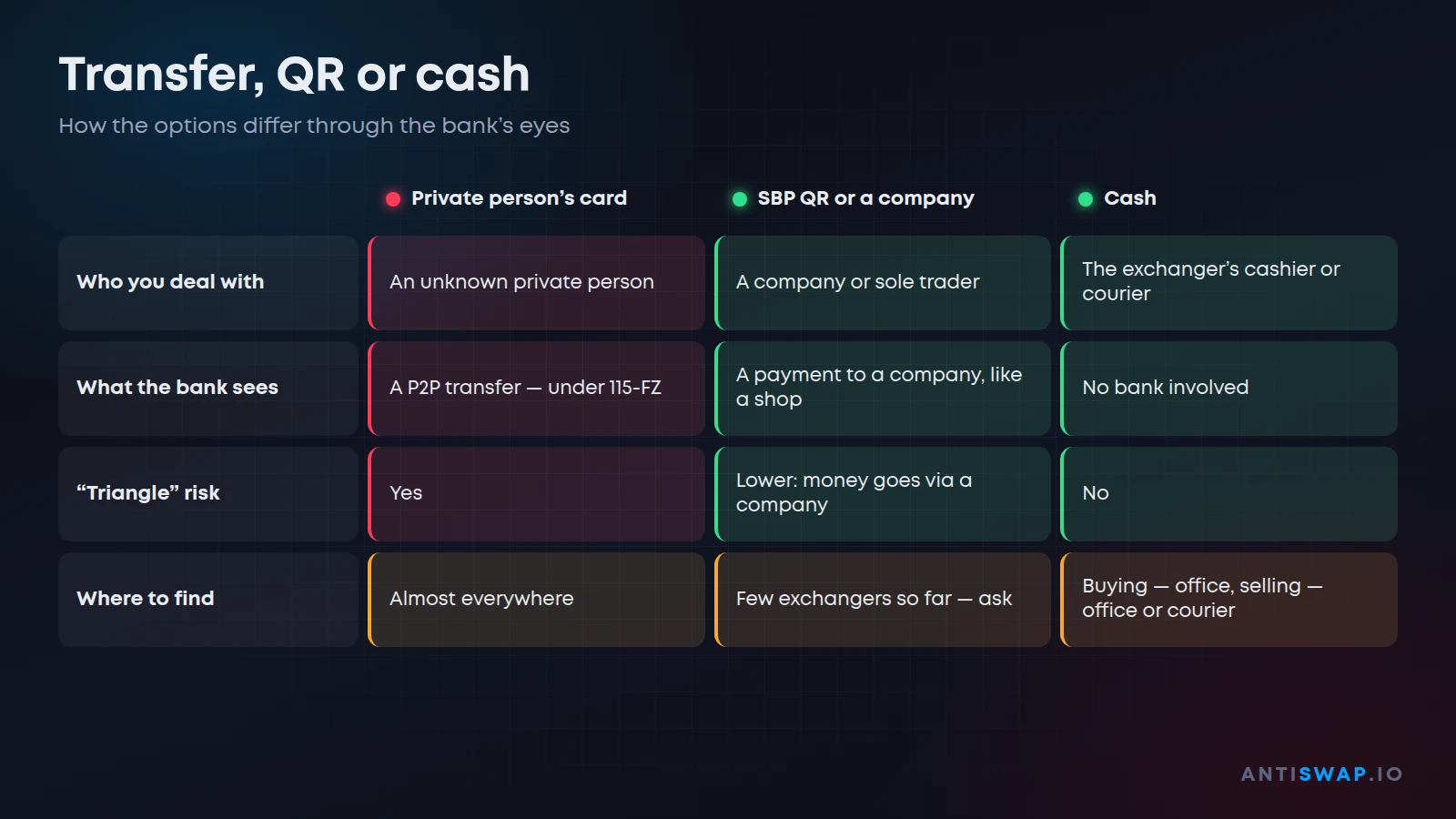
There are few exchangers accepting QR payments so far. The AntiSwap catalog has separate directions: SBP QR → USDT TRC20, Sber QR → USDT TRC20 and T-Bank QR → USDT TRC20.
Buying crypto with a QR code in the AntiSwap catalog:
- SBP QR → USDT TRC20
- Sber QR → USDT TRC20
- T-Bank QR → USDT TRC20
- VTB QR → USDT TRC20
- Raiffeisen QR → USDT TRC20
- Sber QR → USDT BEP20
- Sber QR → BTC
- Sber QR → ETH
| Exchanger | I give | I get | Turnover | Deals | Reviews | |
|---|---|---|---|---|---|---|
≈ 93.24 RUB from 5000 | 1 USDT | 470K+ $ | 26734 | |||
≈ 93.94 RUB from 1221.27 | 1 USDT | 126K+ $ | 445 | |||
≈ 86.21 RUB from 10000 | 1 USDT | 136K+ $ | 8 | |||
≈ 94.63 RUB from 50000 | 1 USDT | - $ | 0 | |||
≈ 110.35 RUB from 1103.5 | 1 USDT | 266 $ | 2 | |||
≈ 87.46 RUB from 40000 | 1 USDT | 444K+ $ | 142 |
Selling USDT to a card: from a private person or a company
With ruble payouts to a card the story is mirrored. If the exchanger pays you from a private person’s card, you get a transfer from a stranger. The bank sees one more individual counterparty, and the money itself may be a victim’s — that is the “triangle”. Frequent sales this way quickly accumulate the “drop” signs from 16-MR.
A payout from a company or sole proprietor, for example via a payment agent, is different. We haven’t heard complaints from clients who received rubles this way. But there is a catch: exchangers hardly ever say this publicly. We checked the rules and exchange pages of 28 exchangers from the catalog — none states plainly which account the payout comes from. A few show indirect signs: a separate “Card and SBP without P2P” method, payout “via a payment provider”, a payment aggregator named on the site. So before the deal, ask the exchanger’s support who will send the money — a private person or an organisation — and keep the answer.
You can compare exchangers paying out to a card, and ask support about a payout from a company, on the direction pages:
Remember the flip side: in 2025 the Bank of Russia advised banks to watch transfers between individuals and “technical companies” used by online casinos and crypto exchangers. A payout from an organisation lowers the risk but doesn’t make it zero.
Cash is the best way to sell crypto
When you exchange USDT for cash — at an office or via the exchanger’s courier — the bank isn’t part of the deal at all: no transfer, no someone else’s money on your card, no “triangle”. You count the banknotes on the spot and the deal is closed. The law sets no limits on cash settlements between individuals. If you later deposit a large sum at a bank, keep in mind: since October 2026 the Bank of Russia advises banks to ask about the source of funds for deposits from 5 million rubles, so keep the exchanger’s order.
Cash exchange needs care too. In 2025–2026 the news reported “souvenir” banknotes instead of real ones, a client robbed when leaving an office in Moscow City, and detentions of staff at unregistered exchange offices that sold crypto to fraud victims. So — only an office or the exchanger’s own courier, only an exchanger with a good reputation and an order on its website, no meetings via ads. If you buy crypto for cash, an office is the only option: couriers who collect cash are practically gone.
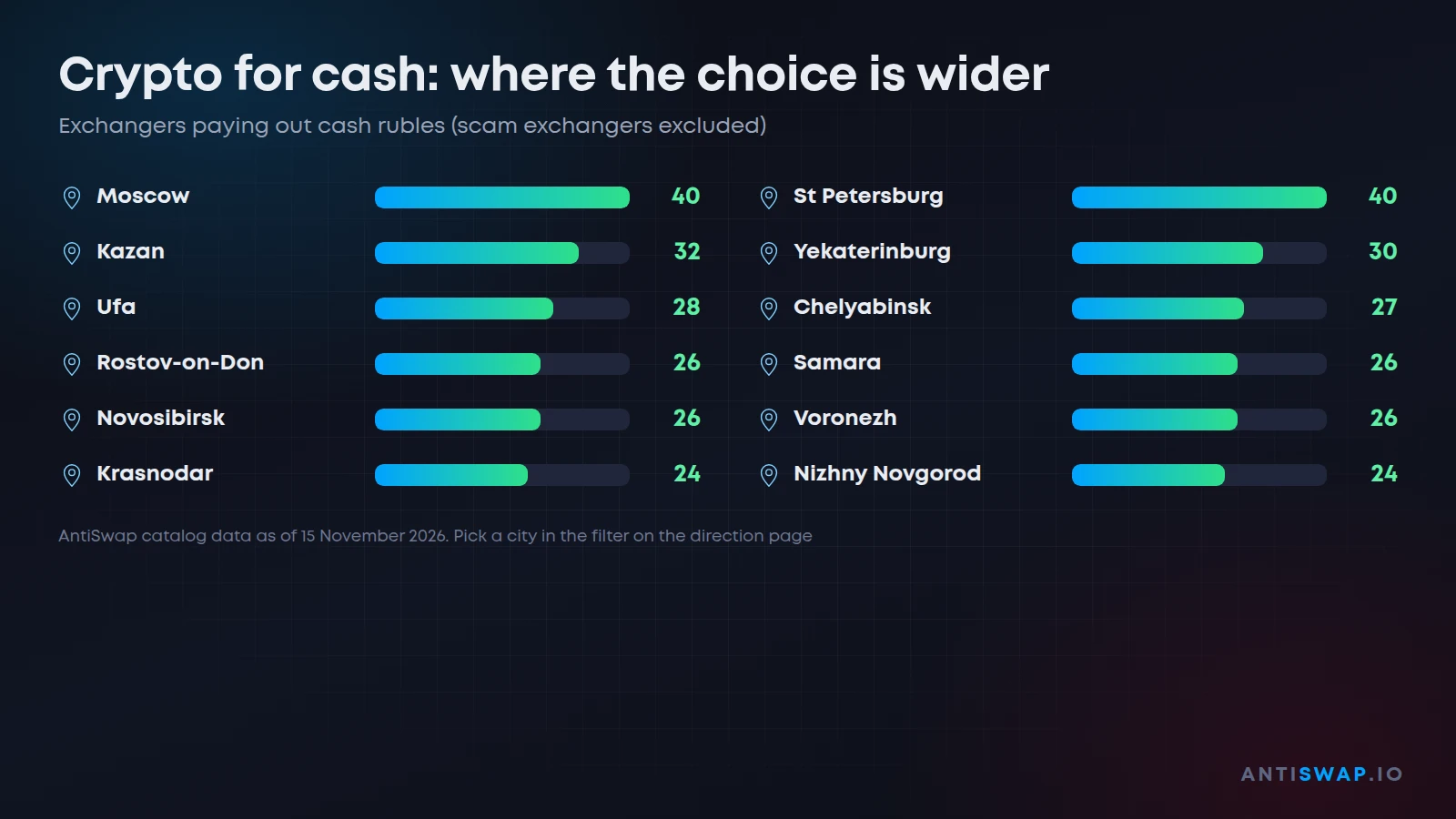
You can pick a city on the direction page USDT TRC20 → cash rubles — the city filter is above the rates table. The reverse direction, if you need to buy USDT for cash: cash rubles → USDT TRC20. Moscow and St Petersburg have the most offices, but there is a choice in dozens of other cities too.
Sell crypto for cash rubles (office or the exchanger’s courier): USDT TRC20, USDT ERC20, USDT BEP20, BTC, ETH, LTC.
Buy crypto for cash (office only): USDT TRC20, USDT BEP20, BTC, ETH.
| Exchanger | I give | I get | Turnover | Deals | Reviews | |
|---|---|---|---|---|---|---|
1 USDT from 5733 | 81.99 RUB | 211K+ $ | 205 | |||
1 USDT from 1000 | 86.35 RUB | 1.1M+ $ | 1275 | |||
1 USDT from 0.011488 | 87.05 RUB | 418K+ $ | 592 | |||
1 USDT from 3506.196618 | 86.16 RUB | 573K+ $ | 133 | |||
1 USDT from 2293.052052 | 86.78 RUB | 5.9K+ $ | 9 | |||
1 USDT from 3000 | 85.49 RUB | - $ | 0 |
| Exchanger | I give | I get | Turnover | Deals | Reviews | |
|---|---|---|---|---|---|---|
1 USDT from 5733 | 81.99 RUB | 211K+ $ | 205 | |||
1 USDT from 0.0115 | 86.96 RUB | 418K+ $ | 592 | |||
1 USDT from 3506.196618 | 85.56 RUB | 573K+ $ | 133 | |||
1 USDT from 2293.052052 | 85.48 RUB | 5.9K+ $ | 9 | |||
1 USDT from 30000 | 81.04 RUB | 17.6K+ $ | 53 | |||
1 USDT from 1500 | 86.38 RUB | - $ | 0 |
If your city isn’t in the tables, open the direction page and choose it in the filter: in the AntiSwap catalog exchangers pay out cash rubles in Kazan, Yekaterinburg, Ufa, Novosibirsk, Krasnodar, Sochi, Vladivostok and other cities.
What the law changes in 2026–2027
Since 1 September 2026 law 282-FZ on digital currencies has been in force. From 1 July 2027 residents will be able to deal in crypto only through intermediaries from the Bank of Russia register; the first of them — VTB, T-Invest Lab, Zefir and Sistema-Kripto — entered the register on 6 October 2026. From the same date banks will have to refuse transfers to “unauthorised recipients”. The State Duma is also considering a bill on a new article 171.7 of the Criminal Code on illegal organisation of digital currency circulation; it has passed only the first reading. Profit from selling crypto is subject to 13–15% personal income tax (law 418-FZ).
The practical takeaway is simple: transfers between private persons will be controlled more and more strictly, so it’s worth choosing the settlement method now.
Checklist
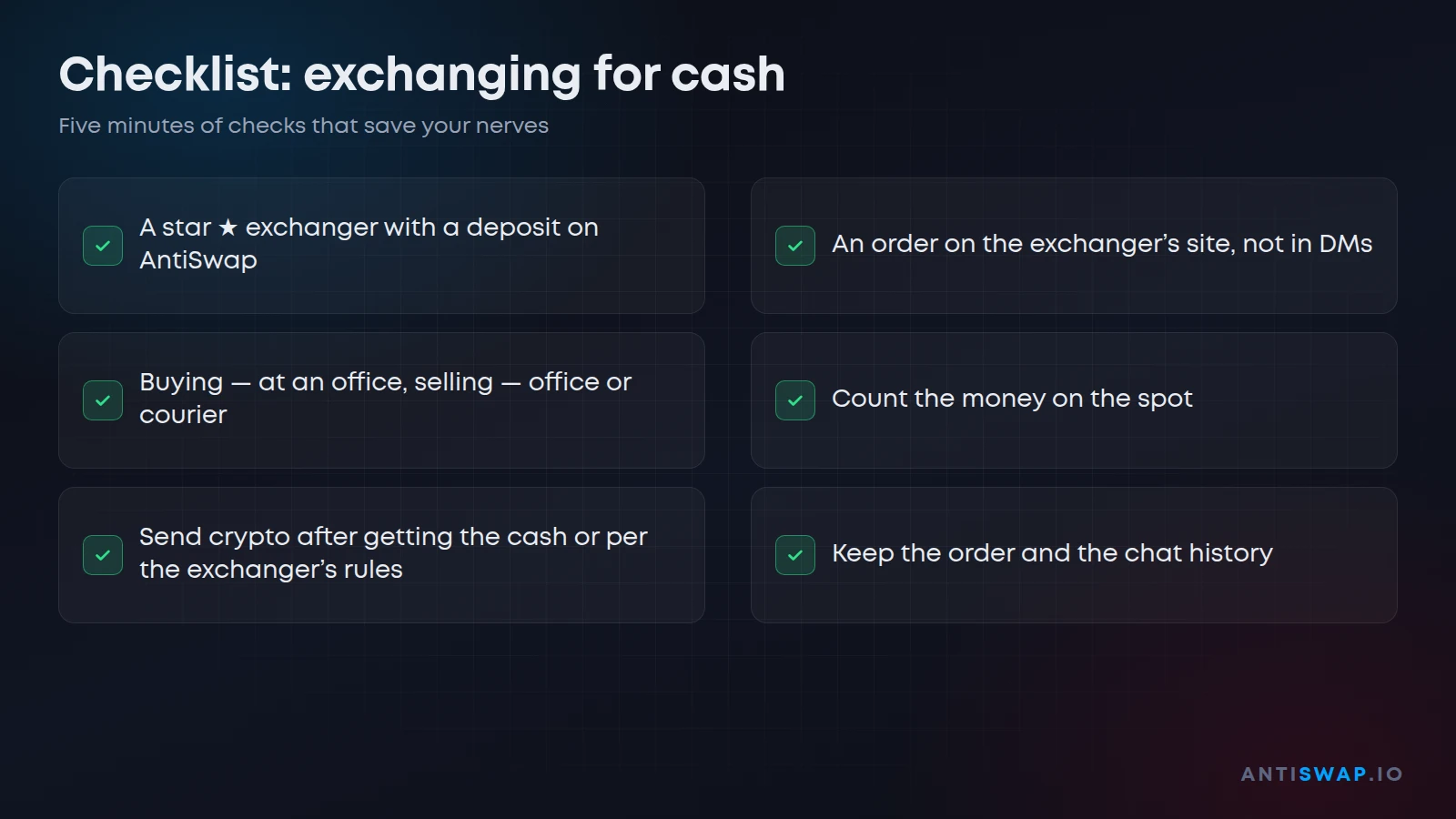
- Choose star ★ exchangers with an insurance deposit: they don’t freeze funds without a valid reason and return them if they can’t complete the exchange.
- Buying USDT — pay with the QR code from the order or in cash at an office, not by transfer to “Ivan I.”’s card.
- Selling USDT to a card — ask in advance who the payout will come from and keep the answer.
- Selling for cash — an office or the exchanger’s courier, count on the spot, an order on the website. Buying for cash — only at an office.
- Keep orders, receipts and chats: the bank or the tax office may need them.
FAQ
Can my card be blocked for buying USDT?
Buying crypto in itself is not a reason for a block. Cards are blocked for “drop” activity signs under 115-FZ and for links to fraudulent transfers under 161-FZ. Transfers to unknown individuals raise both risks; paying a company by QR code or using cash lowers them.
What if my card is already blocked?
Find out the reason from the bank. Under 115-FZ, submit documents explaining the operations; the bank must answer within 7 business days. Under 161-FZ, apply for removal from the database via your bank or directly to the Bank of Russia; the review takes 15 business days.
Is it safe to pay for USDT with an SBP QR code?
We haven’t seen client problems with such payments so far. Pay only with the QR code from the order on the exchanger’s website and check the recipient in your banking app before confirming.
Is it legal to sell USDT for cash?
Yes, until 1 July 2027 deals between individuals are not directly prohibited, and there are no limits on cash settlements between individuals. Profit is subject to income tax. From July 2027 the new 282-FZ rules apply.
How do I find out who the exchanger will pay rubles to my card from?
Ask support before creating an order. Usually it is only visible on the order’s payment page; exchangers rarely state it publicly.
Further reading
- Card blocks under 115-FZ and 161-FZ in P2P
- Exchanger or P2P: which is safer for USDT
- How to exchange USDT for cash rubles
Bottom line
A transfer to a private person’s card is a lottery both ways: luck may last long, or it may end with a block under 115-FZ or 161-FZ and a role in someone else’s criminal case. It is calmer to buy USDT with an SBP QR code and to sell it for cash at an office or via the exchanger’s courier, and if you need a card, with a payout from a company or sole proprietor. Compare rates and pick your city on AntiSwap: buying USDT with an SBP QR code and USDT to cash rubles.