Exchanger vs P2P: Which Is Safer for Buying and Selling USDT
There are two main ways to buy or sell USDT for rubles: the P2P section of an exchange or an online exchanger. P2P often has a slightly better rate, while an exchanger seems simpler. But the real question isn't the rate. It's what happens to your money, your bank card and your crypto if the deal goes wrong.
Let's look at how both options work, what risks each one carries, what the new crypto law changes, and how to pick the safest option for your amount.
How P2P works
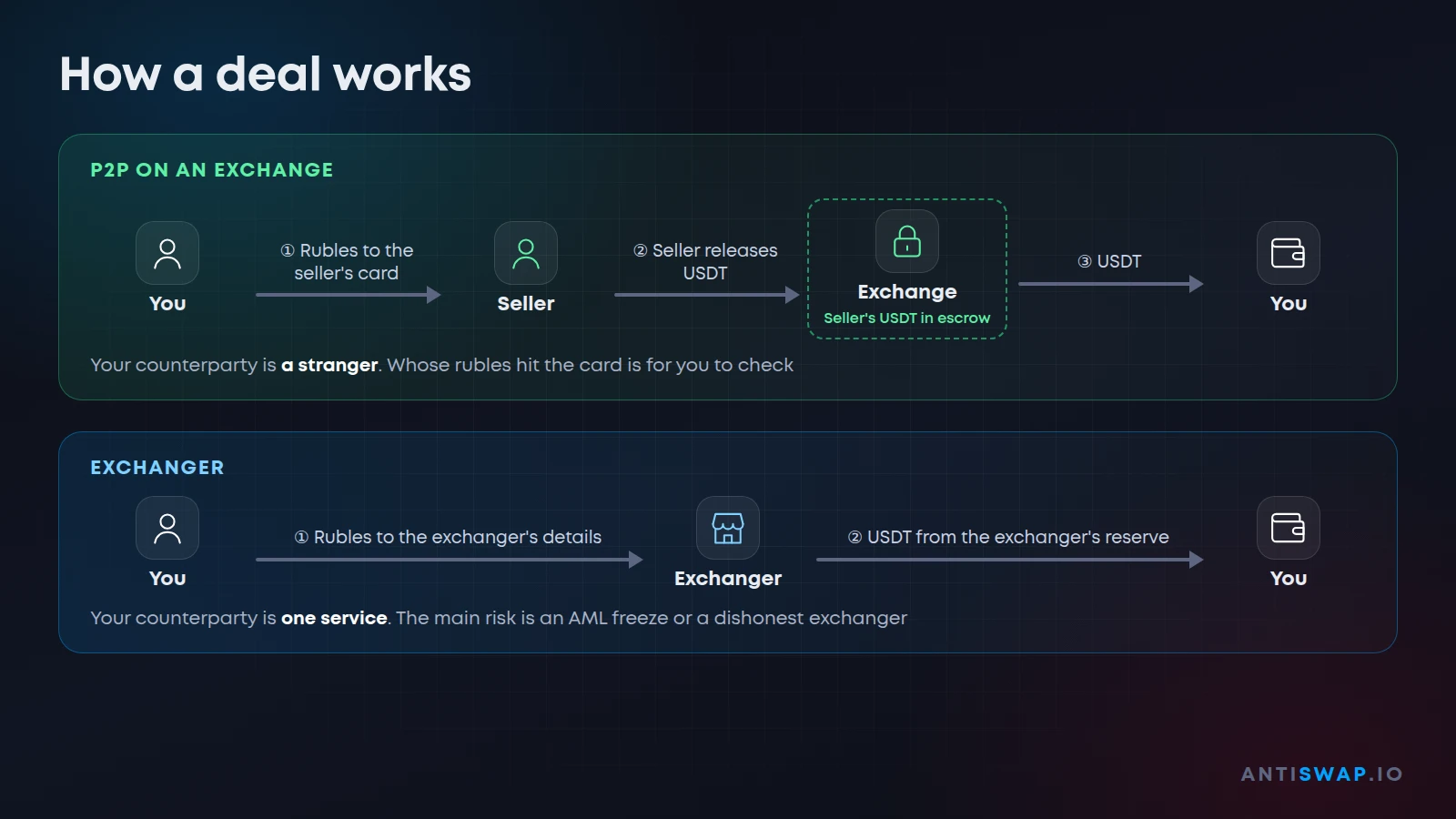
P2P (peer-to-peer) is a deal between two people. The exchange doesn't sell you crypto here: it only matches buyer and seller and secures the transfer of coins.
On the major exchanges it works like this:
- You pick a seller's ad and open a deal.
- The exchange locks the seller's USDT on its side. This is called escrow: until the deal closes, the seller can't take the coins back.
- You send rubles to the seller's card or account directly, bypassing the exchange.
- The seller sees the money and confirms payment, and the exchange releases the USDT to you.
If something goes wrong, you can file an appeal: exchange staff will review the chat and payment proofs. But exchanges openly warn that an appeal doesn't guarantee recovery of losses. Most importantly, escrow only protects the crypto. Rubles go from person to person, and the exchange has no idea whose money it really is.
P2P on an exchange requires KYC, meaning identity verification with a passport and a selfie. We explained what KYC is and how it differs from AML in "AML vs KYC: what is the difference".
The choice of platforms for Russian users has narrowed a lot in recent years. In 2023 Binance sold its Russian business to CommEX, which shut down in 2024. Back in 2023, OKX and Bybit removed rubles or sanctioned banks from P2P. Besides exchanges, there is P2P in Telegram chats and hand-to-hand deals, where there isn't even escrow and the risk is higher still.
How an exchanger works
An online exchanger is a service that buys and sells crypto itself. You create an order, send rubles to the details the exchanger gives you, and receive USDT from its reserve. When selling USDT it's the other way round: you send coins to the exchanger's address and it sends rubles to your card.
Your counterparty here is one service, not a random person. An exchanger has a website, a track record, reviews and, ideally, an insurance deposit. Monitoring sites like AntiSwap help you find and compare exchangers.
Most exchangers don't require KYC for a normal deal. But if an AML check flags your crypto as "risky", verification may be demanded after you have already sent the money. More on that below.
What you risk on P2P
The main P2P risk isn't about crypto, it's about rubles. You don't know where the person on the other side got their money. And in recent years Russian banks and police have been cracking down hard on drops, people whose cards are used to move stolen money.
The "triangle" scheme
This is the best-known trap for USDT sellers on P2P. A fraudster opens a deal with you as a buyer and, at the same time, sells something that doesn't exist to a third person, the victim. The payment details he gives the victim are yours.
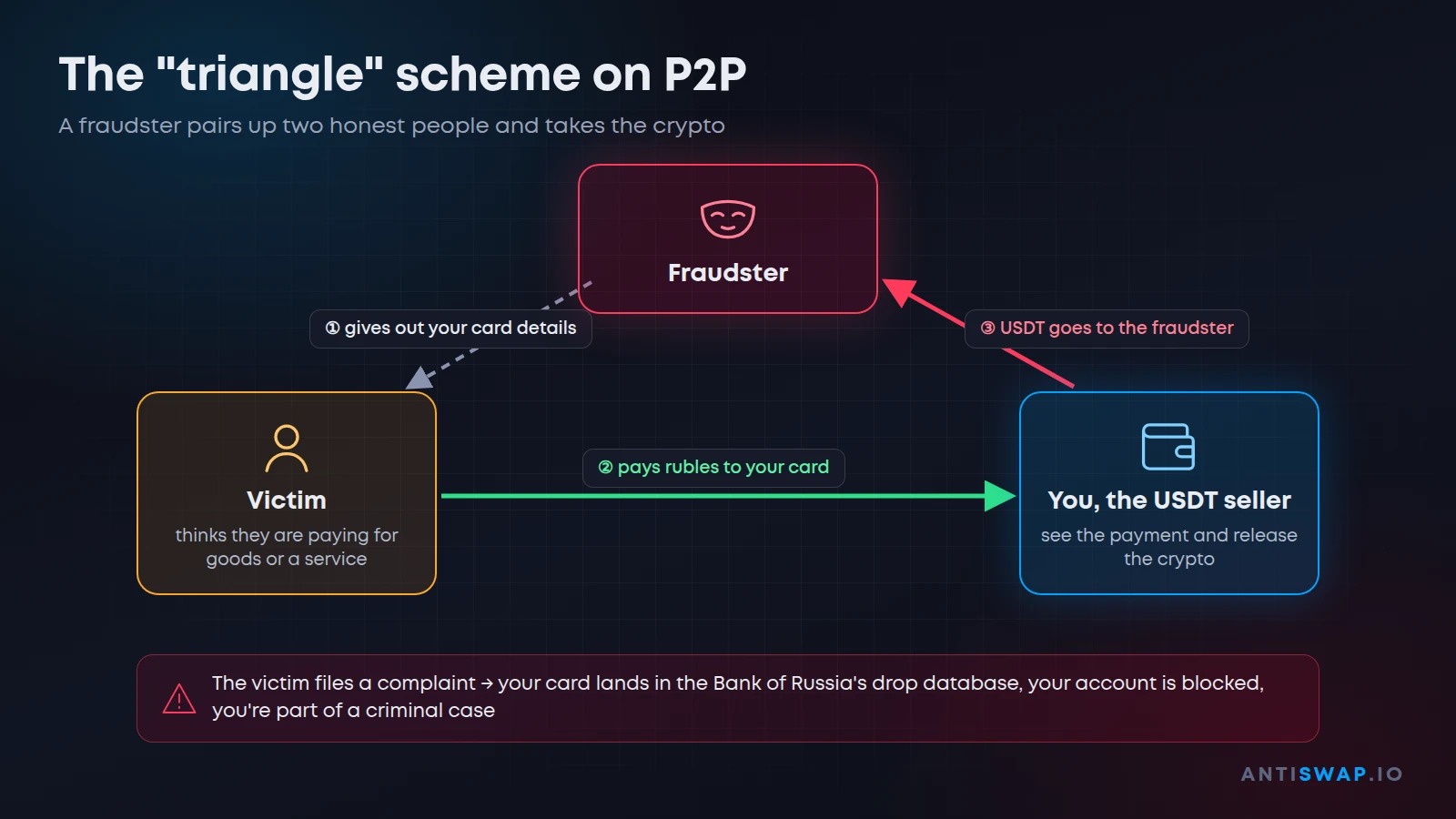
- The victim thinks they are paying for goods or a service and sends rubles to your card.
- You see the payment and honestly release the USDT, to the fraudster.
- The fraudster disappears. The victim realises they were scammed and files a complaint with the bank and the police.
- Your card is named in the complaint: you received the victim's money.
After that, as lawyers describe it, come a blocked account, an entry in the Bank of Russia database and calls from the police. It will be up to you to prove you sold crypto in good faith.
Card blocks and the Bank of Russia drop database
The Bank of Russia keeps a database of operations made without the client's consent. If your card ends up there, your bank must restrict online banking. Since 15 May 2025, people in this database can transfer no more than ₽100,000 a month online. You can challenge the listing through your bank or the Bank of Russia's online reception, but it takes time.
The database is growing fast. According to a Bank of Russia official, by September 2025 it held about 1.2 million drop records, with around 100,000 more accounts identified every month.
Criminal liability
Since 5 July 2025, amendments to Article 187 of the Russian Criminal Code have introduced criminal liability for drops: up to three years for handing over your card or access to it for a reward, or for operating other people's cards on a "curator's" instructions, and up to six years for buying and passing on other people's cards. This doesn't target an honest USDT seller, but if a scam victim's money went through your card, you will be part of an investigation and will have to prove your good faith.
Fake receipts and third-party payments
Another common scenario: the seller gets a screenshot of a "successful transfer" or a fake SMS, but no money arrives. Or money arrives, but from someone with a different name, not the person who opened the deal. Exchanges give the same advice: release crypto only after you see the credit in your own bank, and reject payments from third parties.
A separate story is "arbitrage schemes" that promise profits on P2P rate differences. We covered how people lose money on them in "Crypto arbitrage between platforms: why it's a scam".
What you risk with an exchanger
With an exchanger you don't receive rubles from a random person, so the triangle risk is much lower. But exchangers have their own problems.
AML freeze and a KYC demand
The exchanger checks incoming crypto with an AML service. If the risk score is above the threshold the exchanger set for itself, the exchange stops, the funds are frozen and you are asked to verify: passport, selfie, video, proof of source of funds. The risk score depends on the coins' entire history, so even honestly bought crypto can get flagged. We covered this scenario in detail in "AML vs KYC: what is the difference and why they get your crypto frozen".
A dishonest exchanger
An exchanger may simply not complete the order, stall, or disappear. That's why reviews and track record matter. On AntiSwap we check new reviews every day and move exchangers caught withholding funds to SCAM status. Another popular scammer trick is asking for a "verification deposit" or an "unlock fee". A real exchanger doesn't ask you to pay extra to get your own money back.
Whose rubles you receive
If you sell USDT to an exchanger, note which account the rubles came from. If the payout came from a private person's card, keep the chat and the order confirmation email. If your bank asks questions, they prove you received the money for an exchange, not from fraudsters.
A shared risk: USDT frozen by the issuer
There is a risk that doesn't depend on how you buy. Tether can freeze USDT at any address. According to BlockSec, in 2025 alone Tether blacklisted 4,163 addresses and froze $1.26 billion, 3,506 of those addresses on TRON. Only 3.6% of addresses were removed from the list during the year.
If you receive USDT from a "dirty" address, on P2P or from an exchanger, those coins can cause problems at your next exchange. Read how the blacklist works in "What the USDT and USDC blacklist is", and check an address with our free Blacklist Check. And don't keep large amounts on an exchange; we explain why in "Why you shouldn't keep USDT on an exchange".
Exchanger vs P2P: comparison
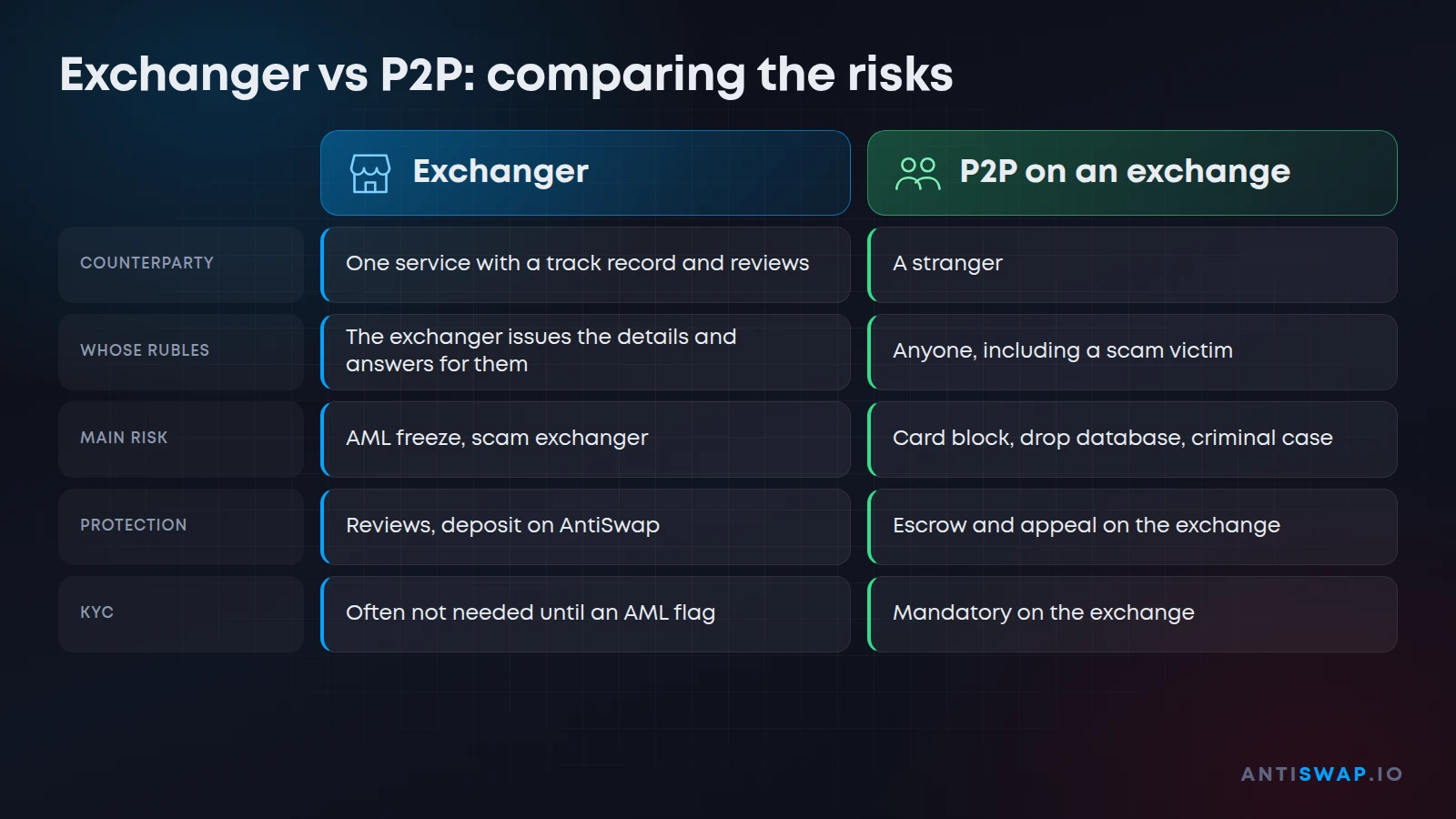
| Exchanger | P2P on an exchange | |
| Who you deal with | A service with a track record and reviews | A stranger |
| Whose rubles | The exchanger issues the details and answers for them | Anyone's, including a scam victim's |
| Main risk | AML freeze, a dishonest exchanger | Card block, Bank of Russia drop database, criminal case |
| Protection | Reviews, insurance deposit on AntiSwap | Escrow and appeal on the exchange |
| KYC | Usually not needed unless there is an AML flag | Mandatory for P2P on an exchange |
| Rate | Usually slightly worse: the exchanger charges for risk and service | Often slightly better |
In short: on P2P the main risk is to your bank card; with an exchanger, to your crypto. Exchangers that commit not to block funds and have posted an insurance deposit remove the AML freeze risk. There is no such insurance against the triangle on P2P.
What the digital currency law changes
On 4 August 2026, Federal Law No. 282-FZ "On Digital Currencies and Digital Rights" was signed. It gradually moves buying and selling crypto to licensed intermediaries.
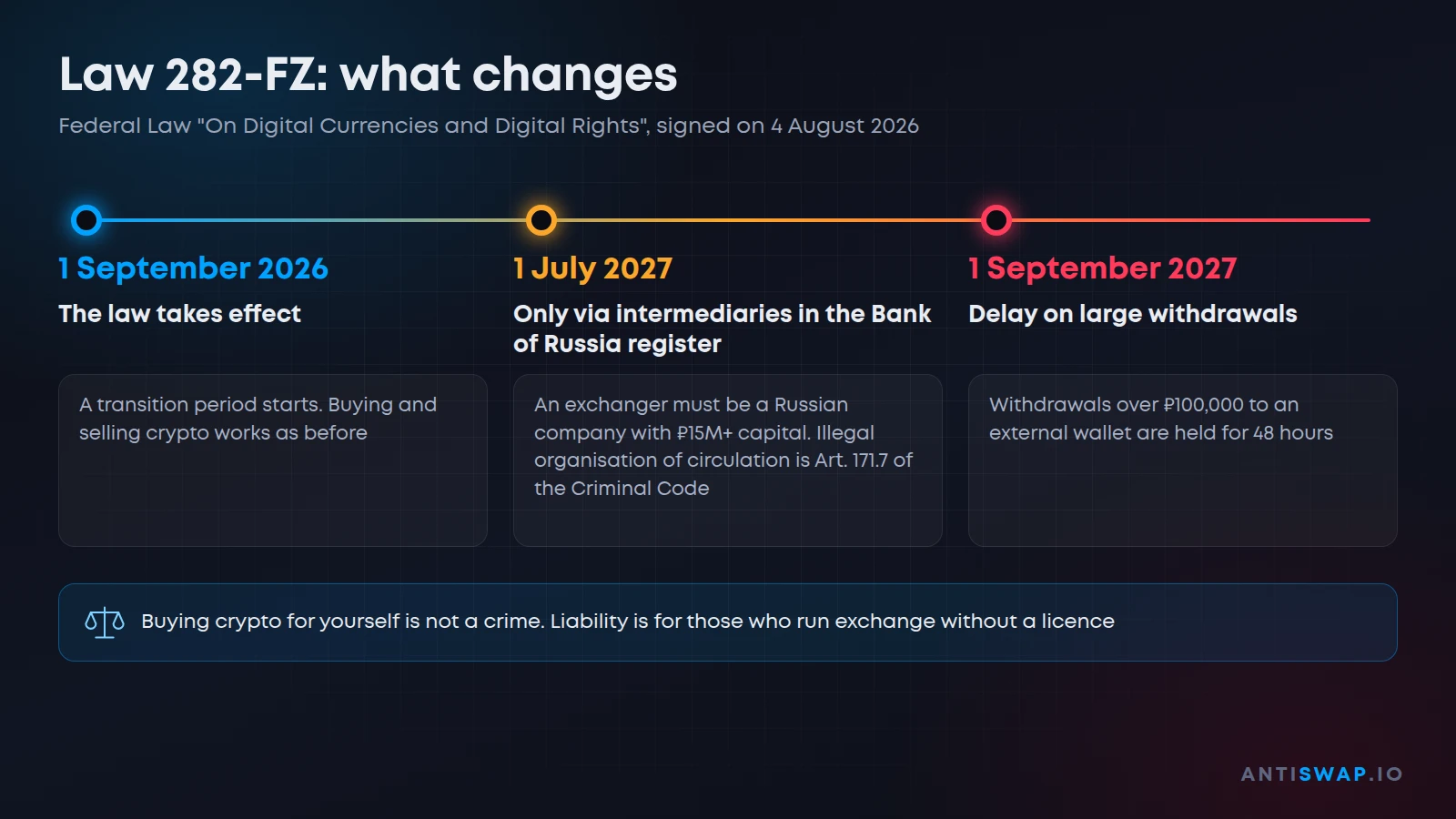
- From 1 September 2026 the law is in force, but there is a transition period. As a BestChange analyst quoted by Kommersant put it, "until 1 July 2027 everything stays as it is".
- From 1 July 2027 only intermediaries in the Bank of Russia register may organise exchange. An exchanger must be a Russian company with own funds of at least ₽15 million. Illegal organisation of digital currency circulation becomes a crime under the new Article 171.7 of the Criminal Code.
- From 1 September 2027 withdrawals over ₽100,000 to an external wallet will be held for 48 hours.
Buying crypto for yourself is not a crime: liability is for those who run exchange without a licence. But analysts expect classic P2P with transfers to a stranger's card to disappear after 1 July 2027, with exchange moving to licensed services. We'll keep track of the changes and update this article.
How to buy or sell USDT more safely
If you choose an exchanger:
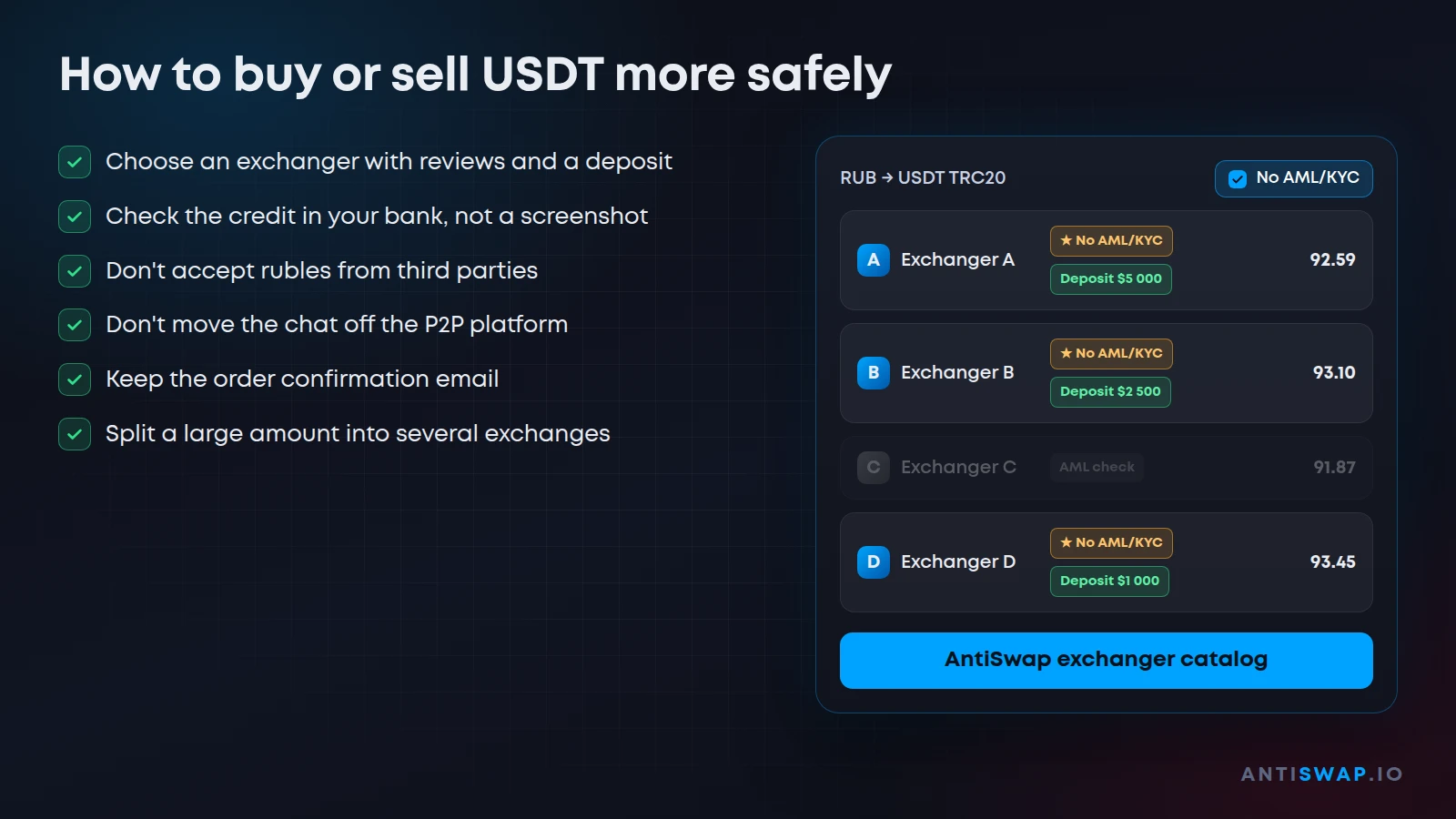
- look for the "★ No AML/KYC" badge in the AntiSwap catalog: it marks exchangers that commit not to block money on AML pretexts and have posted an insurance deposit of at least $1,000;
- make sure the exchange amount doesn't exceed the exchanger's deposit, so the deal is fully covered;
- turn on the "Only without AML/KYC" filter on a direction page, for example Sberbank RUB → USDT TRC20 or USDT TRC20 → Sberbank RUB;
- keep the order confirmation email and verify the sender with our email check service;
- never pay a "verification deposit" or an "unlock fee".
If you still use P2P:
- release crypto only after the money is credited in your bank, not based on a screenshot or SMS;
- check that the payer's name matches the counterparty on the exchange, and don't accept payments from third parties;
- don't move from the deal chat to messengers: outside the exchange an appeal won't help;
- pick verified sellers with a long deal history;
- keep statements and chats: if the bank blocks your card, you'll need them to explain yourself.
Either way: split a large amount into several exchanges, receive USDT to a new address in your own wallet rather than an exchange account, and choose the network wisely; we explained the difference between TRC20, ERC20 and BEP20 in a separate article. The full list of tips is on the "Recommendations for users" page.
FAQ
Which is cheaper, P2P or an exchanger?
On rate alone, P2P is often slightly better: you trade directly with another person, without a service markup.
But the rate difference is usually small, while the cost of a mistake on P2P is a blocked card, transfers capped at ₽100,000 a month, and explanations to the bank and police. For most people, a reliable exchanger with a deposit works out cheaper once risks are counted.
Is it safe to buy USDT on P2P?
Buying is safer than selling: you send rubles, and the exchange releases the crypto to you from escrow. The main risks for a buyer are a dishonest seller who doesn't release the coins, and "dirty" USDT.
A USDT seller takes more risk: it's their card that receives rubles from strangers, and it's them who becomes a link in the triangle scheme.
Can a bank block my card because of P2P?
Yes. If your card received money that a scam victim later disputed, the bank can block your card and online banking, and your data goes into the Bank of Russia database. Even frequent transfers from different people can look suspicious to a bank.
If this happens, stop trading, collect statements, the exchange chat and transaction history, and contact your bank in writing. You can challenge a listing in the Bank of Russia database through your bank or the Bank of Russia's online reception.
Can an exchanger freeze my USDT?
Yes, if the exchanger runs an AML check and decides your coins are "risky". The exchange is then stopped and KYC is demanded.
To reduce this risk, choose exchangers with the "★ No AML/KYC" badge and a deposit on AntiSwap: if the exchanger doesn't fulfil its side of the deal, you can be compensated from the deposit.
Will P2P and exchangers be legal after 1 July 2027?
Under Law No. 282-FZ, from that date only intermediaries in the Bank of Russia register may organise crypto exchange. Services without a licence will be outside the law, and illegal organisation of digital currency circulation becomes a crime.
Buying crypto for yourself is not punishable. We follow the changes and will update the article if the rules for users change.
Bottom line
On P2P you mainly risk your bank card: money from a stranger may turn out to be stolen, and the triangle scheme turns an honest seller into a party to a case. With an exchanger the main risk is an AML freeze of your crypto or a dishonest service. The second risk can be removed in advance: choose exchangers with the "★ No AML/KYC" badge and a deposit in the AntiSwap catalog, and keep the exchange amount within the deposit. And share this article with anyone else who buys or sells USDT.