What is TRON (TRX)? Key features of the coin and an overview of the blockchain
TRON has been in the top 10 cryptocurrencies by market capitalization for several years. Some consider TRX a promising asset with real-world infrastructure, while others are skeptical. In this article, we explore what the TRON blockchain is, how it works, and how it differs from its competitors.
In this article:
- TRON and TRX: what they are and how they work
1.1 Advantages and disadvantages of TRX
1.2 What is TRX staking - How TRON gained fame thanks to USDT
2.1 What the TRON blockchain is capable of - TRON architecture
- TronScan: a brief overview
- Where to buy TRX
5.1. How to choose a reliable exchanger on AntiSwap - Where to store TRX
- Conclusion
TRON and TRX: what they are and how they work
TRON is a blockchain platform created to decentralize digital content. The idea is simple: creators publish their work and receive payment directly from their audience, without intermediaries taking a commission.
Since 2018, TRON has operated on its own blockchain and supports smart contracts. This means developers can build decentralized applications (DApps) on it—ranging from online games to exchanges and lending platforms.
TRX (Tronix) is the native cryptocurrency of the TRON network. It serves several functions:
- Transactions and ecosystem participation. TRX is used for transactions on the TRON network, paying for gas, services, and goods, as well as interacting with decentralized applications.
- dApps. TRX is widely used in decentralized applications, including gaming and entertainment platforms, where it is used to pay for content and interact with other users.
- Staking and voting. In the TRON ecosystem, you can participate in staking by freezing coins to gain voting rights within the network.
At the time of writing, one coin is worth about $0.32, and the total market capitalization exceeds $30 billion.
Advantages and disadvantages of TRX
| Pros | Cons |
| Instant transactions. TRON can process thousands of transactions per second, making it one of the fastest blockchain platforms. Transfers take 3–10 seconds, depending on network load. | Centralization. TRX is dependent on a few validators and developers. This entails risks related to the network potentially being controlled or manipulated to the detriment of users. |
| Low transaction fees. Transaction costs on the TRON platform are significantly lower than on other popular blockchains, such as Bitcoin and Ethereum. | High volatility. The price of TRX, like many cryptocurrencies, can fluctuate significantly. |
| Accessibility. TRON operates continuously worldwide and is available on most major exchanges: KuCoin, Huobi, ByBit, Gate.io, Cryptorg, EXMO, and others. | Security. TRX is subject to vulnerabilities and security risks. You need to keep track of updates and be prepared for potential network attacks or major bugs in smart contracts. |
What is TRX staking
Staking is the freezing of coins in the network in exchange for rewards. Roughly speaking, it is passive income from cryptocurrency that would otherwise just sit idle.
TRON uses the DPoS (Delegated Proof of Stake) mechanism
- TRX coins are frozen, and in return, you receive votes.
Freezing is the process of locking coins in a wallet, which grants holders network resources like "Bandwidth" and "Energy," as well as the ability to vote for Super Representatives. - Votes are used to elect Super Representatives (SRs)—validators who gain the ability to form new blocks and confirm transactions.
- SRs receive rewards and share them with those who voted for them.
There are 27 Super Representatives operating in the network, and the list is updated every 6 hours.
What freezing coins provides:
- Energy — required for executing smart contracts
- Bandwidth — required for regular transactions
How much do you need to stake?
The process of freezing TRX does not require large amounts initially. There is no minimum threshold for freezing; you can start with any number of coins. However, to receive a noticeable income, it is advisable to have at least a few thousand TRX. This is because rewards are distributed proportionally to the number of frozen coins.
How TRON gained fame thanks to USDT
In 2019, Tether launched USDT on the TRON blockchain. Before that, the stablecoin operated only on Ethereum and Omni. The main argument was simple: fees. Transferring USDT via the TRC-20 standard costs a few dollars, whereas on the Ethereum network during periods of high load, fees could easily exceed $15–30. For people transferring small amounts, the difference is significant.
The result was immediate. Today, the volume of USDT on the TRON blockchain exceeds $86 billion, and TRON's share of the total USDT supply is about 46%—nearly half of all tokens circulate here. In 2025, the network processed $7.9 trillion in USDT transfer volume.
What the TRON blockchain is capable of
✓ Content storage and distribution
TRON stores data in a decentralized manner—without a single server that can be blocked or shut down. Creators fully own their work and monetize it directly, without intermediary platforms.
✓ Execution of smart contracts
TRON supports smart contracts, which are essentially programs that execute automatically when predefined conditions are met. Developers build decentralized applications on this basis: exchanges, games, and lending platforms. No intermediaries, everything is transparent and written in code.
✓ Token creation and management
TRON allows for the creation and management of tokens using the TRC-10 and TRC-20 standards. TRC-10 tokens are native assets built directly into the TRON blockchain, while TRC-20 tokens are more advanced and compatible with Ethereum's ERC-20 standard. They can be used for various purposes, including fundraising and rewards.
📌 TRC-20 is a token standard on the TRON network, similar to ERC-20 on Ethereum. USDT TRC-20 and other tokens that operate via TRON smart contracts are issued under this standard. This makes it easier for developers to port parts of their solutions from Ethereum to the TRON ecosystem.
Important! TRX is the gas for USDT TRC-20, meaning it is the transaction fee on the TRON network where this stablecoin is used.
Read more in the article: Tether TRC20: what it is and how to use it
TRON architecture
The TRON blockchain consists of three layers, each responsible for a specific part of the network's operation.
Storage Layer
This is where all blocks, their states, and transaction history are stored. Data is distributed among network nodes rather than sitting on a single server—this makes it resistant to censorship and data loss.
Core Layer
The central layer, which contains three modules:
- Smart Contracts — execute automatic operations based on predefined conditions
- Account Management — processes all actions related to user accounts
- Consensus — responsible for coordinating the network state among all participants via the DPoS mechanism
Application Layer
This is the environment for developers. DApps—decentralized applications based on TRON—are created here. The primary development language is Java, but others are supported: Scala, C++, Python. This approach lowers the barrier to entry: developers do not need to learn a new language from scratch.
TronScan: a brief overview
TronScan is the official blockchain explorer for the TRON network, providing access to real-time transaction information. The service is free, and access to all features is granted after registration.
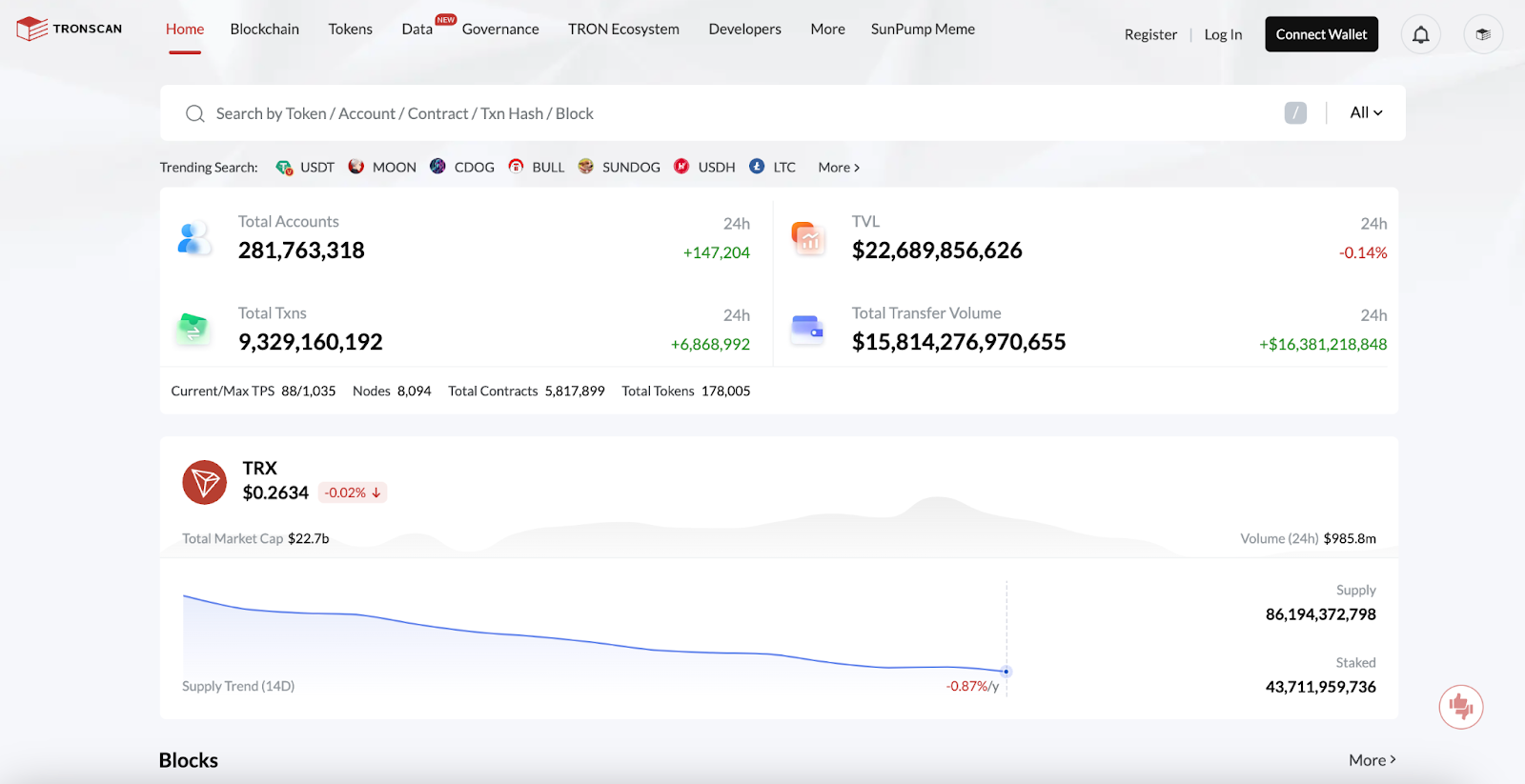
- Transaction monitoring. Users have the ability to track blocks in real-time, check USDT, TRX, BTC, or other currency transactions, and obtain data on smart contracts.
- Wallet management. Market participants can either import their wallet into TronScan or create a new account within the TRON ecosystem, which ensures secure management of digital assets and simplifies their storage and use.
- Token balances. The platform provides a report on token balances in a wallet, including TRX and other TRC-standard coins.
- Governance participation. TronScan encourages clients to actively participate in TRON's governance processes. The staking and voting mechanism allows for the distribution of votes among Super Representatives, forming a governance system within the TRON network.
- Smart contracts. The explorer provides extensive data on the operation of smart contracts in the network. You can track transactions via smart contracts, study source code, and analyze the TRON DApp ecosystem.
Where to buy TRX
You can purchase TRX tokens using several methods:
- Crypto exchanges. They offer a user-friendly interface and a wide range of trading tools. TRX is available on most major platforms, including OKX, KuCoin, and ByBit. Some international platforms restrict access for certain regions, so it is worth checking the current terms on the chosen exchange's website before registering.
- P2P platforms. P2P exchange allows for transactions directly between market participants using various payment methods. This mechanism is often built into crypto exchanges, although the level of trust can vary. Before making a deal, consider the counterparty's reputation and reviews, as disputes can sometimes arise outside the platform.
- Online exchangers. These allow you to quickly convert traditional currencies or digital assets into TRX. This format is convenient because operations are carried out without unnecessary delays and with minimal formalities, while maintaining basic security requirements.
However, there is one point to consider—the terms of different exchangers can vary significantly in terms of transparency and reliability. When interacting with unreliable platforms, delays or transaction blocks are possible. Often, such services may suspend operations to conduct additional AML checks and request identity verification.
To avoid such problems, it is important to carefully choose an exchange platform. The AntiSwap crypto exchanger monitor can help with this. It aggregates over 720 exchangers, each assigned a status. AntiSwap regularly checks user reviews and forms a rating, taking AML cases into account. The monitor analyzes how exchange services apply KYC procedures and notes instances of excessive user requirements.
Here, you can quickly find reliable services with fair terms and convenient payment methods. Exchangers marked with a star undergo additional monitoring checks and are considered the most stable—operations on such platforms proceed without delays or unnecessary complications. In the event of a dispute, you can contact the monitor's administration and, after an investigation, receive compensation from the insurance deposit.
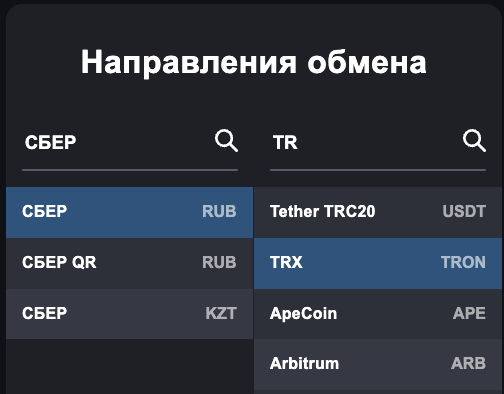
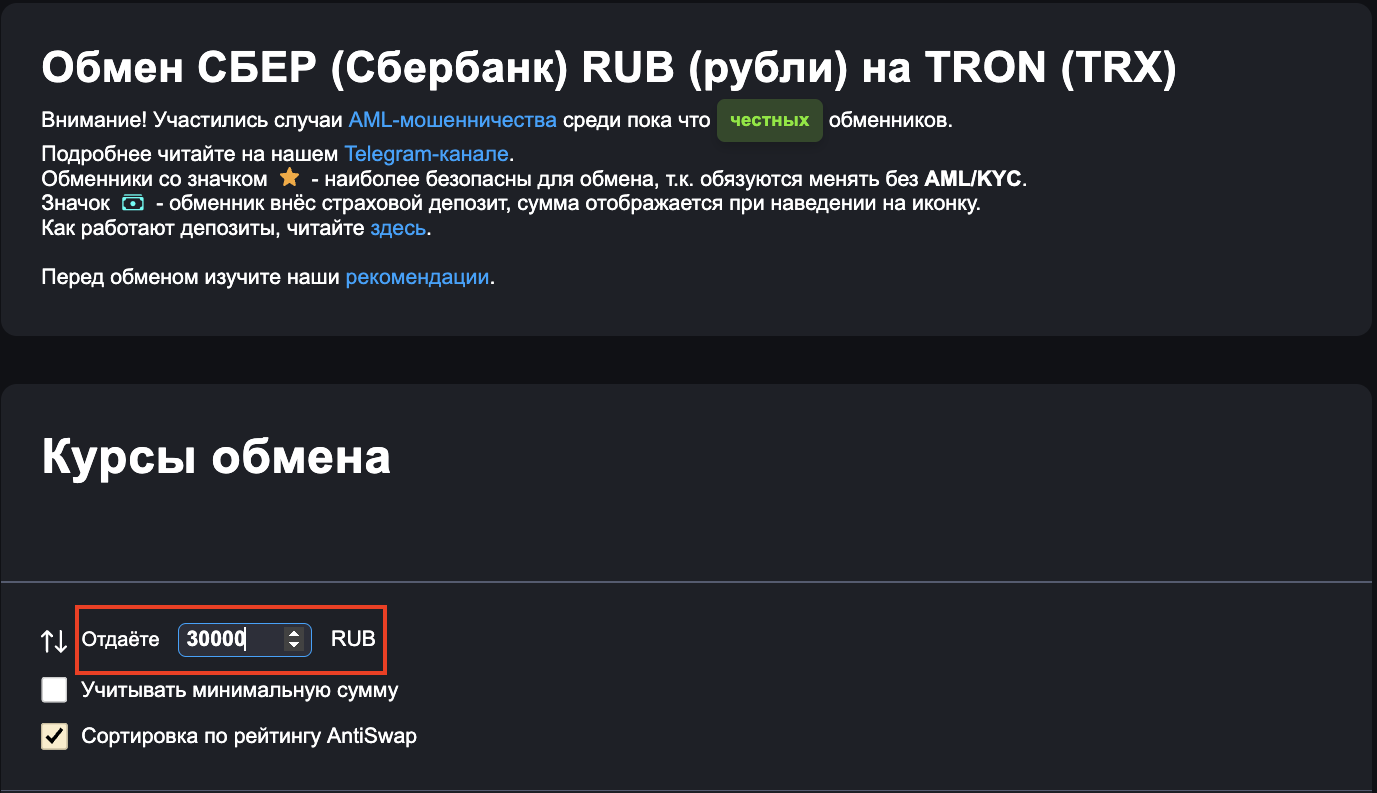
To exchange currencies on AntiSwap, simply set the desired direction and enter the amount—the system will automatically select suitable platforms and show available options. Everything happens without complex steps or registration on third-party sites.
When choosing a service, pay attention to a few important points:
1. Status. Be sure to check the AntiSwap rating. Exchangers are divided into categories:
- Honest — there are no reviews regarding AML-related fund holds that require identity verification.
- Neutral — have a mixed reputation: blocks have occurred, but funds were returned with slight delays, sometimes minus a commission.
- SCAM — AML and KYC blocks occur frequently, sometimes for no apparent reason.
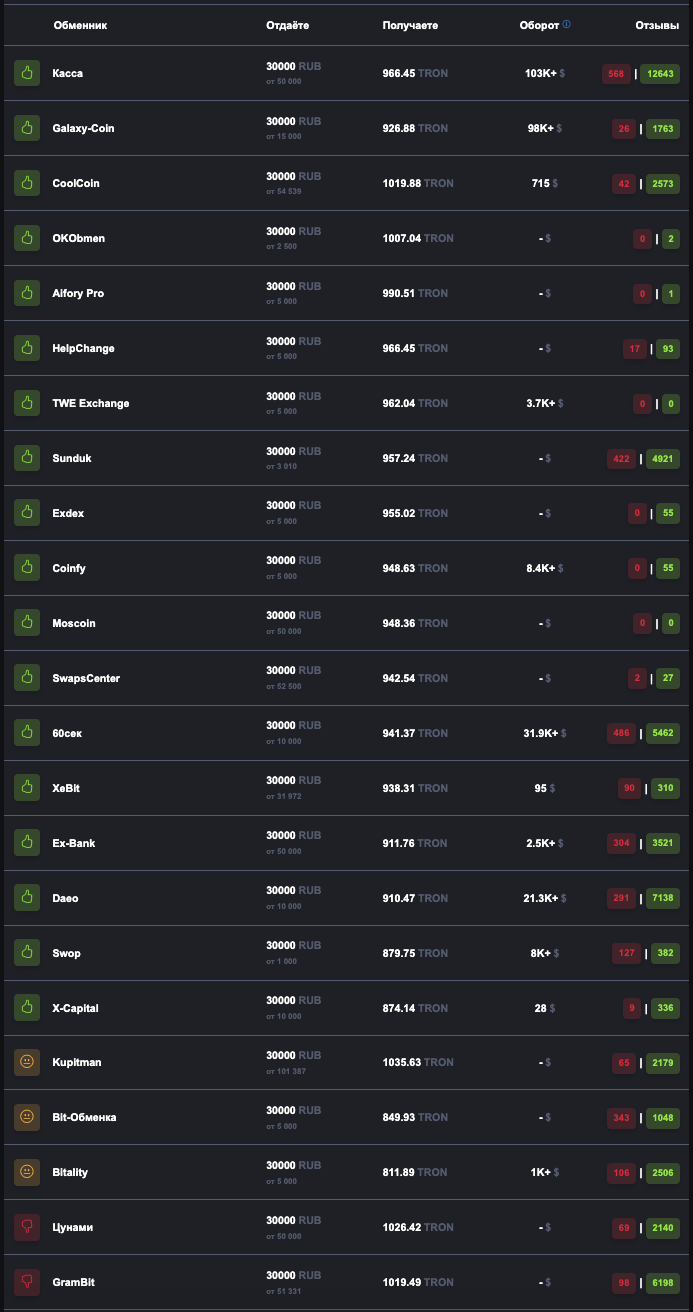
2. Exchange rate. The difference in rates between platforms can be noticeable, so it is worth comparing several offers before proceeding. An overly low or, conversely, excessively favorable rate may indicate hidden fees or unstable exchange conditions.
3. Reviews. Before making an exchange, make sure the platform does not have a history of constant complaints.
Where to store TRX
There are two main options—wallets and exchanges. The difference is fundamental.
Non-custodial wallets: here, the private key is held by the owner, not on a third-party server. No one can freeze or block your funds.
Popular options:
- TronLink — a wallet created specifically for TRON. It supports staking, voting, DApps, and all token standards (TRC-10, TRC-20). Available as a mobile app and browser extension.
- Trust Wallet — a multi-currency wallet suitable for beginners. It supports TRX and TRC-20 tokens and has a built-in DApp browser.
- Atomic Wallet — a multi-currency wallet with staking support and a built-in exchanger.
- Ledger — a hardware wallet for those holding large amounts. Keys are stored offline on a physical device, making hacking virtually impossible.
Exchanges: KuCoin, HTX, Gate.io allow you to store TRX directly on the platform. But there is an important nuance: the funds effectively belong to the exchange. If the platform is hacked or blocked, you could lose access to your assets.
Conclusion
TRON has long ceased to be just another blockchain with its own coin. Today, it is one of the most actively used networks for USDT transfers, working with TRX, smart contracts, and decentralized applications. Low fees, high speed, and TRC-20 support have made TRON a convenient tool for everyday crypto operations.
At the same time, it is important to remember the risks. TRX remains a volatile asset, and storing funds on exchanges or buying through random exchangers can lead to delays, blocks, and additional checks. Therefore, before buying or exchanging, it is worth checking the platform in advance, studying reviews, terms, and its status on the AntiSwap monitor.
If you plan to use TRON for transfers, storing USDT, or buying TRX, choose a reliable wallet, keep a small reserve of TRX for fees, and do not send large amounts through unverified exchangers.
This material is for informational purposes only and does not constitute financial advice. Before performing any operations with digital assets, it is recommended to independently assess the risks and study the current terms on the chosen platforms.