Why You Shouldn’t Keep USDT on an Exchange: Real Stories of Freezes and Blocked Funds
Many people consider USDT a convenient and nearly safe way to store money in cryptocurrency. It is pegged to the dollar, widely used, and seems easy to understand even for beginners. Many have a false sense that keeping such assets on an exchange is normal and safe. In practice, this is not the case. If stablecoins are held on a centralized platform, control over them remains partially with the exchange rather than the owner. In this article, we will break down how USDT is structured, how freezes work, and why an exchange is considered one of the most vulnerable options for storing digital assets.
In this article:
- What is USDT and how does it work
- How centralized exchanges are structured
- The mechanism of USDT freezing
3.1 A couple of examples of mass freezes - Real, recent stories of USDT blocks
- Why USDT on exchanges is particularly vulnerable
- What to do if your USDT is already on an exchange
- Where it is safer to store USDT
What is USDT and how does it work
USDT, or Tether, appeared in 2014. The idea was simple: to create a digital version of the dollar that could be freely moved across the blockchain. Each token is supposed to be backed by real assets, primarily fiat reserves held by the issuing company.
Tether Limited is the company behind the issuance of USDT. It claims that every token issued is backed by corresponding reserves: dollars, bonds, and commercial paper. It has the right to issue and burn tokens, as well as technical control over the smart contracts.
USDT is issued on various blockchains: Ethereum (ERC-20), Tron (TRC-20), BNB Smart Chain (BEP-20), Solana, and others. Each network has its own characteristics: some have higher fees, some have faster transfers, and some are easier to use with wallets. However, the main point remains unchanged: control over the stablecoin is fully retained by Tether Limited, regardless of the level of decentralization of the chosen network.
More details in the article: Tether USDT: TRC20, ERC20, and BEP20 — what is the difference? Which network to choose?
How centralized exchanges are structured
An exchange is not a wallet, but a platform. When a user stores USDT on an exchange, they are entrusting their funds to a third party. Here, user funds are stored in the exchange's general pools—some in hot wallets, some in cold storage. In fact, the USDT is owned by the exchange, and ownership is limited to account access—until the platform decides otherwise.
What can exchanges do with tokens?
- Block access to assets.
- Restrict withdrawals.
- Suspend operations due to suspected violations.
- Transfer data to regulators and Tether Limited.
The mechanism of USDT freezing
Tether has the ability to freeze addresses. The company can freeze USDT tokens at any address at any time. For this purpose, a special "freeze" function is provided in the smart contracts. The reasons for blocking can vary:
- Requests from law enforcement agencies.
- Suspicion of money laundering.
- Interaction with mixer services.
A couple of examples of mass freezes
1. Freezing of Garantex funds
In March 2025, Tether Limited froze USDT worth more than 2.5 billion rubles (approximately $28 million) at addresses associated with the crypto exchange Garantex. This happened at the request of US authorities. The exchange ended up on international sanctions lists and had its assets blocked.
2. Freezing in the Nigeria protests case
In Nigeria, the Abuja High Court ordered the freezing of crypto assets worth $38 million in a case involving the misuse of funds during mass protests. At the request of the Economic and Financial Crimes Commission (EFCC), four crypto wallets, allegedly belonging to activists of the #EndBadGovernance movement, were frozen.
❗️What does this mean for the average user?
If an address comes under suspicion, even by mistake, Tether can block the USDT without notice. Unblocking funds is difficult; it requires legal proceedings and consulting with lawyers. In practice, such a situation most often leads to a loss of access to the money.
Real, recent stories of USDT blocks
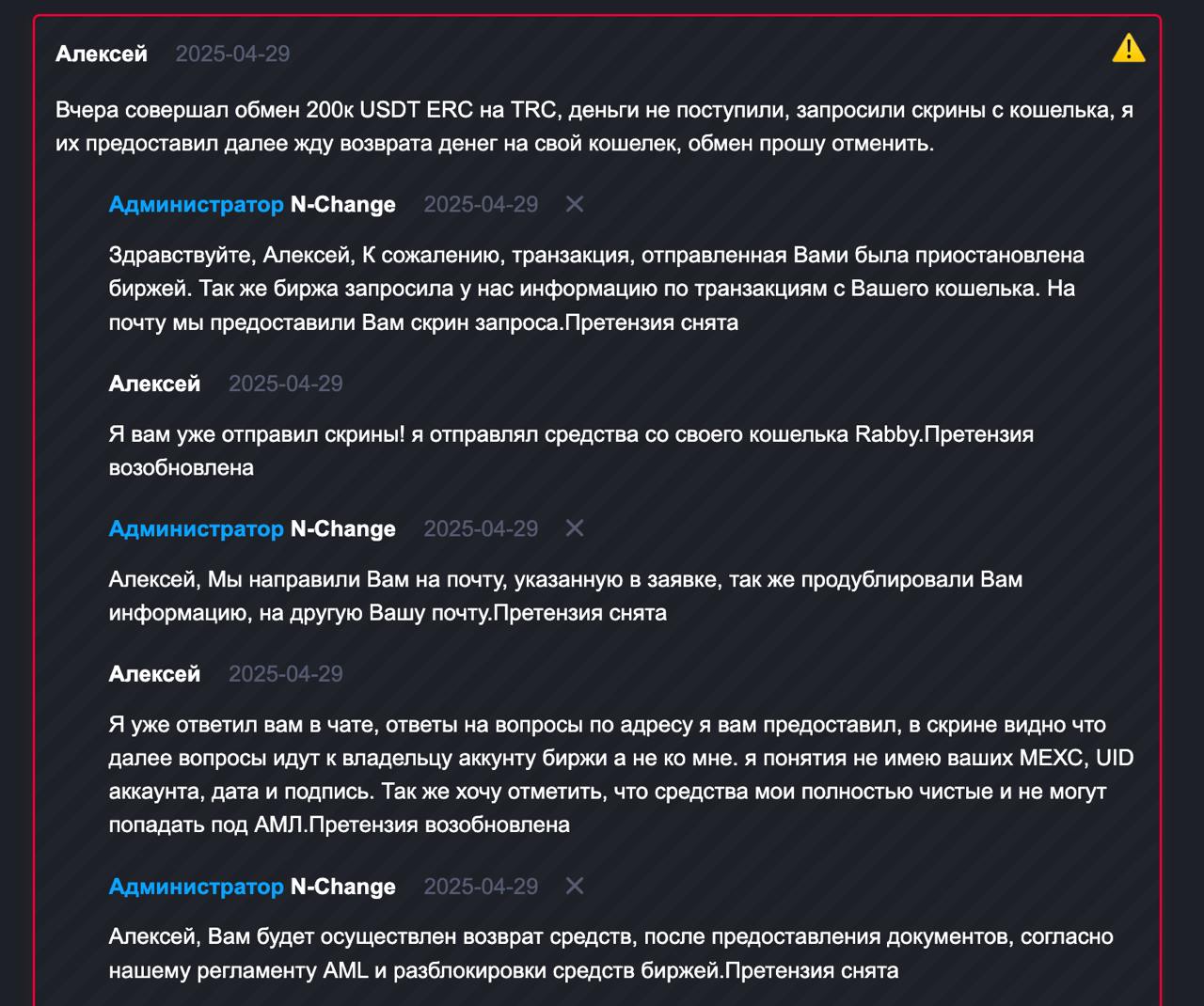
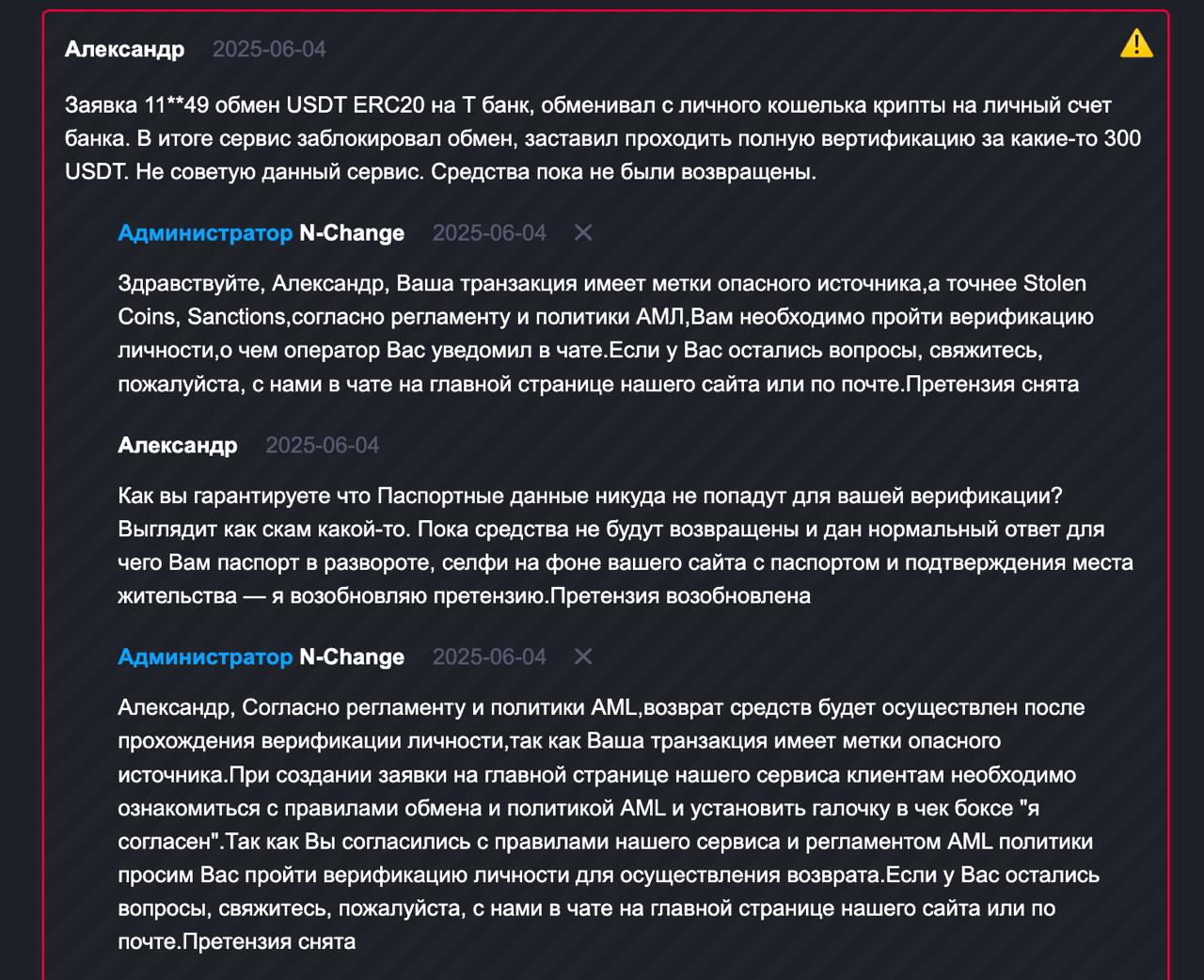
Users often sell USDT through exchangers and end up in a situation where the service exchanges currency through an exchange, blocks the operation, and demands KYC verification. Two recent cases ↓
- Alexey reported that when exchanging 200,000 USDT ERC for TRC, the funds were not credited. According to the exchanger, the transaction was suspended by the exchange, after which the client was asked for personal data to process a refund. The review also noted that a refund is only possible after completing the KYC procedure and having the funds unblocked by the exchange.
- A similar situation happened to Alexander. The user went to an exchanger for a simple operation but ended up in a situation where access to their money became dependent on the exchange. The client is not informed about who exactly is checking the transaction, how documents are processed, or when the check will be completed.
📎 Recommendation. To avoid platforms that violate user rights, it is important to choose verified platforms from the start. The monitoring service Antiswap helps with this. It tracks current rates and collects user reviews, categorizing exchangers as "Scam," "Honest," or "Neutral." The monitoring service does not conduct exchanges and does not accept funds; it only shows conditions and reviews.
Why USDT on exchanges is particularly vulnerable
- Any exchange will transfer data to Tether upon request. Large exchanges cooperate with Tether and law enforcement agencies. A single request is enough for an account to come under scrutiny.
- If an account is frozen, the USDT becomes inaccessible forever. Funds can only be unblocked by the decision of the exchange itself or through lawyers. In practice, this is almost impossible.
What to do if your USDT is already on an exchange
The first step is to consider moving your funds to a personal wallet. This helps maintain control over your assets and reduces dependence on third-party platforms. It is also important to understand a few things: account security depends directly on the reliability of the platform, password protection, and enabled two-factor authentication. Furthermore, experienced users often distribute assets across different wallets and networks so as not to depend on a single storage point. It is worth learning how decentralized wallets work and what advantages they offer in terms of control over funds. A simple understanding of these principles helps in making more informed choices about platforms and cryptocurrency storage.
Where it is safer to store USDT
- Cold wallets: hardware and software. The best solution is a hardware wallet (Ledger, Trezor). It is like a safe: the tokens are held by the owner, and no one can block them.
- Secure mobile wallets. For example, Trust Wallet. The main thing is not to forget to make a backup of your seed phrase.
- Using DEX and self-custody. These are used by those who want to increase their level of privacy and control without relying on centralized platforms.
Storing USDT on an exchange is convenient as long as everything is working. But in our time, comfort does not always equal safety. The more users learn about how wallets and networks work, the higher the chance of keeping their funds regardless of the circumstances.
⚠️ This material is prepared for informational purposes only and does not constitute financial advice.