Tether USDT: TRC-20, ERC-20, and BEP-20 explained. What’s the difference, and which network should you choose?
Tether (USDT), developed by Tether Limited, is the world's largest stablecoin, with a market capitalization of approximately $84 billion. There are three main blockchain platforms for USDT operations: Ethereum, Tron, and Binance Smart Chain. All USDT tokens (TRC20, ERC20, and BEP20) are pegged to the US dollar, providing stability and protection against volatility. In this article, we examine each network individually and explain the principles for choosing between them.
In this article:
- Why choose Tether TRC20
- What makes Tether ERC20 notable
- What you should know about Tether BEP20
- Advantages and disadvantages of the networks
- Key differences between TRC20, ERC20, and BEP20
5.1 Transaction speed
5.2 Commission fees
5.3 Network compatibility - Understanding which network suits different tasks
- Where to buy USDT TRC20, ERC20, and BEP20
7.1 Cryptocurrency exchanges
7.2 P2P markets
7.3 Exchange services - Where to safely store USDT TRC20, ERC20, and BEP20 tokens
Why choose Tether TRC20
Tether TRC-20 is a version of USDT that operates on the TRON blockchain. TRON is a decentralized platform focused on high performance, supporting the creation of various applications and smart contracts.
Transfers on the Tether TRC20 network occur in mere seconds with minimal fees, which is especially important for users and companies that regularly perform large and frequent financial transactions.
Read: Full overview of Tether TRC-20
What makes Tether ERC20 notable
Tether ERC20 is a USDT format functioning on the Ethereum blockchain. Its specific feature is that it allows tokens to interact with a variety of decentralized applications, ensuring a high level of compatibility. Because of this, it is considered a convenient tool for minimizing risks, making payments, and locking in purchasing power during market instability.
Read: Full overview of Tether ERC20
What you should know about Tether BEP20
BEP-20 is a token standard on the Binance Smart Chain (BSC). It is built on the ERC-20 standard and replicates its functions. On the BSC blockchain, all cryptocurrencies comply with the BEP-20 standard, which defines the rules for their use, transfer, confirmation, and management.
BSC is a separate blockchain network within the Binance ecosystem that supports smart contracts and decentralized applications (dApps). It is compatible with the Ethereum Virtual Machine (EVM), allowing developers to port projects from Ethereum to BSC. Thanks to this compatibility, transactions on BSC are faster and cheaper.
Read: Full overview of BEP-20
Advantages and disadvantages of the networks
| Network | Advantages | Disadvantages |
| TRC-20 |
|
|
| ERC-20 |
|
|
| BEP-20 |
|
|
Key differences between TRC20, ERC20, and BEP20
The key difference between USDT ERC20, TRC20, and BEP20 is that they belong to three separate blockchain networks and have different characteristics.
Transaction speed
→ TRC20 (3 sec). Due to throughput, transactions on the TRON network are very fast. It can process a large number of operations simultaneously.
→ ERC20 (15 sec). ERC20 transactions take longer to confirm and are often delayed due to network congestion.
→ BEP20 (5 sec). Compared to ERC20, BEP-20 coins have slightly higher throughput, and congestion occurs rarely.
Commission fees
The exact transaction fee usually depends not only on the network but also on the terms of the platform where the operation is performed. However, if we look at the base fee, the order is generally as follows:
→ BSC (BEP20) – up to $1.
→ Tron (TRC20) — up to $6.9.
→ Ethereum (ERC-20) — up to $8.4.
It is worth noting that on Ethereum, there is a concept called "gas" — the fee you pay to send a transaction or execute a smart contract. It measures how much computational resource is required to perform an operation on the blockchain. Each step requires a certain amount of "gas." For example, accessing ERC-20 tokens requires 45,000.
Many people don't know this, but the USDT TRC20 fee can be reduced using certain tricks. We are currently preparing a guide on this topic.
Network compatibility
TRC20 tokens are fully compatible with the Tron network and are supported by all wallets and applications operating on this platform. However, they may have limited compatibility outside the Tron ecosystem, which is not very convenient for users relying on broad integration.
ERC20 has a significant advantage in terms of compatibility, as Ethereum is one of the most common platforms for developing decentralized applications (dApps). A huge number of applications, wallets, and exchanges support ERC20.
BEP20 is integrated into the Binance ecosystem, which also supports ERC20 thanks to a bridge between BSC and Ethereum. This makes it easy to exchange funds between these networks. BEP20 has good support on platforms associated with Binance but may not be supported in a wider range of services compared to pure ERC20 assets.
Understanding which network suits different tasks
The choice of network depends on the user's goals and the features of the platform itself.
- ERC20 is more often chosen by those who value decentralization and a broad ecosystem of applications. It provides a high level of security, but fees are traditionally higher.
- TRC20 is known for low costs and speed, making it popular among users performing frequent operations in the DeFi environment.
- BEP20 can be considered a compromise between cost and functionality, especially if the user interacts with the Binance ecosystem.
Where to buy USDT TRC20, ERC20, and BEP20
Cryptocurrency exchanges
All 3 USDT formats are supported by many crypto exchanges. You can purchase USDT on most major platforms — they have a separate section for buying cryptocurrency. For example, KuCoin, ByBit, MEXC, Gate.io, etc.
But! It is important to understand that most platforms require KYC verification to perform operations. Some platforms restrict registration for users from certain regions.
P2P markets
You need to register and verify on a platform with a built-in P2P feature (e.g., ByBit), go to the appropriate section, and click "Buy." A list of available currencies will open; you must select the desired currency, pay for the deal, and confirm the payment. After that, your balance will be credited with USDT.
Important! Working on a P2P market always involves interacting with other users, which can lead to unexpected situations. In the best case, the seller may delay the transfer of funds, and in the worst case, they may not fulfill their obligations.
Exchange services
Exchange services remain the simplest and fastest way to convert currencies today. It is enough to choose a platform with suitable conditions and rates — operations are fast and without unnecessary complications. Such platforms allow you to exchange funds in a familiar way without diving into the technical details of how the blockchain works.
Note! Some exchanges block transactions, demanding KYC verification and not returning funds for many months. If the purchase is made in a crypto-to-crypto direction, you should be wary of AML blocks. If it is fiat-to-crypto, they will most likely just ask you to replace the crypto wallet for receiving if they consider the specified option to have high risk. To avoid problems, you need to choose exchanges carefully.
For convenient selection, there is the AntiSwap monitoring service. Data on all crypto exchanges is available here: rates and reviews, as well as a reliability rating, which includes three categories of services: honest, neutral, and scam.
✓ Honest — no reviews about AML blocks or requirements to pass KYC verification.
✓ Neutral — blocks happen, but with a refund of funds minus the fee.
✓ SCAM — often freeze transactions due to AML, delay refunds, and require full verification.
AntiSwap simplifies the search for safe exchanges. How does it all work?
Below are examples of how the search works on AntiSwap. You can see how the direction is set, the amount is specified, and exchanges with current rates are displayed. The system shows everything in real-time, without intermediaries.
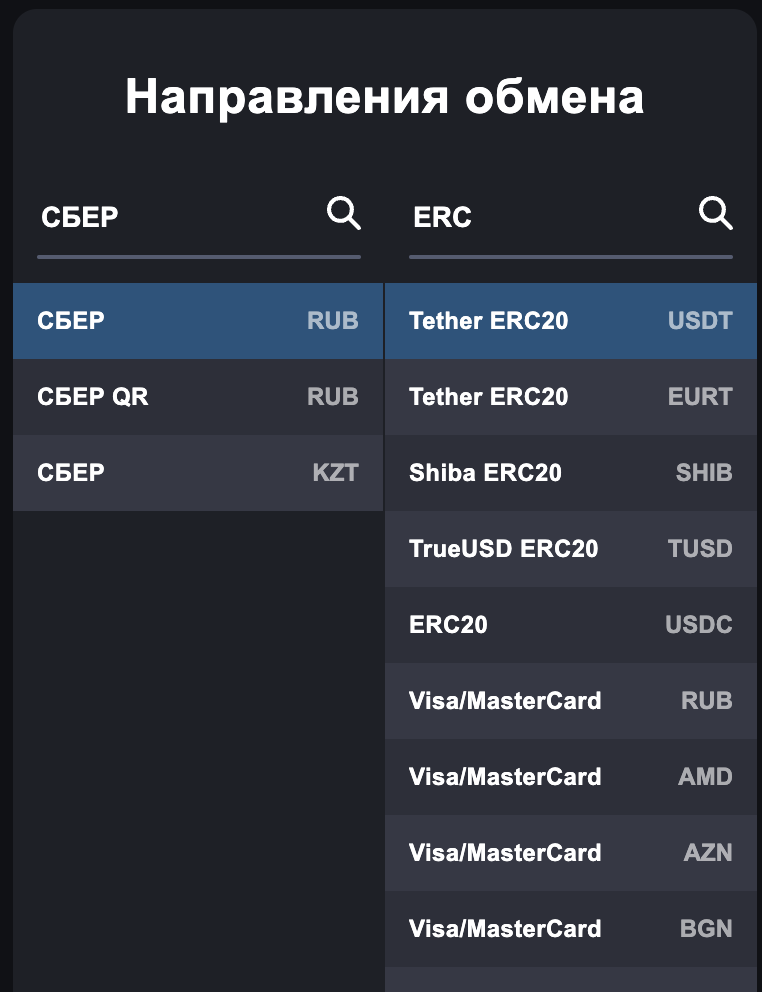

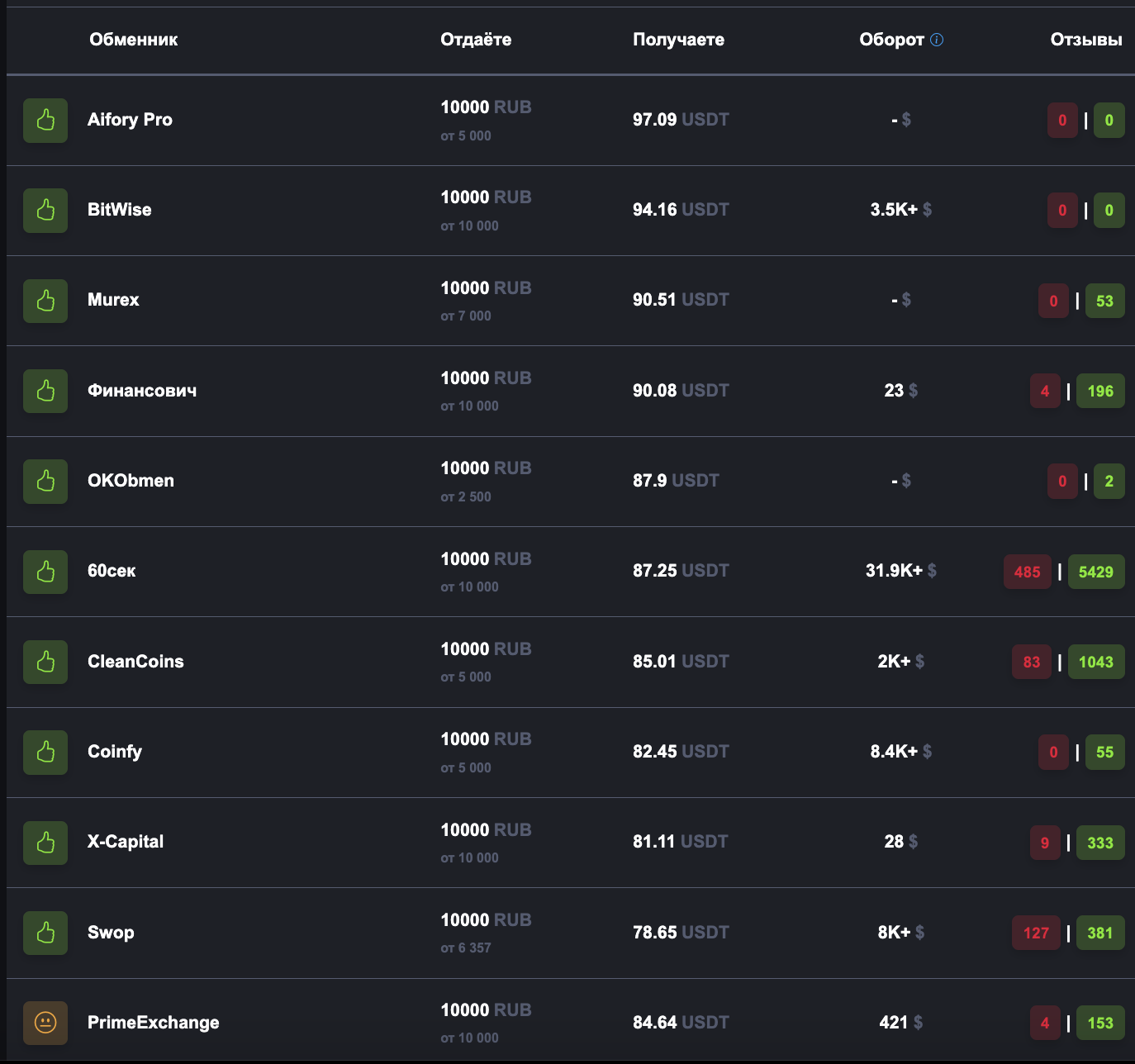
Platforms from the "honest" category are marked separately — there are no complaints related to AML checks for them. And a star in the rating means an increased level of trust: such services consistently conduct operations without delays or unnecessary checks.
Where to safely store USDT TRC20, ERC20, and BEP20 tokens
Due to sanctions, many have lost access to certain cryptocurrency services. It has become unclear where to reliably store digital assets now so as not to worry about them disappearing. Let's look at the options for platforms that are currently available to most countries.
Cryptocurrency exchanges
- KuCoin. Focused on the global market and provides users with access to all key tokens, including USDT in the aforementioned formats. KuCoin provides protection through various levels of authentication.
- Bitfinex. Has a good reputation in terms of security and offers support for all three types of USDT. The exchange has reliable security measures: storing a large volume of assets in cold wallets and complex authentication systems.
- Gate.io. The exchange provides a wide selection of currency pairs and supports USDT on all popular blockchains. Gate.io works on improving security measures and withdrawal speeds.
Wallets
- MetaMask (ERC20 and BEP20). One of the most popular wallets for storing coins on the Ethereum blockchain. It also supports BEP20 by configuring the Binance Smart Chain network. MetaMask gives full control over private keys. Furthermore, thanks to support for various networks, it allows you to easily manage ERC20 and BEP20 in one place.
- Trust Wallet (TRC20, ERC20, BEP20). This is an open-source mobile wallet where you can store private keys locally on your device, ensuring a high level of security.
- TronLink (TRC20). For those who actively use the TRON network and want to manage USDT TRC20, this is the optimal choice. The wallet has all the necessary functions for working with TRON tokens. TronLink is available as a mobile app and as a browser extension.
Important! During the setup of a crypto wallet, a seed phrase is created — a sequence of 12, 18, or 24 words. It serves as a key to restore access in case of device loss. If the seed phrase is lost, it is impossible to regain access to the funds: transactions on the blockchain are irreversible, and there are no centralized password reset mechanisms here.
Each of the standards has its strengths and weaknesses, and the choice between them depends not only on current needs but also on the long-term strategy of use. Before choosing a platform for any operations with digital assets, you should study its reputation, terms, and reviews. This material is not financial advice — it is created solely for informational purposes. Ignoring the verification of a platform can lead to risks, including blocking of transactions due to AML procedures or loss of funds due to unreliable services.