Dirty Crypto: What It Is, How to Check It and What to Do
"Your crypto is dirty": more and more people hear this after honestly buying USDT or bitcoin and then trying to exchange it or deposit it to an exchange. The coins get frozen, documents are demanded, and sometimes the money never comes back. But what is "dirty" crypto really? Why can it end up with someone who broke no rules? And what should you do if it happens to you?
Let's explain in plain words where dirty crypto comes from, how to check your coins before an exchange, and where you can exchange them without risking a loss.
What dirty crypto is
Dirty crypto is crypto that has passed through addresses linked to crime or sanctions: darknet markets, mixers, hacked exchanges, scammers, sanctioned services. There's no official term; it's slang. In AML-service language such coins are called "high-risk".
The key point: all blockchain transfers are public and permanent. Any coin can be traced many steps back. So coins you honestly bought can also turn out "dirty": a few transfers before reaching you, they simply passed through a "bad" address. We explained how transaction chains are traced in "Is bitcoin anonymous?".
How "dirty" coins are is decided by AML services. They study an address's history and assign a risk score, a percentage. At Crystal, for example, 0–25% is low risk, 26–74% medium, 75–100% high. But every service has its own method, and the same address can get very different scores. We covered this in detail in "How the AML bot helps steal its users' money".
Where dirty crypto comes from
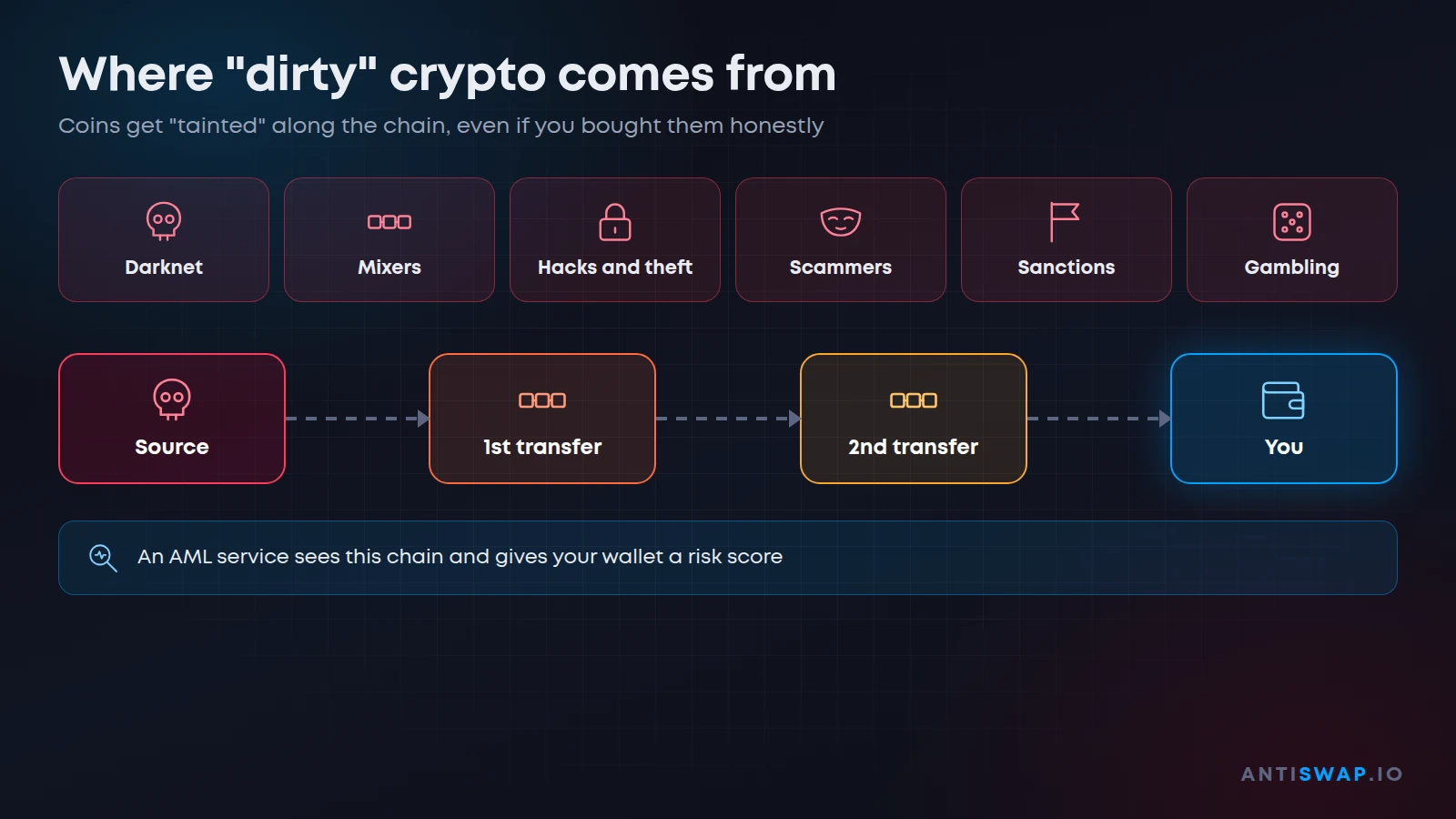
AML services sort fund sources into categories. At AMLBot, for example, the "dangerous" ones include darknet, mixers, scams, stolen coins, ransomware, sanctions, terrorist financing and gambling. If your coins are linked to such sources, the risk score goes up.
The most common ways an ordinary person ends up with dirty crypto:
- buying on P2P from a stranger who got the coins from a dubious source;
- payment from a client or partner whose coins passed through risky addresses;
- exchanging at a dubious exchanger that pays out in "dirty" coins;
- a "dust" attack, when someone deliberately sends a tiny amount to your address from a "bad" wallet. In August 2026 Kraken customers received about 12,000 such transfers from wallets linked to the sanctioned HTX exchange;
- re-evaluation of old transactions. AML databases are constantly updated, and coins considered clean yesterday can become "dirty" today if a newly identified sanctioned address is found in their history.
How widespread it is
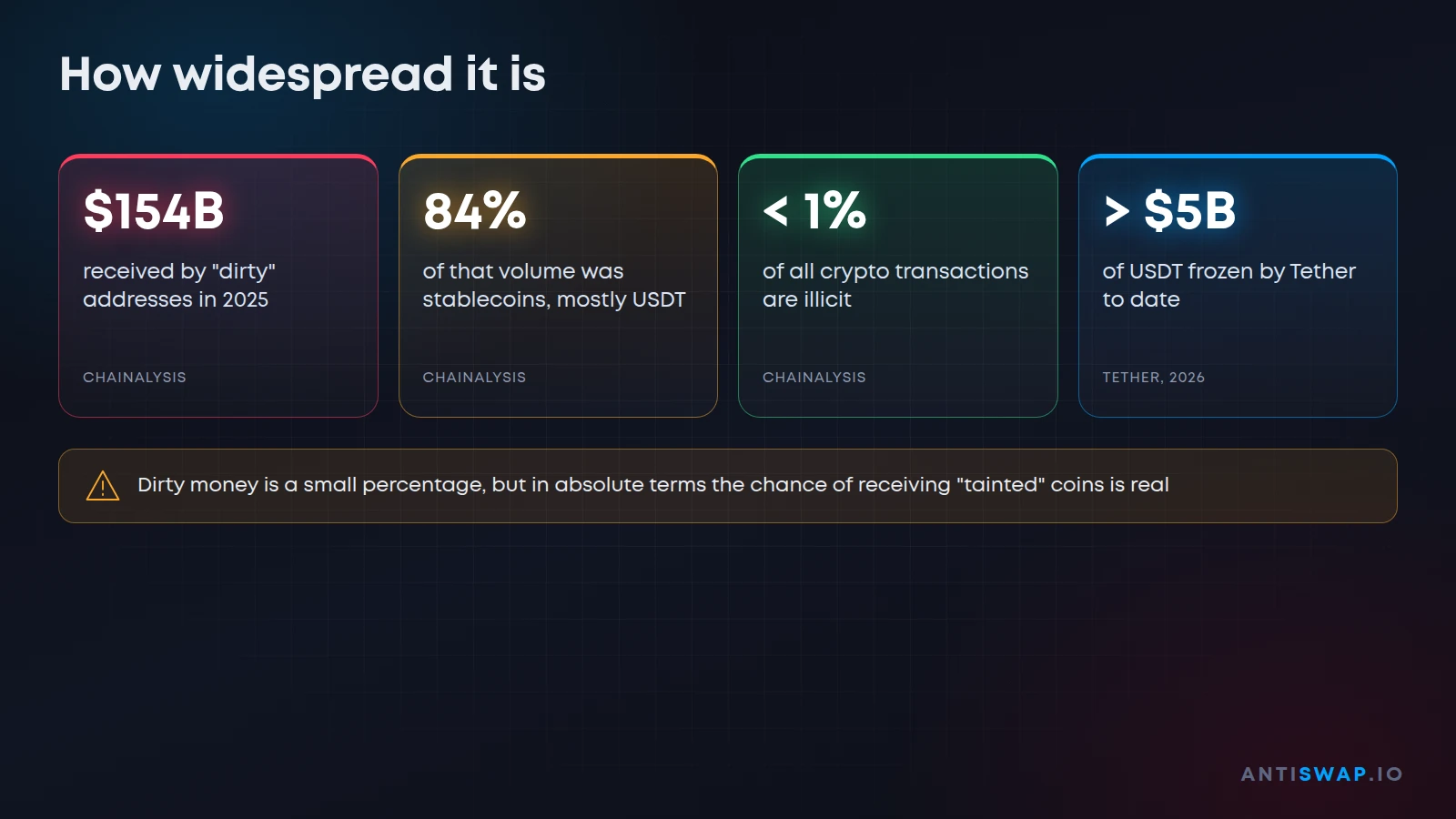
According to Chainalysis, illicit addresses received about $154 billion in 2025, and 84% of that volume was in stablecoins. Yet illicit activity was less than 1% of all crypto transaction volume.
So in percentage terms there's little "dirty" money, but in absolute terms there's a huge amount of it, mostly in USDT, the very coin most people use for exchanges. That's why the chance of receiving "tainted" coins is real.
What dirty crypto can lead to
- A freeze on an exchange. Exchanges screen incoming transfers and, at high risk, block funds, demand documents and may close the account.
- A freeze at an exchanger. Many exchangers check coins with an AML service and, with a high risk score, stop the exchange, freeze the funds and demand KYC. We explained how this works in "AML vs KYC: what is the difference".
- A freeze by Tether itself. If an address is linked to crime or sanctions, Tether can block USDT directly on the blockchain. According to the company, it has frozen more than $5 billion to date. Read how such blocks work in "What the USDT and USDC blacklist is".
How to check whether crypto is dirty
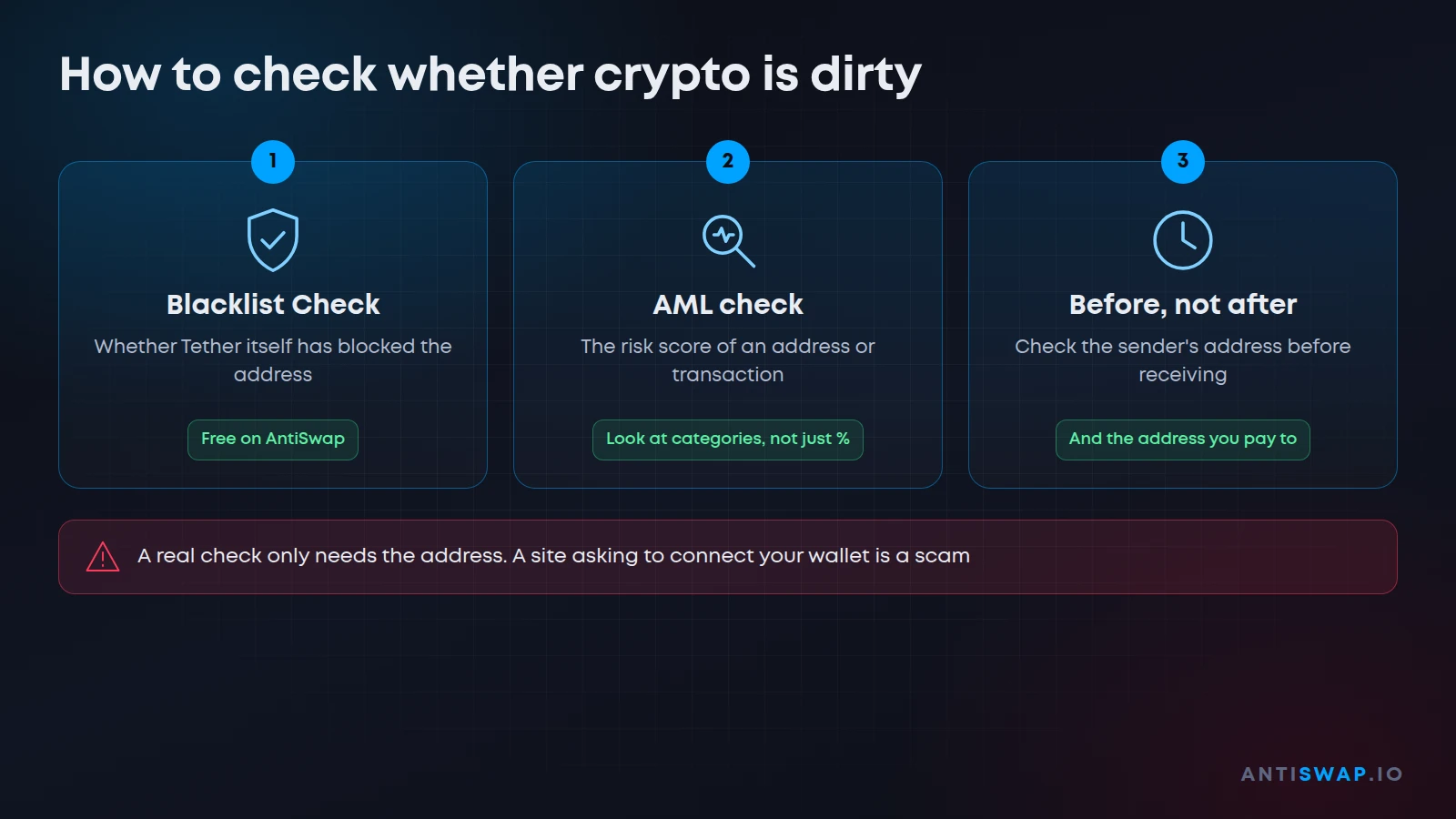
- Check the address with Blacklist Check. Our free Blacklist Check shows whether Tether itself has blocked an address. It works with Ethereum (USDT and USDC) and TRON (USDT), with data updated daily.
- Run an AML check. Services such as AMLBot, Crystal, MistTrack or Scorechain show the risk score of an address or transaction, and many offer a free first check. Look not just at the percentage but at the categories: 5% from a sanctioned source is more dangerous than 40% from unnamed services.
- Check before, not after. Check the sender's address before accepting coins, and the address you're about to pay to.
Keep two limitations in mind. First, different AML services give different results, and your "clean" report doesn't guarantee the exchanger will see the same. Second, even AMLBot admits that low risk doesn't guarantee clean funds.
Beware of fake AML checks. Malwarebytes described sites that impersonate AML services and drain wallets. A real check only needs the public address. If a site asks you to connect your wallet or sign a transaction, it's a scam.
What to do if your crypto turns out to be dirty
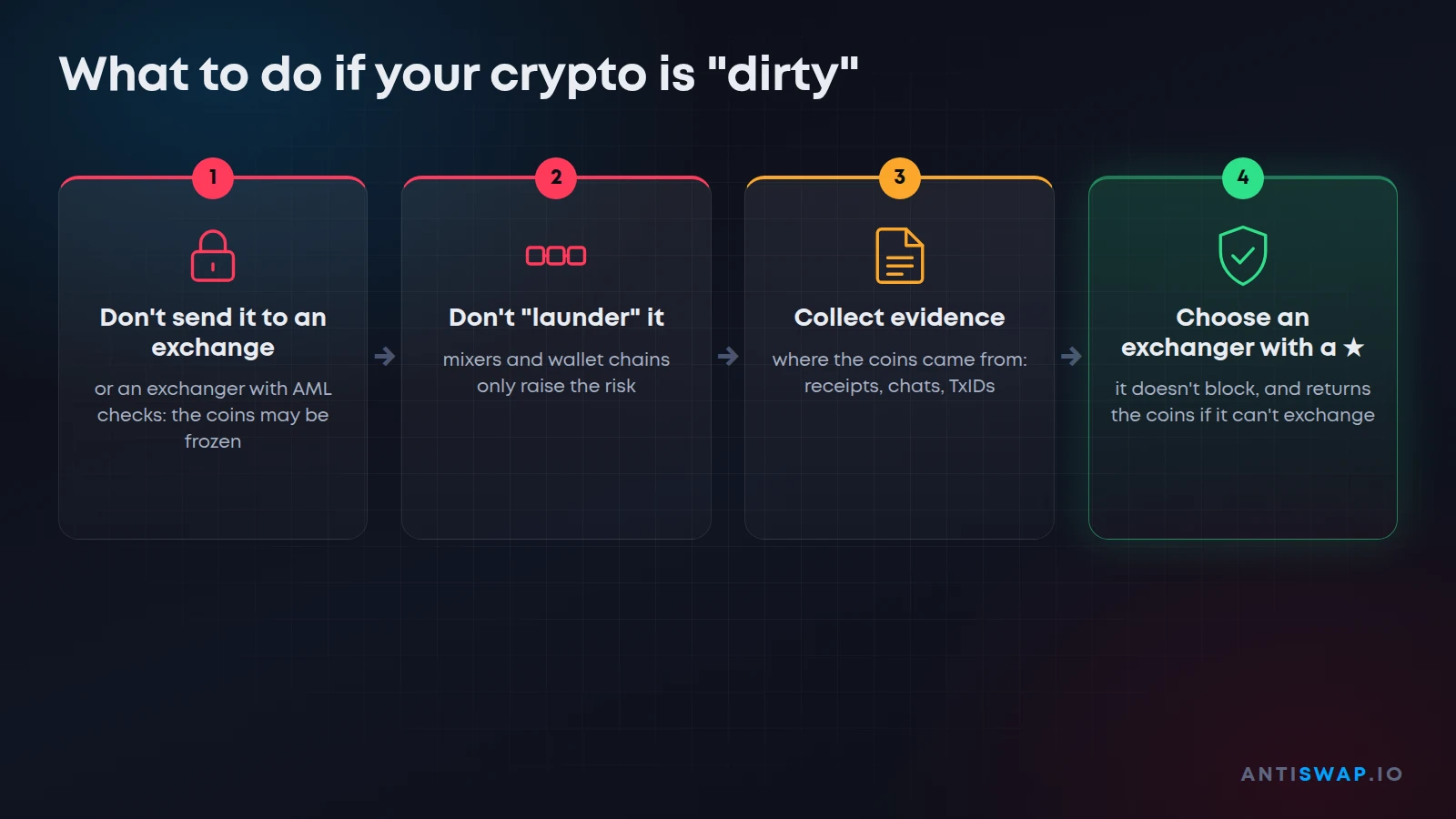
- Don't send it to an exchange or to an exchanger that runs AML checks. A high risk score will almost certainly lead to a freeze, a document demand and a long wait.
- Don't try to "launder" it. Mixers and long chains of transfers between your own wallets won't clean the coins; they'll only raise the risk and draw attention.
- Collect proof of origin. Purchase receipts, chats with the seller, transaction hashes, statements. If you got the coins honestly, these documents will help prove it.
- Exchange through a star exchanger. Such exchangers don't block crypto on AML pretexts, and if for some reason they can't exchange it, they return the coins to the sender.
If your funds are already frozen, don't pay any "unlock fees" and don't send documents until you've been told in writing the reason, the AML service, the risk score and the deadline. Keep the chat and leave a review on AntiSwap.
Star exchangers on AntiSwap
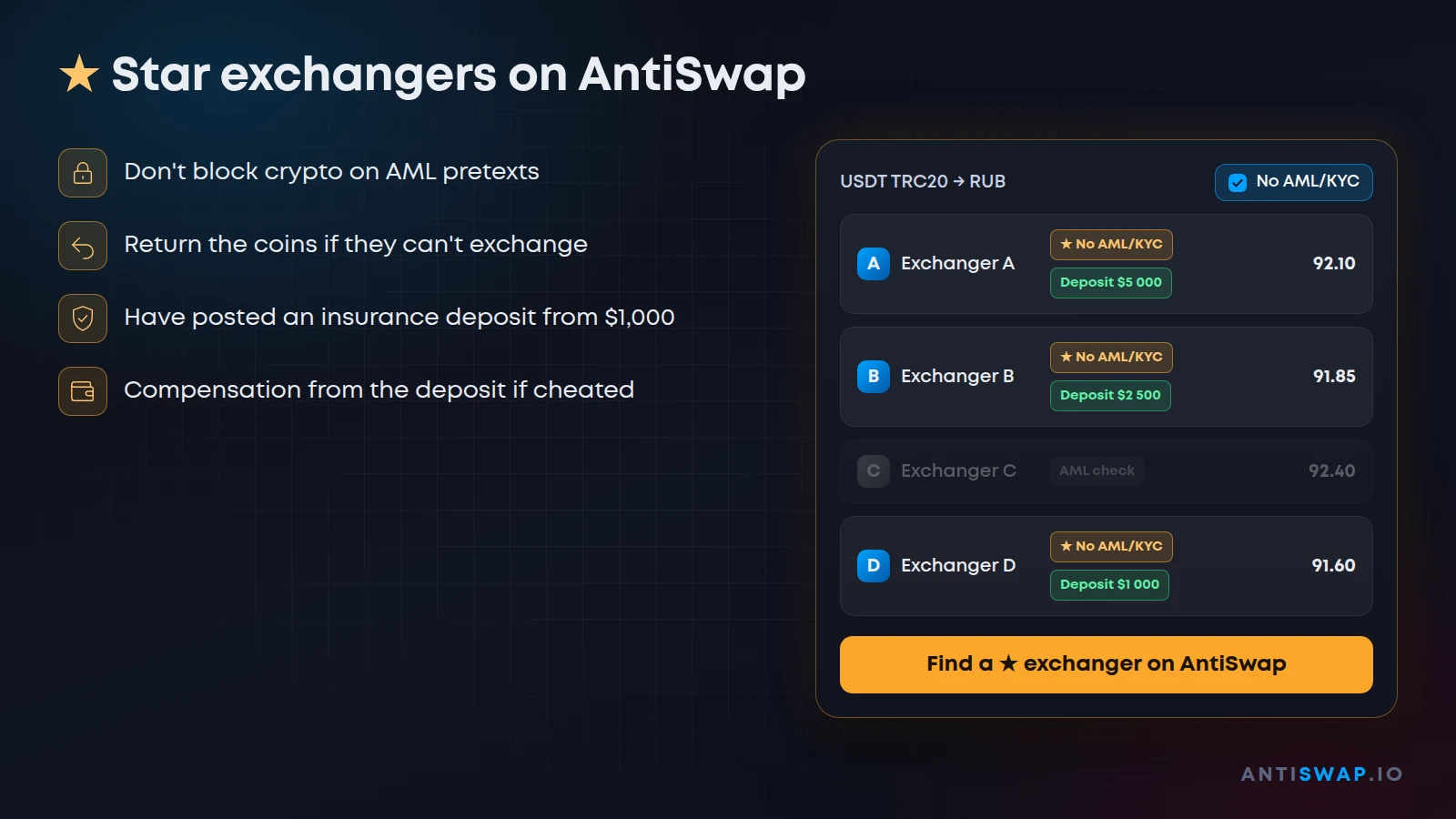
The AntiSwap catalog lists exchangers with the "★ No AML/KYC" badge. This protects you when honest coins get frozen without any explanation:
- they don't block crypto without a valid reason and explain their decision on the order;
- if they can't exchange the coins, they return them instead of freezing them indefinitely;
- each such exchanger has posted an insurance deposit of at least $1,000, held by the AntiSwap administration;
- if the exchanger doesn't fulfil its side of the deal, the client can be compensated from the deposit.
To find them, open the direction you need and turn on the "Only without AML/KYC" filter, for example USDT TRC20 → Sberbank RUB or BTC → Sberbank RUB. Keep the exchange amount within the exchanger's deposit and save the order confirmation email; you can verify it with our email check service. More tips are on the "Recommendations for users" page.
FAQ
Can I end up with dirty crypto if I didn't break any rules?
Yes, and it's the most common situation. The risk score depends on the coins' whole history, not just your actions. If a few transfers before you the coins passed through a scammers' or sanctioned service's address, an AML system may flag them as risky.
This happens most often when buying on P2P from strangers or receiving payment from clients. So check the sender's address before a deal.
Can dirty crypto be "cleaned"?
No. The transaction history is written into the blockchain forever, and no transfers will change it. Mixers and wallet chains only raise the risk score: AML services treat mixers as a dangerous category.
If the coins are already "dirty", the best option is to exchange them where they won't be blocked, for example at a star exchanger on AntiSwap.
An exchanger said my crypto is dirty and froze it. What should I do?
Ask in writing for the AML service, the risk score, the categories and the review deadline. Offer to have the funds returned to the original address. Don't pay any "unlock deposits": real services don't ask for them.
Keep the chat, the order email and the transaction hash, and leave a review on AntiSwap. If the exchanger has a deposit on AntiSwap, you can file a compensation claim.
Why do different services show different risk for the same address?
Every AML service has its own address database, method and category weights. One knows an address belongs to an exchange; another treats it as "unnamed". So the same wallet can get 10% in one service and 90% in another.
The decision to block is made not by the AML service but by the exchanger, which sets its own threshold. So it's more reliable to choose an exchanger that commits in advance not to block funds.
Is it safe to keep dirty crypto in my own wallet?
While the coins are in your personal wallet, neither an exchange nor an exchanger can freeze them. But if it's USDT and the address is linked to sanctions or crime, Tether itself may block it.
Check the address with Blacklist Check and don't keep large amounts on a single address. We explained why you shouldn't keep USDT on an exchange in "Why you shouldn't keep USDT on an exchange".
Bottom line
Dirty crypto is coins that have passed through addresses linked to crime or sanctions. Anyone can receive them, even an honest buyer. Check addresses before a deal with Blacklist Check and AML services, don't try to "launder" coins, and for exchanges choose star exchangers "★ No AML/KYC" in the AntiSwap catalog: they don't block crypto, and if they can't exchange it, they return it. And share this article with anyone else who exchanges crypto.