Can Tether Freeze USDT?
Many people see USDT as a digital dollar that "nobody can take away". But this dollar has an issuer, Tether, and it can block the coins at any address. In 2025–2026 this has already happened thousands of times, and the total frozen has passed $5 billion.
Let's go through it in plain words: who freezes USDT and why, how often it happens, what happens to the money and whether it can be recovered, whether an honest person can be affected, and how to protect your stablecoins.
The short answer: yes, it can
The USDT smart contract has functions that let Tether add an address to a blacklist, remove it, and even destroy the blocked tokens. Only Tether controls them. We covered how this works at the contract level in "What the USDT and USDC blacklist is".
The right to freeze is written directly into Tether's terms of service. The company may freeze tokens if the law requires it or if it "in its sole discretion" considers it prudent. The same terms say Tether may blacklist an address, confiscate tokens and hand property over to government or law enforcement authorities.
Blacklists are kept separately for each network. Most freezing statistics concern Ethereum and TRON, the two networks where the most USDT circulates. An address being clean on one network says nothing about the other.
Who freezes USDT and why
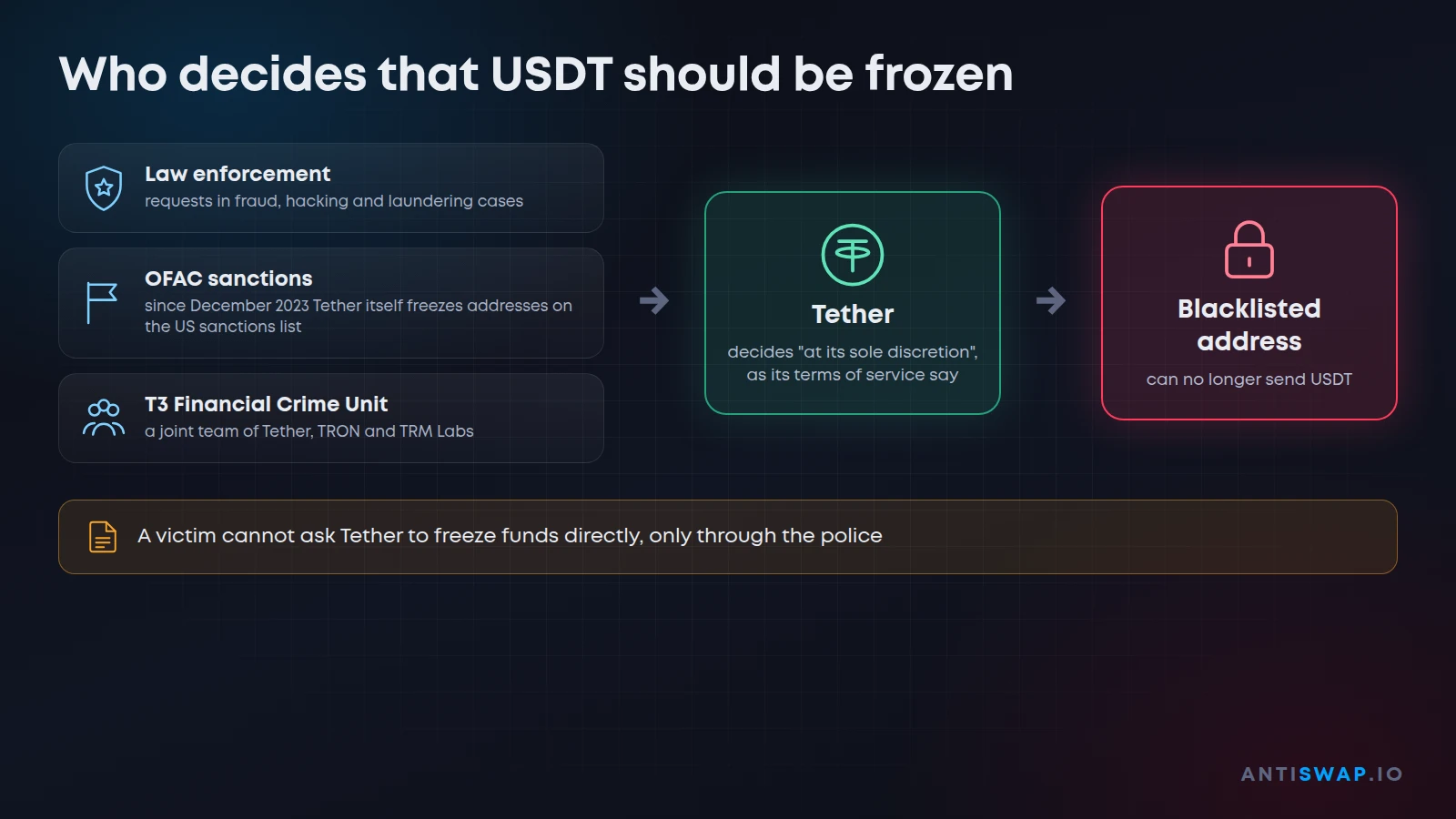
Tether makes the decision to freeze, but the initiative usually comes from others.
- Law enforcement. According to Tether itself, as of September 2026 the company works with more than 340 agencies in 70 countries and has supported more than 2,850 investigations: fraud, hacking, money laundering, terrorist financing.
- US sanctions. Since December 2023, Tether has voluntarily frozen addresses on the OFAC sanctions list, including new additions. Before that, it did so only at the authorities' request.
- T3 Financial Crime Unit. A joint team of Tether, TRON and the analytics firm TRM Labs. By May 2026 it had frozen more than $450 million across 23 jurisdictions.
Important: a scam victim can't write to Tether directly and ask it to freeze an address. You need to go to the police, and the agency sends the request to Tether.
How often it happens
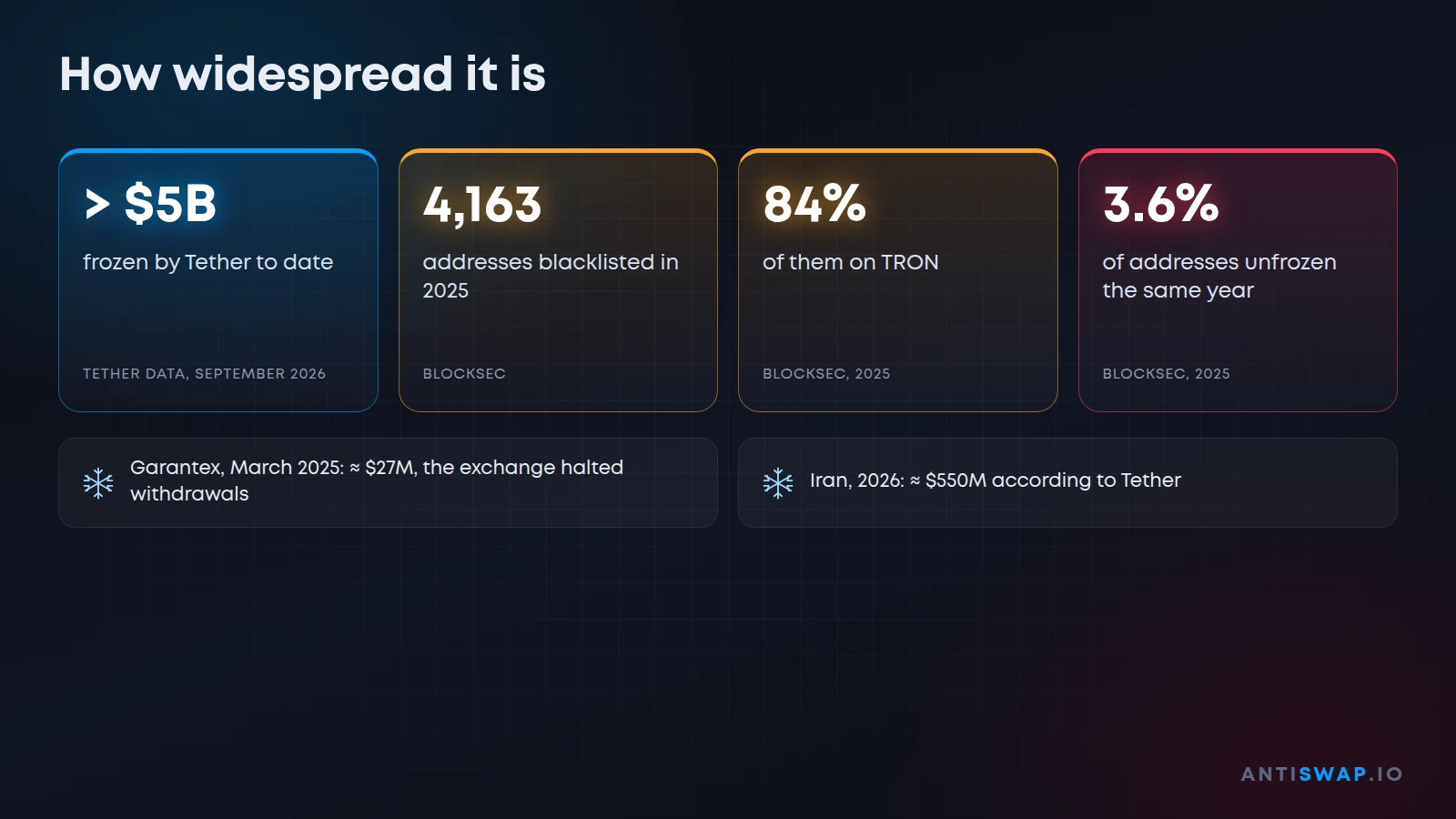
Freezes have long been widespread. Here's what the numbers say:
- according to Tether, the company has helped freeze more than $5 billion to date, more than $2.4 billion of it at the request of US authorities;
- by BlockSec's count, in 2025 alone 4,163 addresses holding $1.26 billion were blacklisted, 84% of them on TRON, where most USDT TRC20 circulates;
- a third of the addresses were empty when frozen: blocks also hit wallets the money had already moved on from.
The most high-profile cases of recent years:
- Garantex, March 2025. Tether froze about $27 million in the Russian exchange's wallets. Garantex immediately halted trading and withdrawals, and customers lost access to their funds.
- Iran, 2026. In April Tether, in coordination with OFAC, froze about $344 million, and in July about $130 million more. In total, according to the company, about $550 million this year on addresses US authorities linked to Iran's central bank and sanctions networks.
What happens to frozen USDT
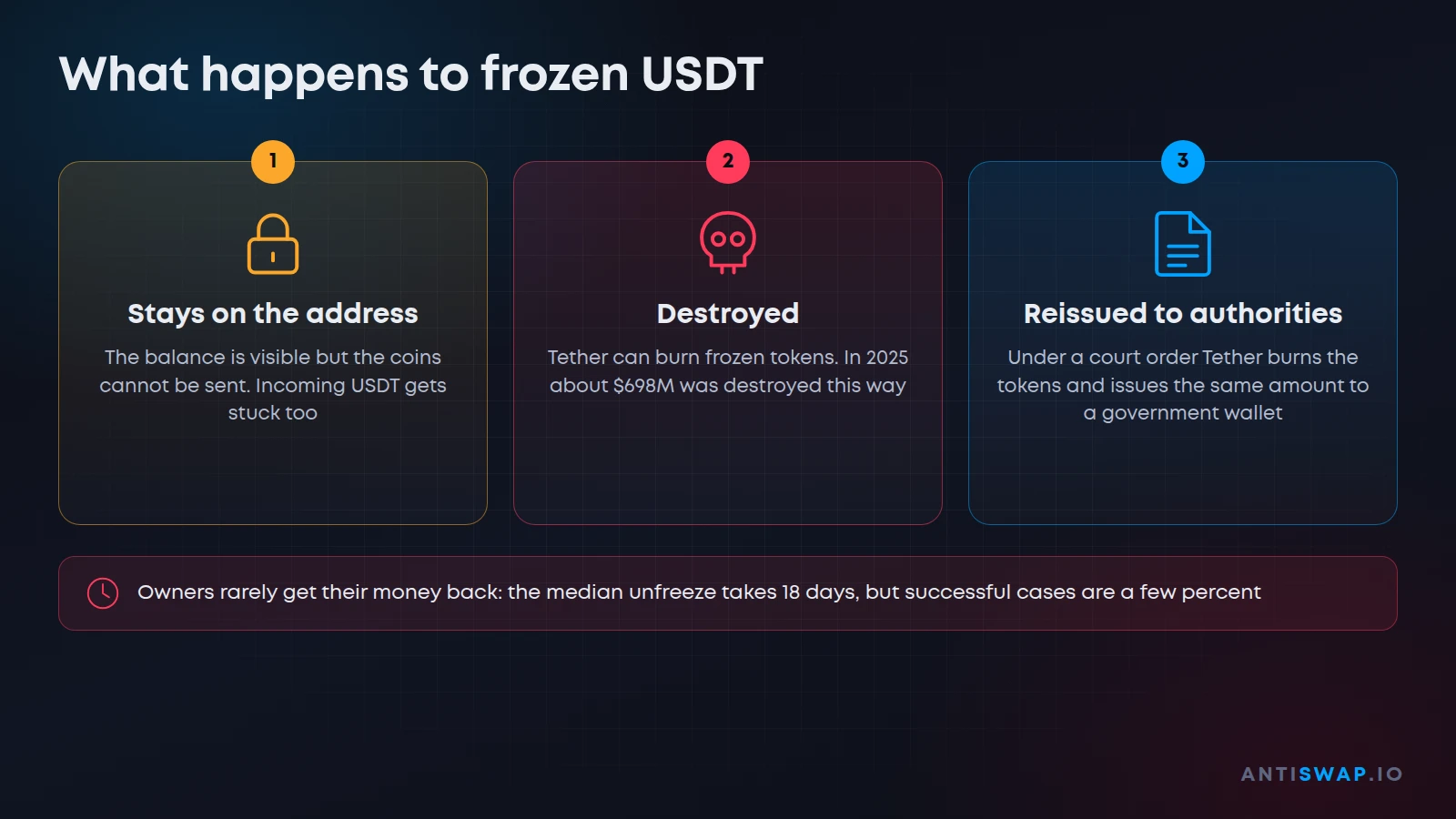
Frozen coins have three possible fates:
- They stay on the address. The balance is visible in the wallet and in the block explorer, but the USDT can't be sent. New USDT arriving at such an address gets stuck too.
- They are destroyed. Tether can burn blocked tokens. According to BlockSec, about $698 million was destroyed this way in 2025, more than half of everything frozen that year.
- They are reissued to the authorities. Under a court order, Tether burns the tokens on the frozen address and issues the same amount to a government wallet. This is how, for example, money is returned to scam victims in the US.
Can USDT be unfrozen
In theory yes, in practice rarely. According to BlockSec, of all addresses blocked in 2025, only about 3.6% were unfrozen. For the lucky ones it took a median of 18 days, but complex cases drag on for more than 100 days.
There are usually three paths: petition Tether with documents and proof of the funds' origin, sue the company, or, if the freeze is tied to a US case, prove in court that you're an innocent owner. All three are slow and almost always need a lawyer. BlockSec bluntly advises you to plan for the loss while pursuing recovery.
Can an honest person be affected
Yes, and this is the main risk for ordinary users.
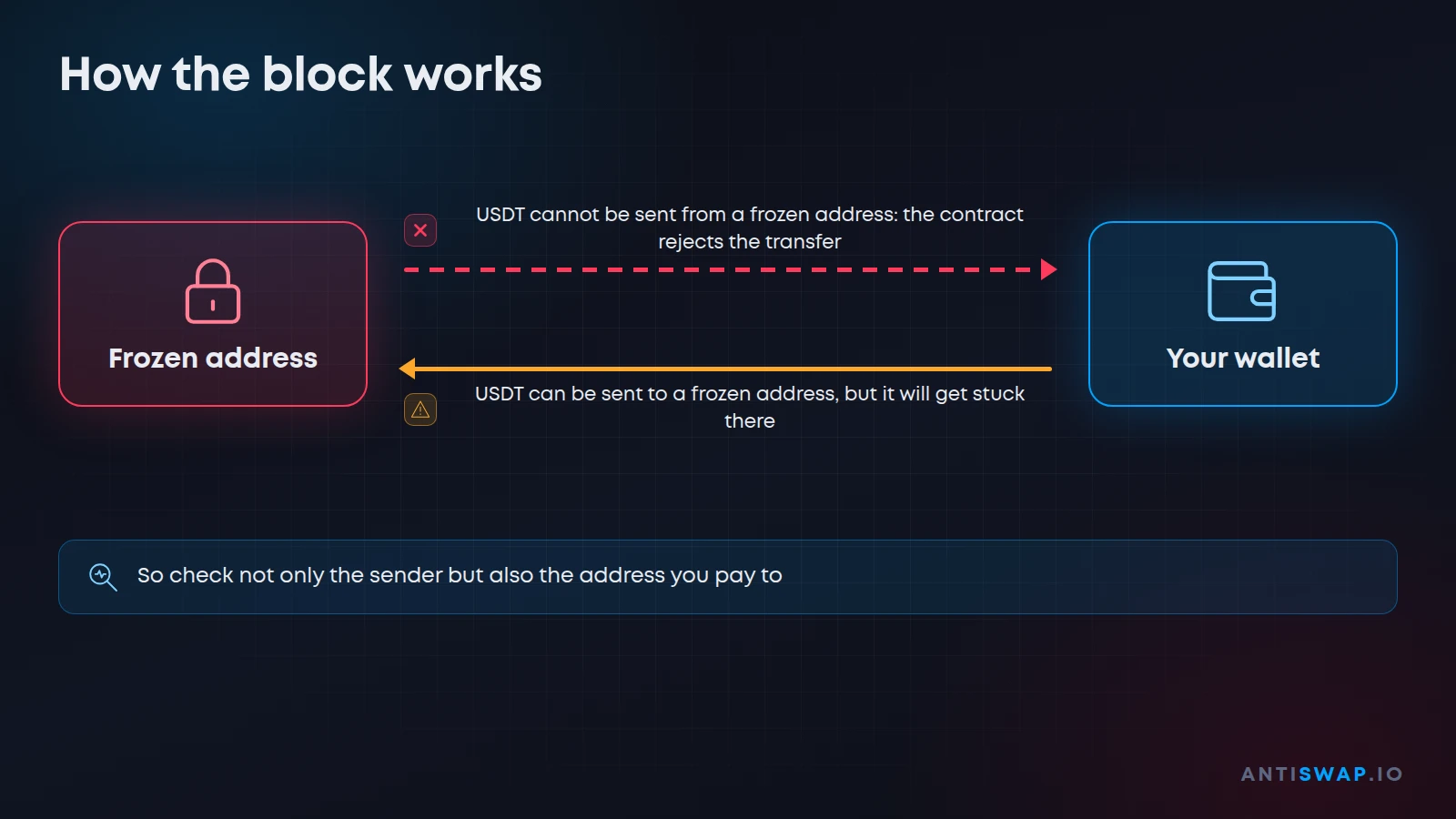
According to the USDT contract code, the block only checks the sender. That leads to two practical conclusions:
- you can't receive USDT from an already frozen address: the contract rejects such a transfer;
- you can send USDT to a frozen address, and that money will get stuck there. So you need to check the address you pay to as well.
But that's not the only danger. An address you honestly dealt with today may be frozen tomorrow, and your wallet ends up in a chain of "dirty" transfers. One example is two businessmen from Thailand: in October 2025 Tether froze their $42.4 million at an informal request from US investigators, and the seizure warrant only appeared four months later. The businessmen say they received the USDT in ordinary commercial deals and are now suing Tether.
Accepting USDT from strangers on P2P is especially risky. We explained why in "Exchanger vs P2P: which is safer for buying and selling USDT".
USDT on an exchange or with an exchanger
If you keep USDT on an exchange, the coins actually sit at its addresses. When Tether freezes a platform's wallet, all its customers lose access at once, as happened with Garantex. After the freeze, the exchange's founder recalled the old rule: "not your keys, not your money". More on storage risks in "Why you shouldn't keep USDT on an exchange".
Don't confuse a Tether freeze with a block set up by an exchanger or exchange itself after an AML check. These are different things: Tether blocks an address on the blockchain, while an exchanger simply doesn't complete the order and keeps your money. We explained how that works in "AML vs KYC: what is the difference" and "What an AML Risk Score means".
How to protect your USDT
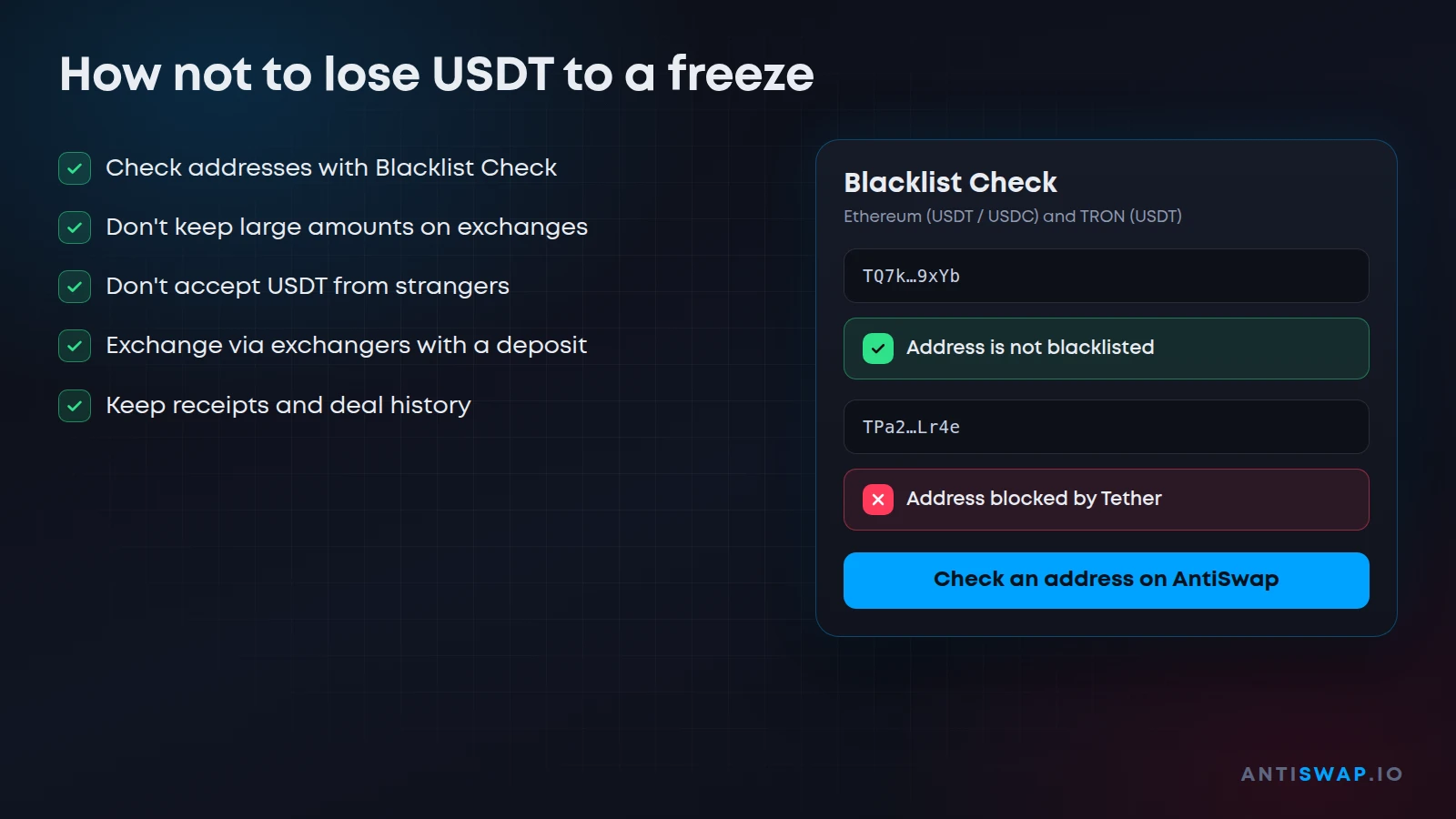
- Check addresses before a deal. Our free Blacklist Check shows whether an address is on Tether's official blacklist. It supports Ethereum (USDT and USDC) and TRON (USDT), with data updated daily. Check both who pays you and the address you send money to.
- Keep USDT in your own wallet, not on an exchange. It won't protect the address itself from a freeze, but it protects you from the platform's problems.
- Don't accept USDT from strangers, and don't agree to "great deals" in Telegram chats.
- Use new addresses to receive funds and don't mix money from different sources.
- Keep evidence: receipts, chats, transaction hashes. If the address does get frozen, you'll need them to prove the funds' honest origin.
- Exchange through verified exchangers. The AntiSwap catalog lists exchangers with the "★ No AML/KYC" badge and an insurance deposit of at least $1,000: if the exchanger doesn't fulfil its side of the deal, the client can be compensated from the deposit. Turn on the "Only without AML/KYC" filter, for example on the USDT TRC20 → Sberbank RUB direction, and keep the exchange amount within the deposit.
If you're considering other stablecoins, remember: USDC can also be frozen, as Circle's terms state directly. DAI's contract, by contrast, is immutable, and a single address can't be frozen in it. A comparison of stablecoins is in "Dai, USDT and USDC: a full comparison".
FAQ
Can Tether freeze USDT in my personal wallet?
Yes. The freeze works at the USDT smart contract level, so it doesn't matter where the coins are stored: Trust Wallet, a hardware wallet or an exchange. You still hold the private key, but you can no longer move USDT from a blocked address.
Other coins on the same address, such as TRX or ETH, keep working as usual: the block only affects USDT.
Why might an ordinary person get frozen?
Most often for links to fraud, hacks, money laundering or sanctioned addresses. It may not be your fault: for example, if you received USDT from someone who was themselves a link in a scam.
To reduce the risk, don't accept crypto from strangers, check addresses with Blacklist Check and keep proof of where your funds came from.
How do I find out whether an address is frozen?
The simplest way is to enter the address in our free Blacklist Check. It checks Tether's official blacklist on Ethereum and TRON.
Tech-savvy users can also check the status themselves: the USDT contract on Etherscan or Tronscan has a read function for blacklist status. But for most people a ready-made service is easier.
Can frozen USDT be recovered?
Sometimes, but the odds are low: according to BlockSec, only about 3.6% of blocked addresses were unfrozen in 2025. This usually requires documents proving the funds' origin and a lawyer's help.
The timelines run to weeks and months, so it's far more important to avoid a freeze in the first place.
Are there stablecoins that can't be frozen?
USDC, like USDT, can be frozen. DAI can't be frozen at the contract level, but its market and choice of exchangers are noticeably smaller than USDT's.
If you still choose USDT, the key is to check addresses, keep coins in your own wallet and exchange through verified services.
Bottom line
Yes, Tether can freeze USDT at any address, and it does so more and more often: more than $5 billion has been frozen to date, and thousands of addresses were blacklisted in 2025 alone. Funds are rarely unfrozen, so you need to protect yourself in advance: check addresses with Blacklist Check, don't keep large amounts on exchanges, don't accept USDT from strangers, and exchange through exchangers with the "★ No AML/KYC" badge and a deposit in the AntiSwap catalog. And share this article with anyone else who keeps savings in USDT.