How to Send Money from Russia to Europe and Germany in 2026
Sending money from Russia to Europe in 2026 is a hard problem. Major banks don't send euros, German banks hardly accept payments from Russia, Zolotaya Korona has left the EU, and Russian cards don't work abroad. Yet relatives, students and Russians who have moved abroad still need money.
Using Germany as the example, this guide covers what changed, which methods still work, which EU rules to keep in mind, and how to get euros in cash or by transfer through an exchanger.
Quick answer: what works
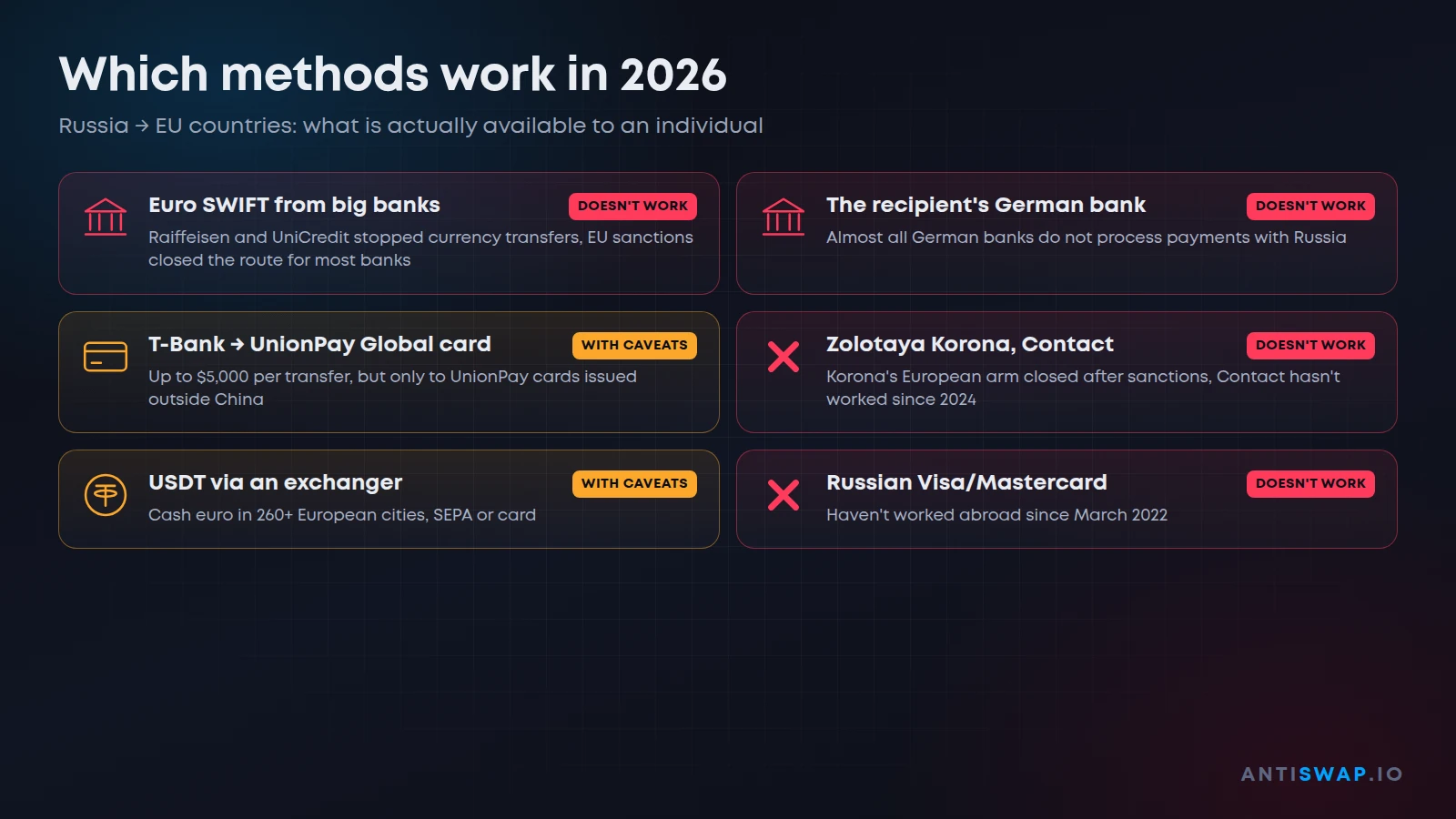
Direct, simple methods are almost gone. As of autumn 2026, the realistic options are:
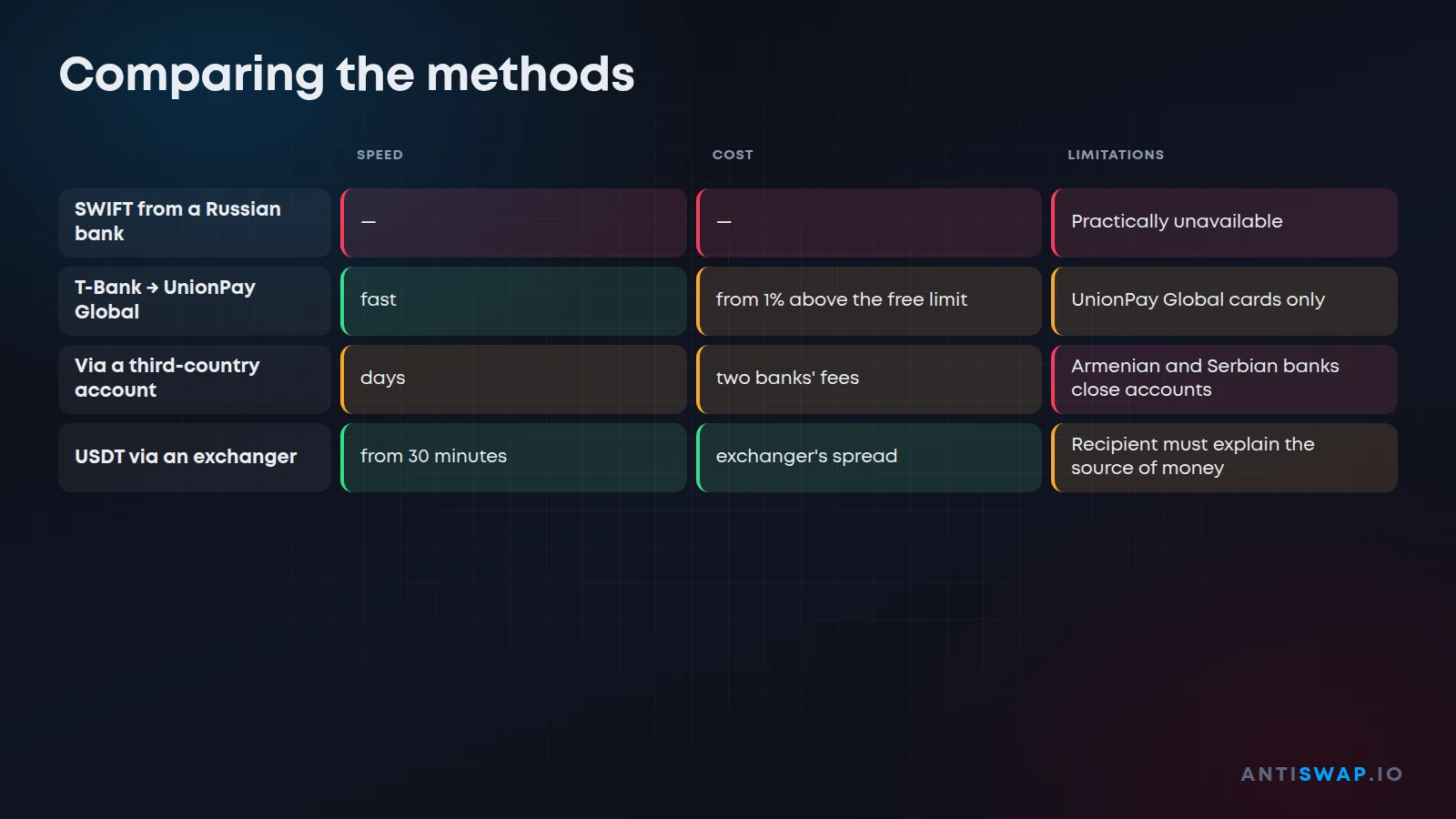
- T-Bank → UnionPay Global card: if the recipient has a UnionPay card issued outside China;
- an account in a third country: but banks in Armenia, Serbia and Kazakhstan are scrutinizing Russians ever more strictly;
- USDT through an exchanger: cash euros in hundreds of European cities, a SEPA transfer or a card payout.
What changed by 2026
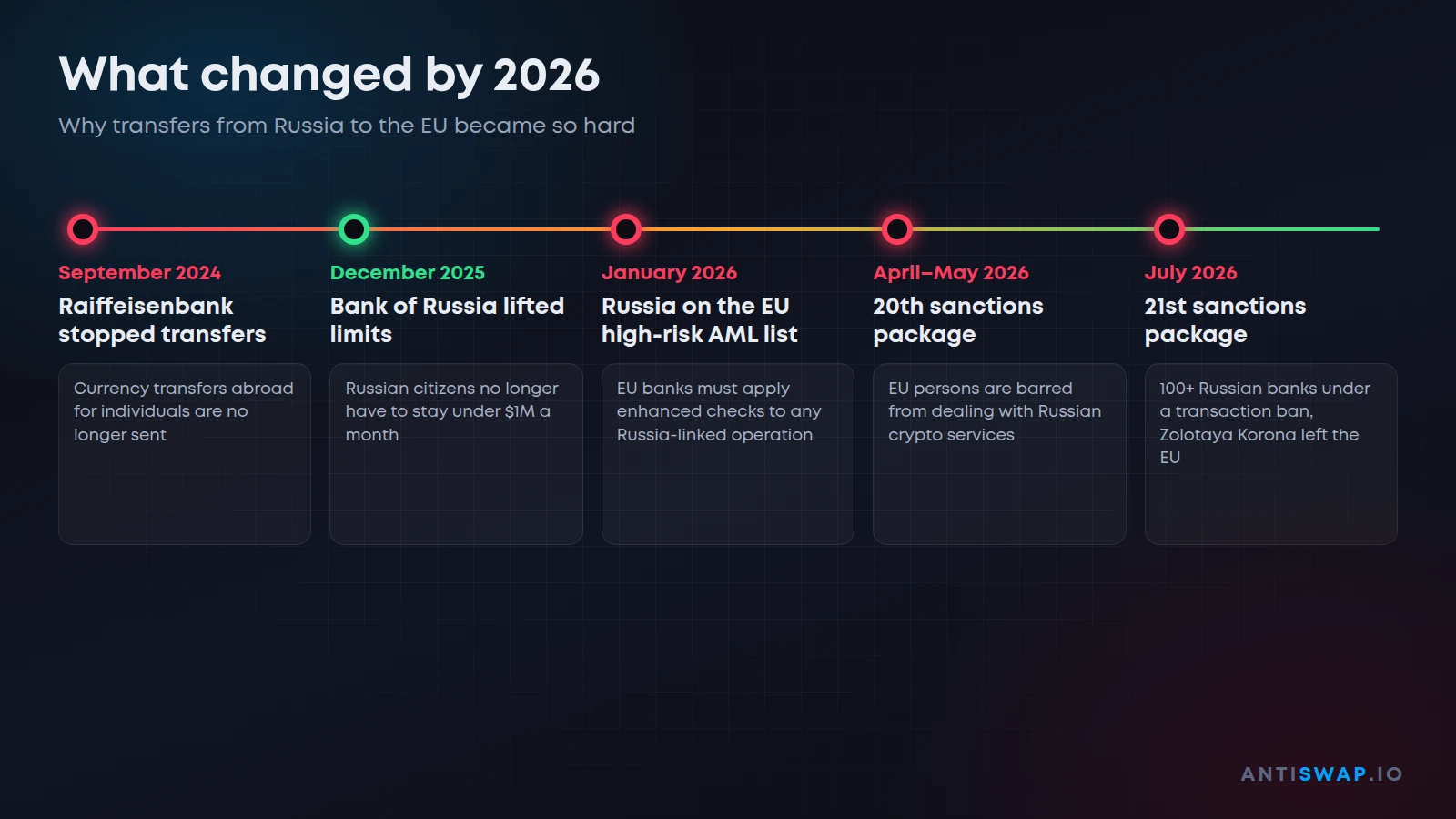
- Russian banks stopped sending foreign currency. Raiffeisenbank ended foreign-currency transfers for individuals on 2 September 2024, and UniCredit on 23 January 2025.
- The Bank of Russia lifted its limits. Since 8 December 2025, Russian citizens no longer have to stay under $1 million a month. The obstacle now isn't Russian limits but European restrictions.
- Russia is on the EU's AML "blacklist". Since 29 January 2026, EU banks must apply enhanced due diligence to every transaction linked to Russia, checking the source of funds and the purpose of the transfer.
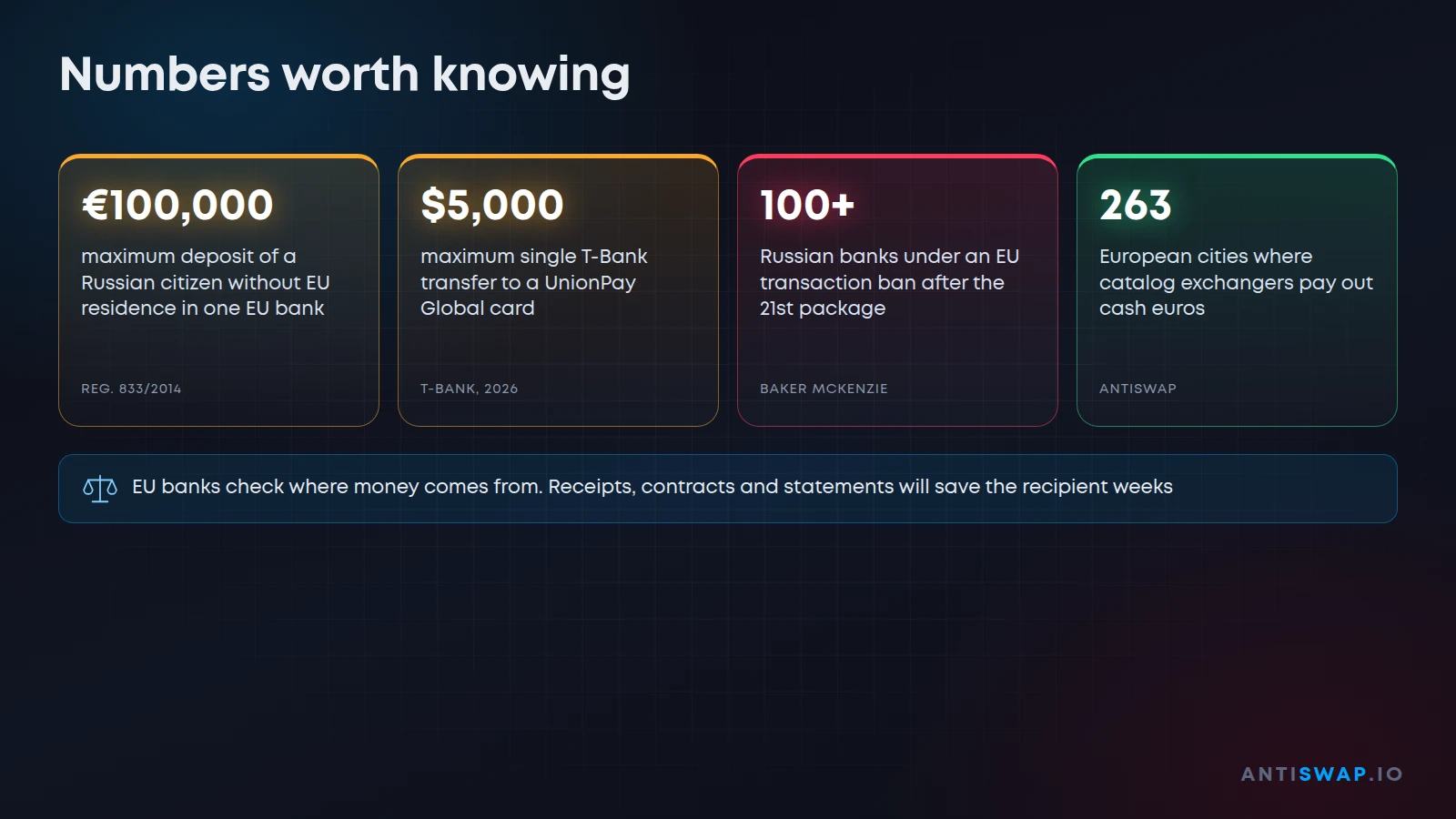
- Sanctions on banks and services. After the 21st sanctions package in July 2026, the EU transaction ban covers more than 100 Russian banks, and Zolotaya Korona's European unit gave up its license.
Bank transfers: why they barely work
The problem is on both ends. Russian banks are either under the EU transaction ban or have stopped foreign-currency transfers themselves. On the German side, according to the Düsseldorf Chamber of Industry and Commerce, almost all German banks currently don't process payments to or from Russia, because correspondent banks can't or won't run the sanctions screening.
Still, there's no general ban on personal transfers. A telling case: in 2025 a Frankfurt court ordered a Sparkasse to release €37,000 it had frozen because the money came from a Moscow company. The court ruled that an ordinary payment from a non-sanctioned party isn't prohibited financial assistance. But it took a lawsuit to prove it.
T-Bank and UnionPay Global cards
Since May 2026, T-Bank has been sending money to UnionPay Global cards in European countries, including Germany, France, Belgium and Spain. The maximum per transfer is $5,000. Without a subscription you can send up to 20,000 rubles a month for free; above that the fee starts at 1%.
The main caveat: this only works for UnionPay cards issued outside China. Regular European Visa and Mastercard cards can't be topped up this way.
Via an account in a third country
A popular route used to be a transfer to a bank in Kazakhstan, Armenia or Georgia and from there to Europe. In 2026 it works worse and worse: after Russia was added to the EU AML list, banks in Armenia and Serbia began turning Russians away, refusing new accounts, closing existing ones and freezing transfers, and Kazakh banks stepped up their checks. Besides, the EU bank will still see the chain and may ask for documents.
Via USDT and an exchanger
Exchangers pay out cash euros in hundreds of European cities or send money via SEPA and to cards. It works like this:
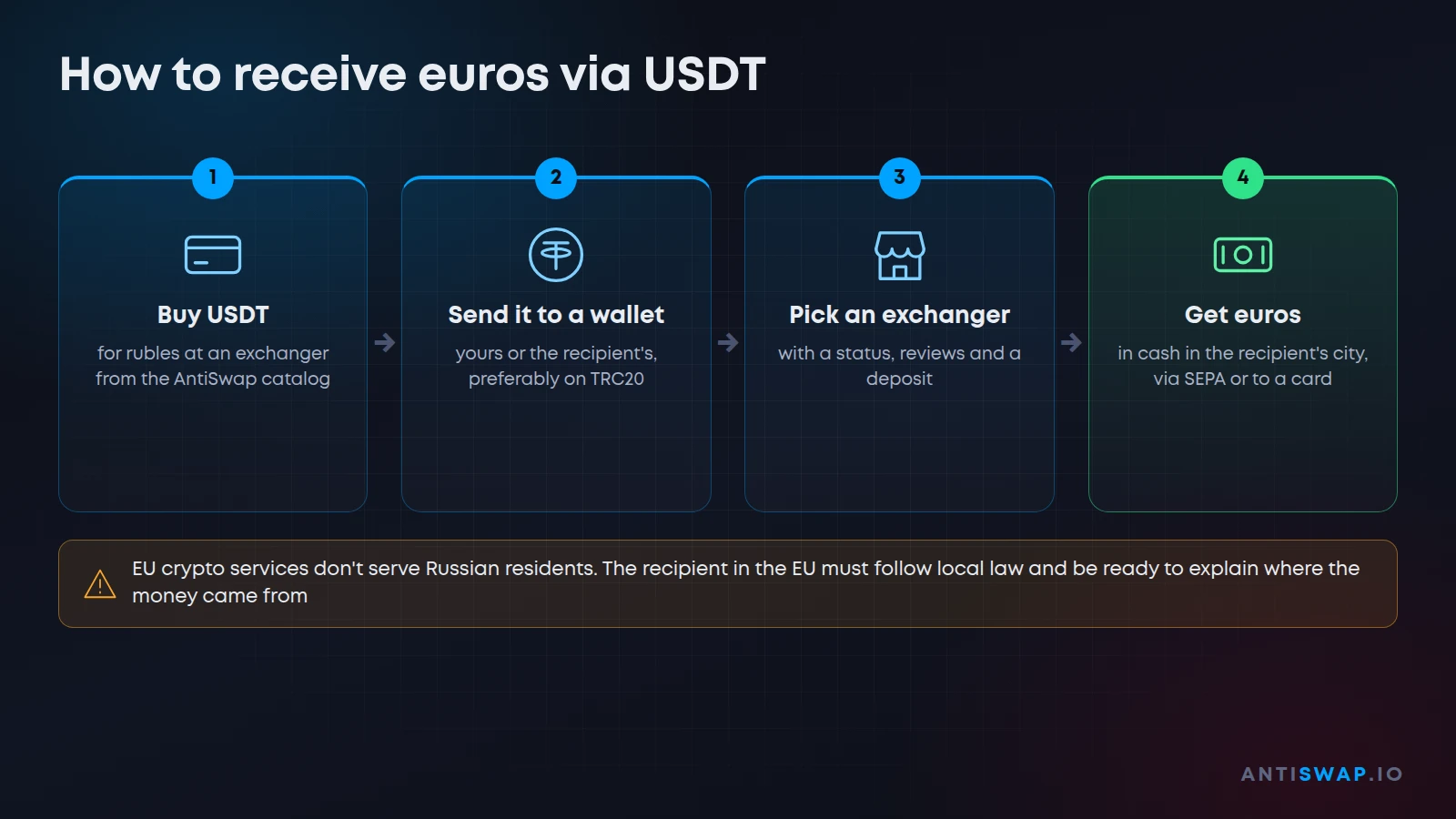
- Buy USDT for rubles at an exchanger from the AntiSwap catalog.
- Send the USDT to a wallet, yours or the recipient's. The TRC20 network is the most convenient.
- Choose an exchanger with a status, good reviews, a deposit and the "★ No AML/KYC" badge.
- Get euros in cash in the recipient's city, via SEPA or on a card.
Step 1: buy USDT for rubles.
| Exchanger | I give | I get | Turnover | Deals | Reviews | |
|---|---|---|---|---|---|---|
≈ 106.33 RUB from 1026 | 1 USDT | 2.1M+ $ | 1486 | |||
≈ 90.91 RUB from 12000 | 1 USDT | 153K+ $ | 150 | |||
≈ 88.61 RUB from 50000 | 1 USDT | 468K+ $ | 122 | |||
≈ 87.59 RUB from 17518.9 | 1 USDT | 18.3K+ $ | 69 | |||
≈ 93.17 RUB from 20000 | 1 USDT | 5.1K+ $ | 16 |
Step 2: get euros, for example in cash in Berlin or by SEPA transfer.
| Exchanger | I give | I get | Turnover | Deals | Reviews | |
|---|---|---|---|---|---|---|
≈ 1.11 USDT from 11138.67 | 1 EUR | 536K+ $ | 146 | |||
≈ 1.17 USDT from 5000 | 1 EUR | 142K+ $ | 17 | |||
≈ 1.1 USDT from 11039.1159 | 1 EUR | - $ | 0 | |||
≈ 1.13 USDT from 5000 | 1 EUR | 20.1K+ $ | 9 | |||
≈ 1.19 USDT from 11067.77 | 1 EUR | - $ | 0 | |||
≈ 1.1 USDT from 10000 | 1 EUR | 15.3K+ $ | 8 |
| Exchanger | I give | I get | Turnover | Deals | Reviews | |
|---|---|---|---|---|---|---|
≈ 1.14 USDT from 1138.89 | 1 EUR | 142K+ $ | 17 | |||
≈ 1.15 USDT from 3456.6 | 1 EUR | 536K+ $ | 146 | |||
≈ 1.14 USDT from 400 | 1 EUR | 15.3K+ $ | 30 | |||
≈ 1.15 USDT from 50 | 1 EUR | 75.7K+ $ | 360 | |||
≈ 1.15 USDT from 3451.3274 | 1 EUR | 135K+ $ | 11 | |||
≈ 1.13 USDT from 500 | 1 EUR | - $ | 0 |
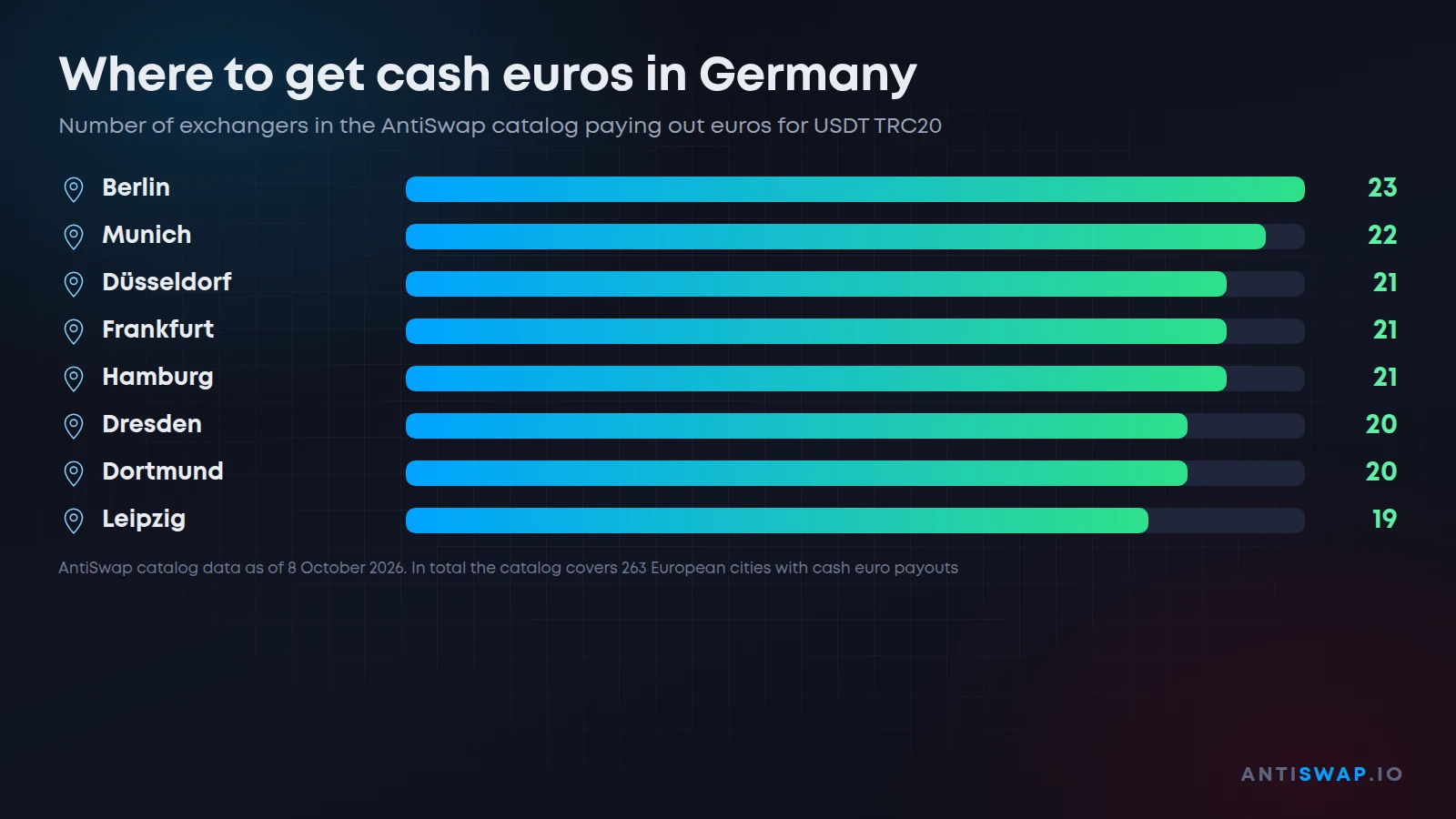
Exchangers in the AntiSwap catalog pay out cash euros in 263 European cities, from Barcelona and Warsaw to Prague and Lisbon. Pick a city on the USDT TRC20 → cash EUR page.
EU rules you need to know
- EU crypto services don't serve Russians. Since 25 November 2025, European crypto platforms may not provide services to Russian citizens and residents, and since May 2026 EU persons are barred from transactions with Russian crypto services.
- A deposit cap. Russian citizens and residents without an EU residence permit may not hold more than €100,000 at a single EU bank.
- Source-of-funds checks. The recipient in the EU must be ready to explain to their bank where the money came from. Keep receipts, contracts and statements.
We don't advise circumventing sanctions: the recipient in the EU is bound by local law. An exchanger is a way to get euros quickly, not a reason to break the rules of your country.
Risks and how to avoid them
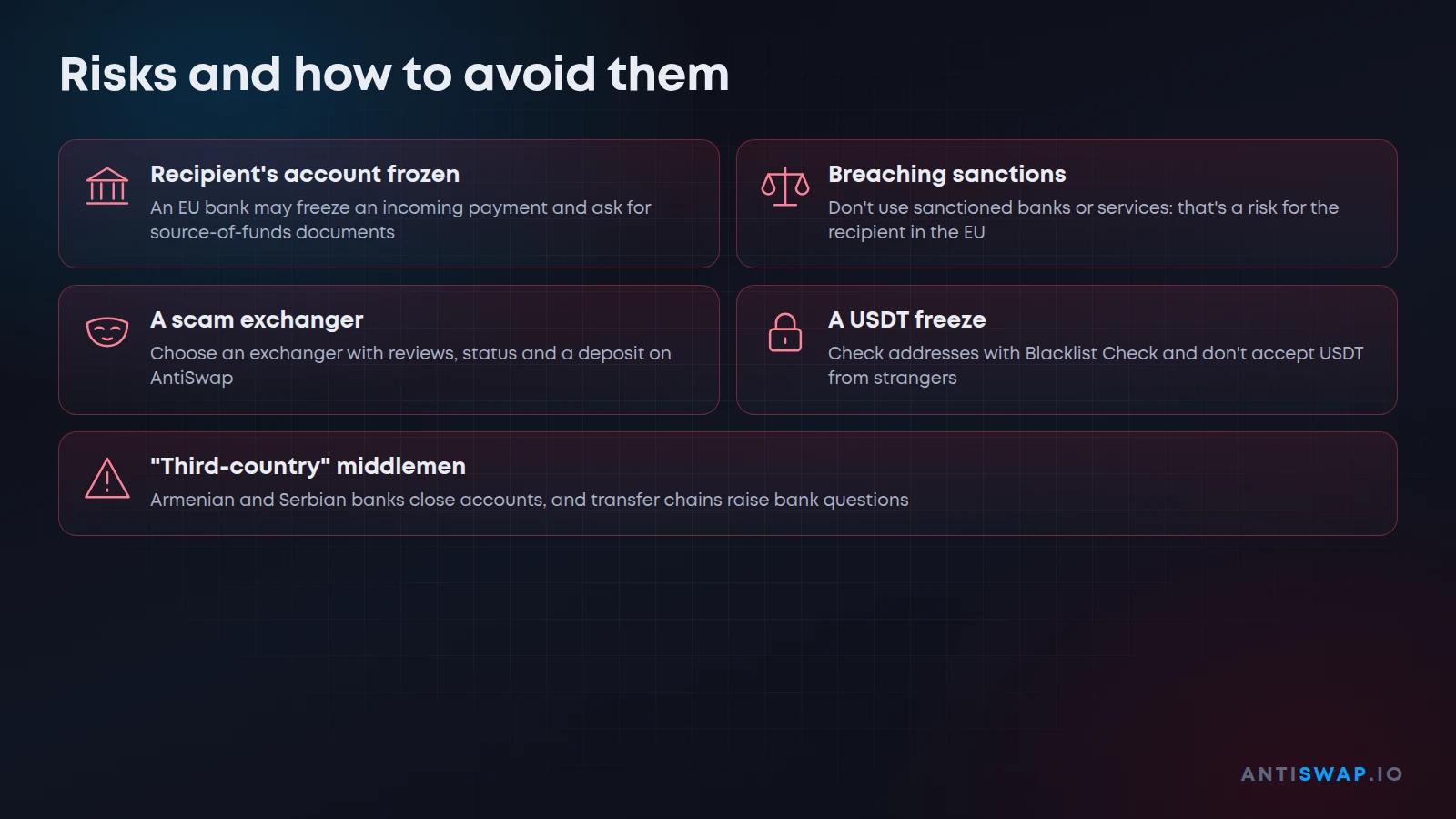
- The recipient's account gets frozen. Prepare source-of-funds documents in advance.
- A scam exchanger. Check the status, reviews and deposit on AntiSwap. More in "Can an exchanger fail to return your crypto?".
- "Dirty" or frozen crypto. Check USDT with Blacklist Check and read what to do with "dirty" crypto.
- Your card gets blocked in Russia. Buying USDT from strangers on P2P can get you caught under 115-FZ or 161-FZ. More in "P2P card blocks under 115-FZ and 161-FZ".
Checklist before you send
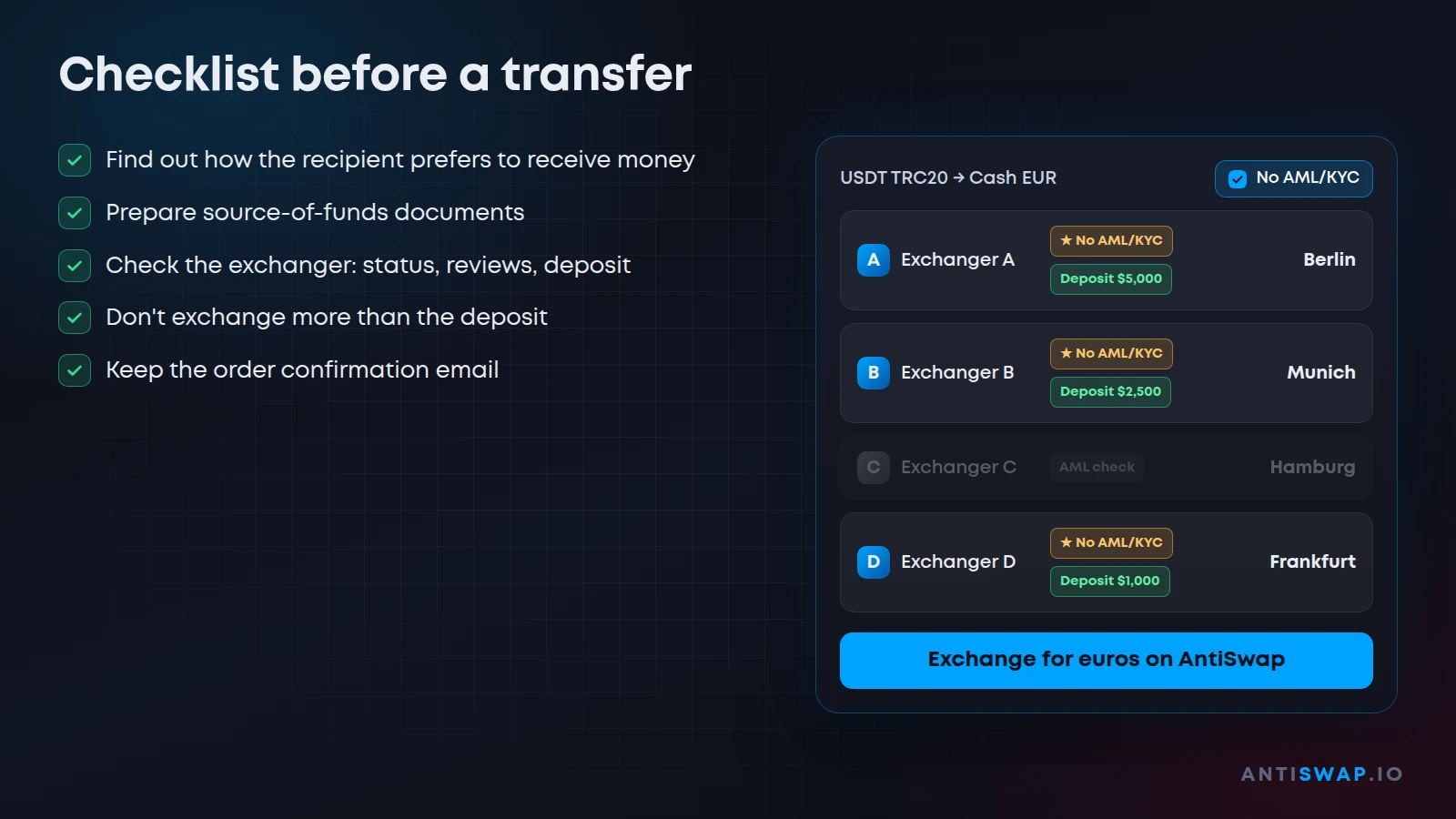
- Ask the recipient how they'd prefer to receive the money: cash, SEPA or a UnionPay card.
- Prepare documents on the source of funds.
- Choose an exchanger with the "★ No AML/KYC" badge and a deposit: such exchangers don't freeze crypto on AML grounds, and if they can't complete the exchange, they return it.
- Don't exchange more than the exchanger's deposit.
- Save the order confirmation email and verify it with our email check service.
FAQ
Can I send euros from a Russian bank to a German one?
Practically not. Major Russian banks are either under the EU transaction ban or have stopped foreign-currency transfers for individuals themselves. And almost all German banks don't process payments with Russia.
If some bank does offer such a transfer, expect a long review, document requests and a possible return.
Does Zolotaya Korona work for Europe?
No. After the EU's 21st sanctions package in July 2026, Korona's European unit gave up its license, and new transfers to EU countries are unavailable.
From Russia, Korona now sends money to only a few countries outside the EU.
Can I get cash euros for USDT?
Yes. Exchangers in the AntiSwap catalog pay out cash euros in 263 European cities, including Berlin, Munich, Frankfurt and Hamburg. Open the USDT TRC20 → cash EUR direction and pick a city.
The recipient in the EU should be ready to explain the source of the money if they deposit it at a bank.
Are there limits on transfers from Russia to Europe?
The Bank of Russia's limits for Russian citizens were lifted on 8 December 2025. The restrictions now are on the EU side: sanctions on banks, a €100,000 deposit cap for Russians without an EU residence permit, and enhanced checks on Russia-linked transactions.
Services like T-Bank have their own limits too, for example up to $5,000 per transfer to a UnionPay Global card.
Does the recipient have to pay tax?
It depends on the country and the amount. In Germany, for example, gifts are taxed above tax-free allowances that depend on the degree of kinship. If the recipient sells crypto, local tax rules apply.
For large sums, consult a tax advisor in the recipient's country in advance.
Transfers to other countries
- How to send money to Turkey
- How to send money to Uzbekistan
- How to send money to Kyrgyzstan
- How to send money to Tajikistan
- How to send money to Armenia
- How to send money to Georgia
- How to send money to the UAE
Bottom line
In 2026, a transfer from Russia to Europe isn't a question of "which bank to choose" but of "which method still works". Bank transfers are almost unavailable, Zolotaya Korona has left the EU, and accounts in third countries are being closed. What remains is transfers to UnionPay Global cards and exchanging USDT for euros through a trusted exchanger: cash in the recipient's city, SEPA or a card. Compare rates and pick an exchanger with a star and a deposit on the USDT TRC20 → cash euros page in the AntiSwap catalog.