How to Send Money from Russia to Turkey in 2026: All the Ways
Turkey is still one of the top destinations for Russians. People move there, vacation there, buy apartments there and send money to relatives there. Transfers in 2026 aren't simple, though: Mir cards don't work, Turkish banks are wary of payments from Russia, and advice in older articles is long out of date.
This guide covers which ways of sending money from Russia to Turkey actually work now, what they cost, what the risks are, and how to get Turkish lira in cash or on a card through an exchanger.
Quick answer: what works
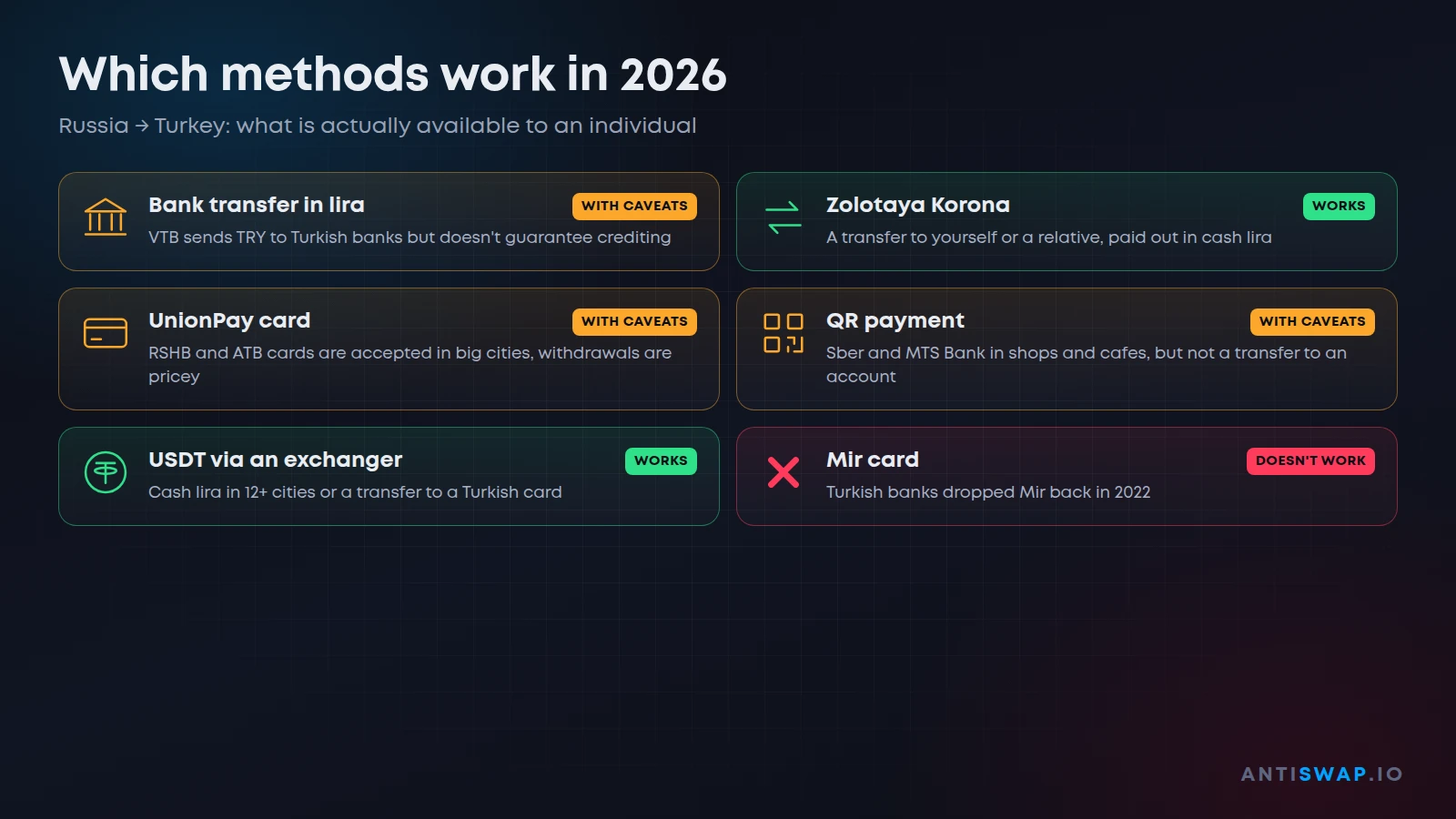
If you need to send money to Turkey right now, these are the options that work as of autumn 2026:
- Zolotaya Korona (KoronaPay): a fast transfer to yourself or a relative, paid out in cash lira;
- a bank transfer in lira through VTB: to an account at a Turkish bank, but crediting isn't guaranteed;
- USDT through an exchanger: cash lira in Istanbul, Antalya, Alanya and other cities, or a transfer to a Turkish card;
- a UnionPay card or QR payments: for paying on the spot instead of transferring money.
What changed by 2026
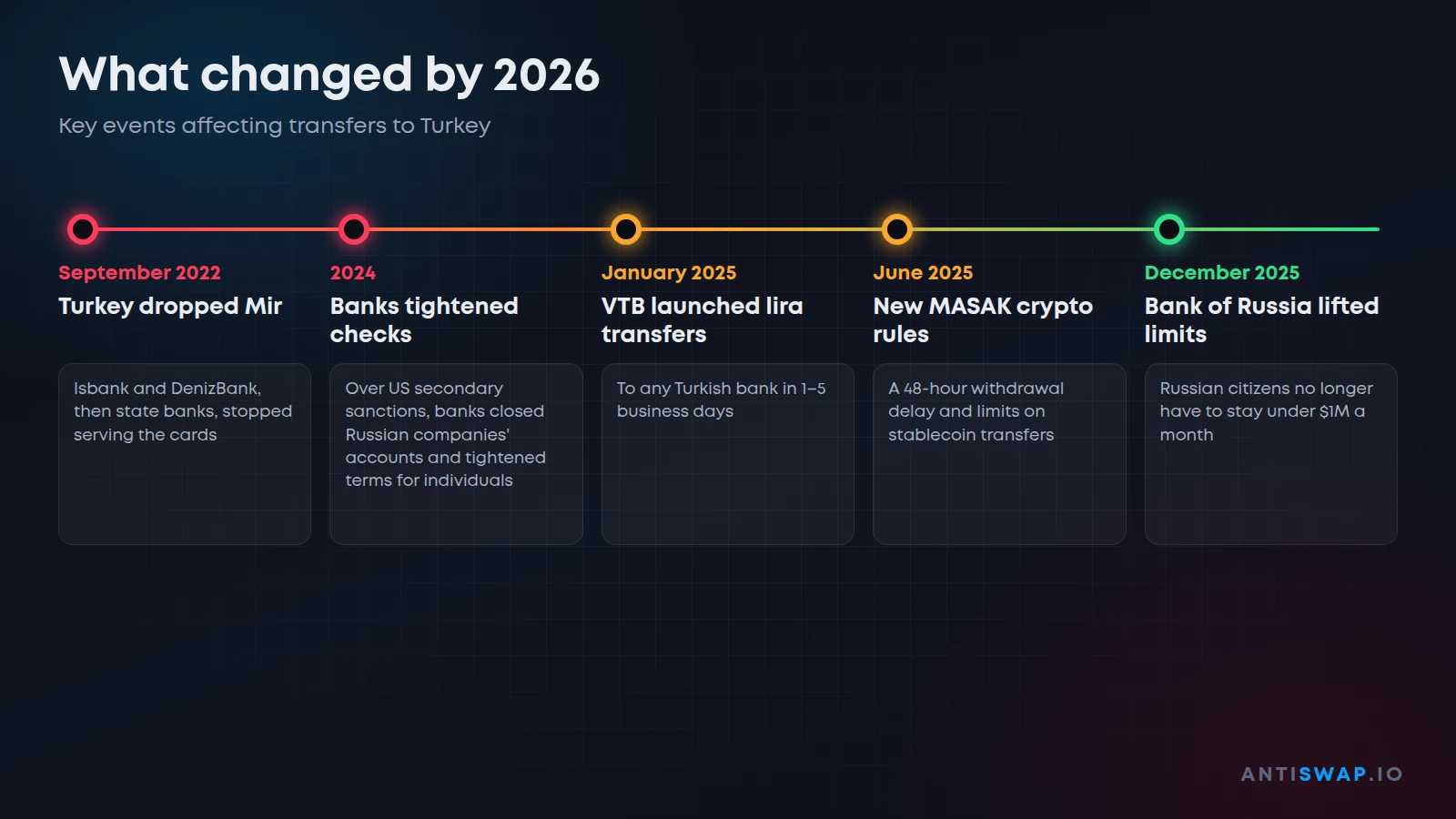
- Mir cards haven't worked in Turkey since 2022. In September 2022 Isbank and DenizBank stopped accepting the cards, and state banks dropped them soon after.
- Turkish banks became more cautious. After the US executive order on secondary sanctions in late 2023, some banks began closing accounts of Russian companies and tightened terms for individuals.
- The Bank of Russia lifted its transfer limits. Since 8 December 2025, Russian citizens no longer have to stay under $1 million a month. If an article mentions a "$10,000 limit", it's out of date.
- Zolotaya Korona cut its list of countries. After the EU's 21st sanctions package in July 2026 the service left many destinations, but Turkey stayed on the list.
Bank transfer in lira
Since 19 January 2025, VTB has been sending transfers in lira to any bank in Turkey. They take 1 to 5 business days. The fees add up from several parts:
- 0.75% of the amount, minimum $40: VTB's fee;
- 0.15% for currency control ($10 to $2,000);
- 1% to the correspondent bank.
The main caveat: VTB doesn't guarantee crediting and advises the recipient to check with their bank in advance whether it will accept the transfer. If the Turkish bank rejects the payment, the money comes back, but you lose time and part of the fees.
Buying property in Turkey usually requires the bank route: the recipient's bank issues the currency purchase documents needed for the deal and for citizenship by investment. Arrange such transfers with a lawyer in advance.
Zolotaya Korona
Zolotaya Korona is the simplest way to send money to yourself or a relative in Turkey. According to Rambler, as of summer 2026:
- you create the transfer in the mobile app, and the recipient's name must be in Latin letters exactly as in their passport;
- you can pay with a Russian bank card, but not every card is accepted;
- the money is paid out in cash lira at payout points, including Turkish PTT post offices;
- there is no separate fee, but how good the deal is depends on the conversion rate.
Note: on 23 July 2026 the Korona operator was sanctioned by the EU, and the list of countries shrank noticeably. Before sending, check in the app that the destination is available that day.
UnionPay cards and QR payments
If you're travelling to Turkey yourself, you don't have to transfer money. You can pay on the spot:
- UnionPay. Rosselkhozbank and ATB cards are accepted in restaurants, pharmacies and malls in Istanbul, less so in smaller towns. You can withdraw cash, but it's expensive: Rambler cites a fee of 999 lira for withdrawing 10,000 lira, plus the Russian bank's fee.
- QR payments. Sber and MTS Bank let you pay in Turkey by QR code through their apps. It's handy in shops and cafés, but you can't transfer money to someone else's account this way.
Via USDT and an exchanger
The most flexible way to get lira is to exchange crypto at an exchanger. Many exchangers in Turkey pay out cash lira at their office or send it to a Turkish card, and some exchange rubles straight into cash lira.
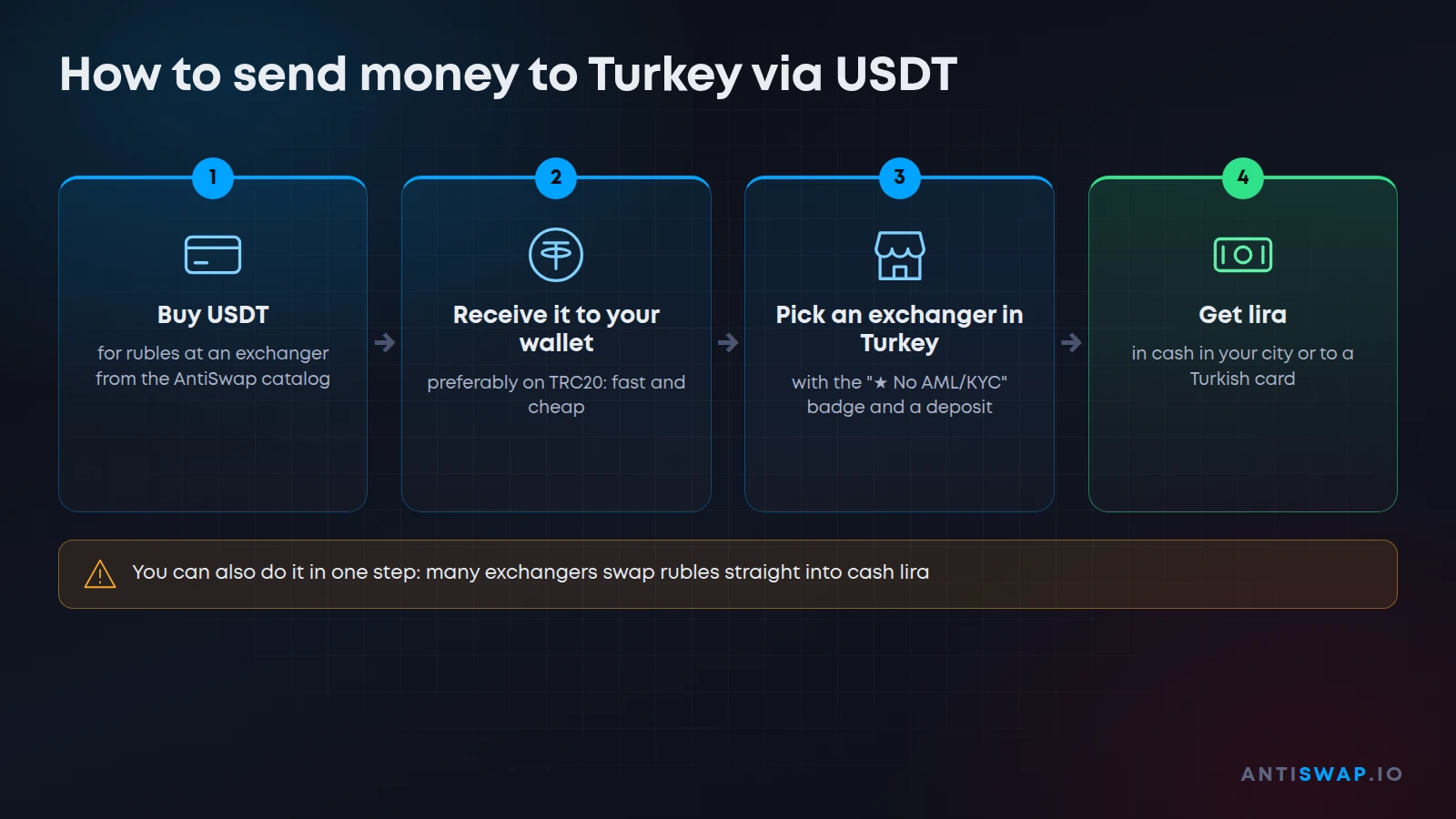
- Buy USDT for rubles. Pick an exchanger in the AntiSwap catalog. If you already have USDT, skip this step.
- Receive the USDT in your wallet. The TRC20 network is the most convenient: transfers take about a minute. More in "Tether USDT: TRC20, ERC20 and BEP20, what's the difference".
- Choose an exchanger in the city you need with a status, good reviews, a deposit and the "★ No AML/KYC" badge.
- Get your lira in cash at the exchanger's office or on a Turkish card.
These exchangers currently swap Sberbank rubles for USDT:
| Exchanger | I give | I get | Turnover | Deals | Reviews | |
|---|---|---|---|---|---|---|
≈ 107.33 RUB from 1035 | 1 USDT | 2.1M+ $ | 1486 | |||
≈ 91.74 RUB from 12000 | 1 USDT | 153K+ $ | 150 | |||
≈ 88.6 RUB from 50000 | 1 USDT | 468K+ $ | 122 | |||
≈ 88.42 RUB from 17683.34 | 1 USDT | 18.3K+ $ | 69 | |||
≈ 94.08 RUB from 20000 | 1 USDT | 5.1K+ $ | 16 |
And this is where you can get cash lira in Istanbul and Antalya right now:
| Exchanger | I give | I get | Turnover | Deals | Reviews | |
|---|---|---|---|---|---|---|
1 USDT from 10000 | 48.94 TRY | 536K+ $ | 146 | |||
1 USDT from 10000 | 49.33 TRY | - $ | 0 | |||
1 USDT from 2000 | 49.09 TRY | - $ | 0 |
| Exchanger | I give | I get | Turnover | Deals | Reviews | |
|---|---|---|---|---|---|---|
1 USDT from 10000 | 49.33 TRY | - $ | 0 | |||
1 USDT from 2000 | 49.09 TRY | - $ | 0 |
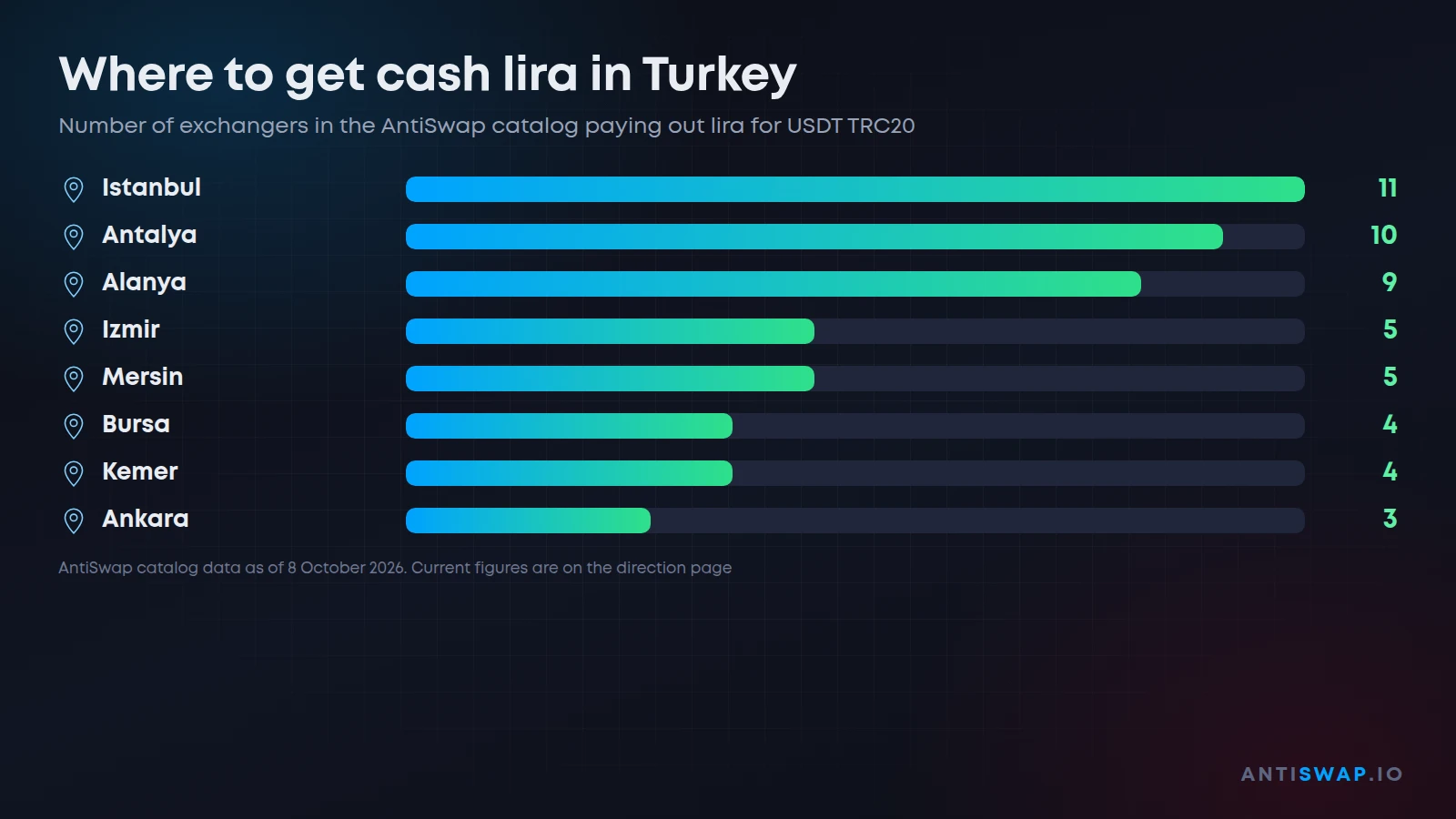
If the recipient would rather get money on a Turkish bank card, use the USDT TRC20 → Visa/Mastercard TRY direction. More than 50 exchangers in the catalog support it.
What to know about crypto in Turkey. Paying with crypto in Turkey has been banned since 30 April 2021, and since 2024 crypto services have been supervised by the Turkish capital markets regulator. Since 28 June 2025, Turkish crypto exchanges have followed MASAK rules: withdrawals no sooner than 48 hours, and stablecoin transfers capped at $3,000 a day and $50,000 a month. So for a tourist without Turkish documents, it's easier to exchange USDT at an exchanger than on a local exchange.
Comparing methods and costs
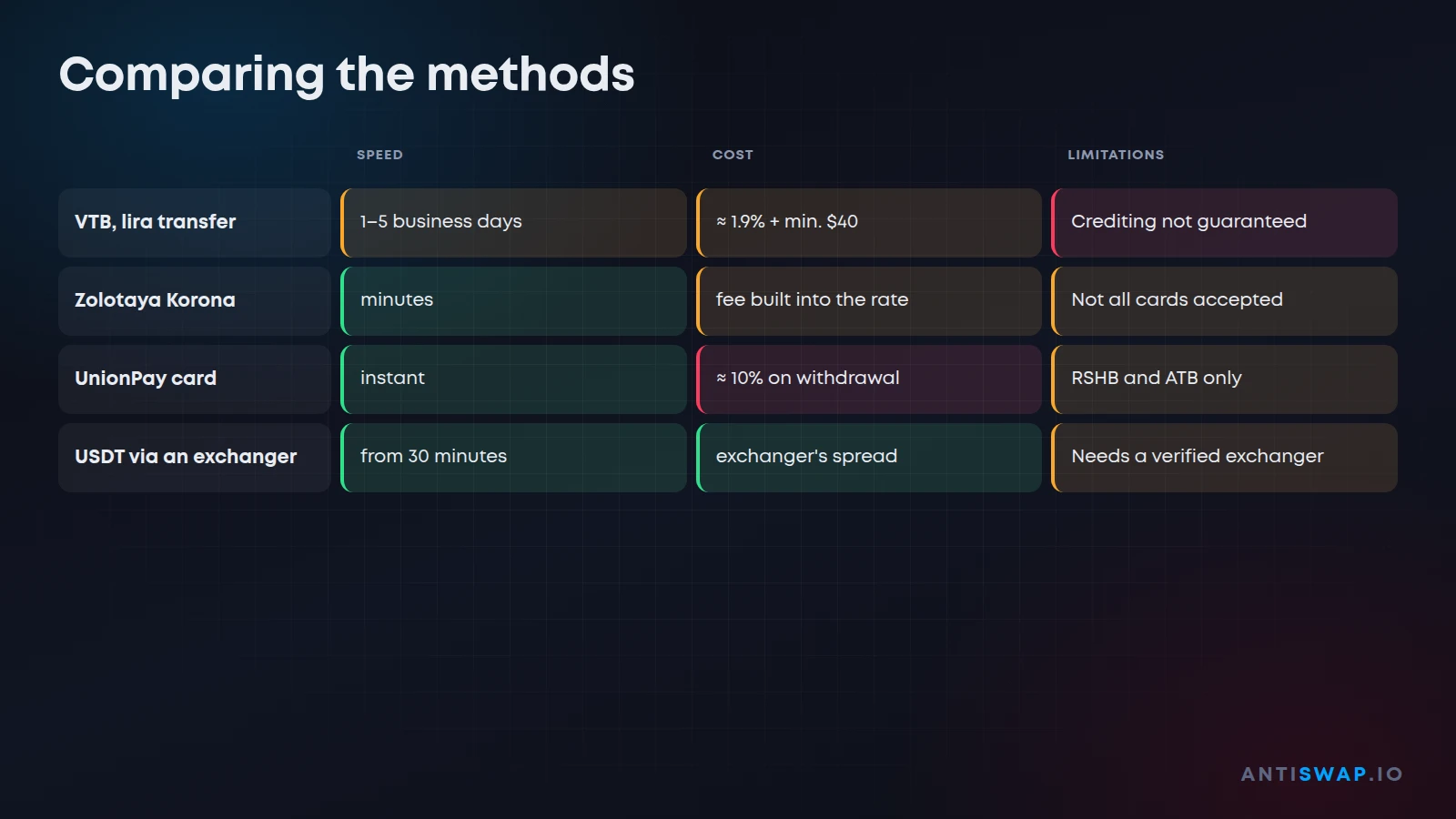
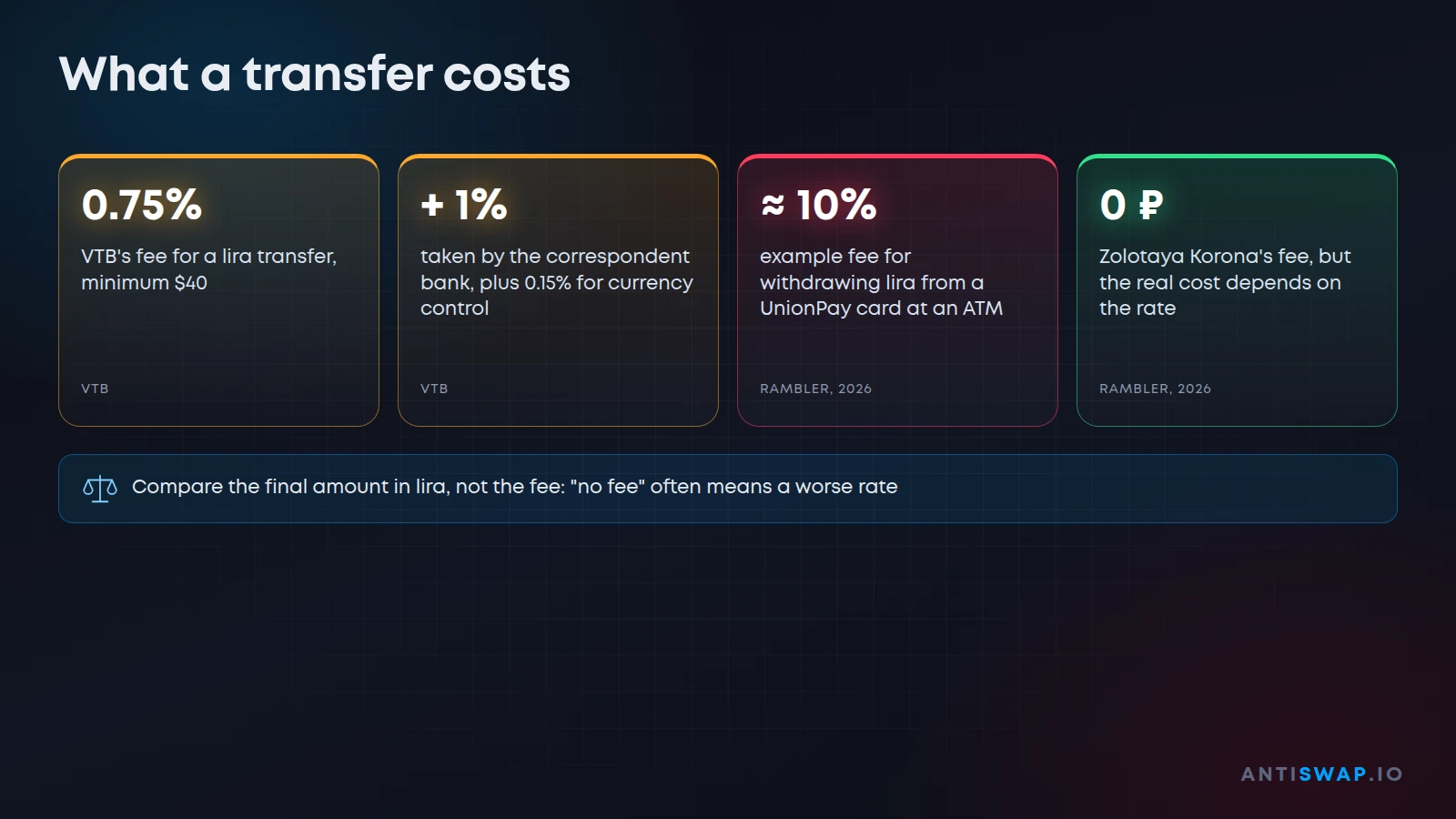
The main rule: compare the final amount in lira, not the fee. "No fee" often means a worse rate, and a "cheap" bank transfer can bounce and cost you time. On an AntiSwap direction page, exchangers are sorted by rating, and you see right away how many lira you'll get for your amount.
Risks and how to avoid them
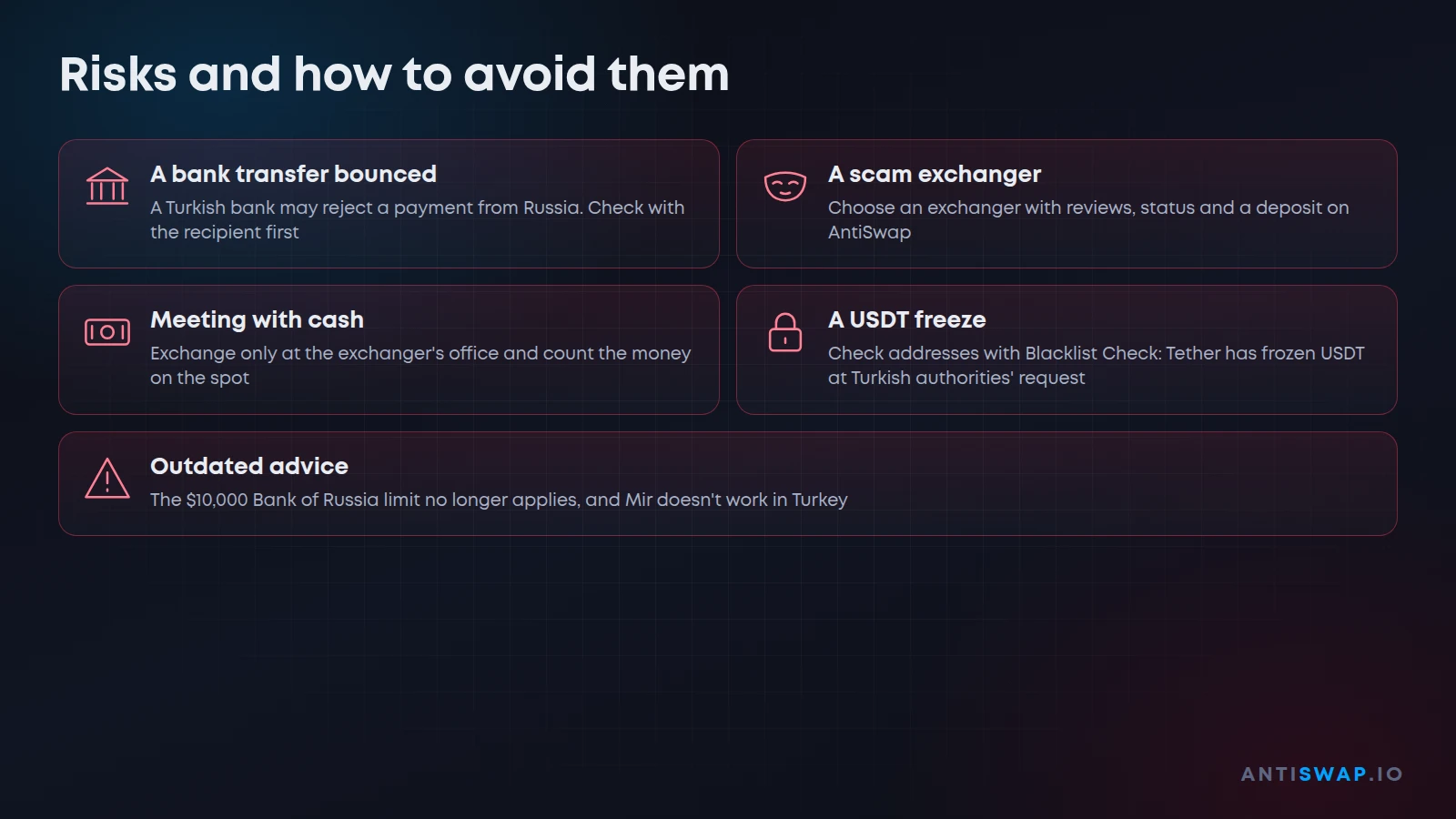
- A bank transfer bounces. Ask the recipient whether their bank accepts transfers from Russia, and start with a small amount.
- A scam exchanger. Check the status, reviews and deposit on AntiSwap. We explain why it matters in "Can an exchanger fail to return your crypto?".
- Cash at a meetup. Exchange only at the exchanger's office and count the money on the spot.
- Frozen USDT. In early 2026 Tether froze $544 million at the request of Istanbul prosecutors. Check addresses with our Blacklist Check and read whether Tether can freeze USDT.
- "Dirty" crypto. If you're not sure where the coins came from, read "Dirty crypto: what it is, how to check it and what to do".
Checklist before you send
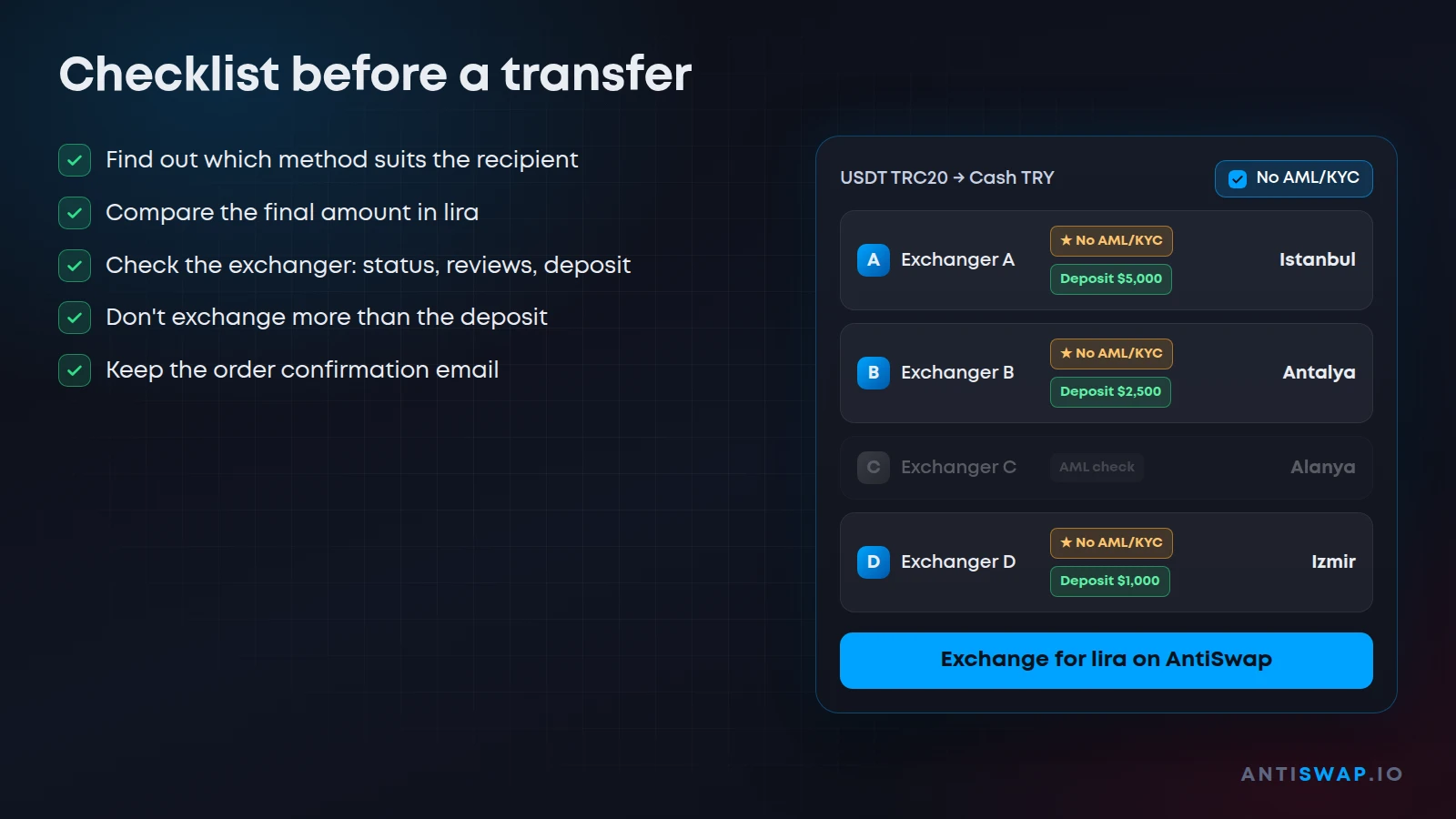
- Ask the recipient how they'd prefer to receive the money: cash, a card or an account.
- Compare the final amount in lira across all methods.
- Choose an exchanger with the "★ No AML/KYC" badge and a deposit: such exchangers don't freeze crypto on AML grounds, and if they can't complete the exchange, they return it.
- Don't exchange more than the exchanger's deposit.
- Save the order confirmation email and verify it with our email check service.
FAQ
Can I send money to Turkey through Sberbank?
Sber launched direct transfers to Turkish cards back in 2024, but the terms have changed more than once since then. Check in the app that the destination is available before sending.
Right now Zolotaya Korona, VTB lira transfers and USDT exchange work more reliably. Sber customers can also pay for purchases in Turkey by QR code.
Does Zolotaya Korona work for Turkey in 2026?
Yes. As of autumn 2026, Turkey is one of Korona's few remaining destinations. But the list of countries shrank after the EU sanctions in July 2026, so check it in the app before sending.
Money is paid out in cash lira, and the recipient's name must be in Latin letters exactly as in their passport.
Are there limits on transfers from Russia to Turkey?
The Bank of Russia's limits for Russian citizens were lifted on 8 December 2025. Banks and transfer services still have their own per-transaction and daily limits.
Bank of Russia restrictions remain only for non-residents from "unfriendly" countries.
How do I get cash lira for USDT?
Open the USDT TRC20 → cash TRY direction on AntiSwap and choose a city and an exchanger with a status, reviews and a deposit. Create an order, send the USDT and collect your lira at the exchanger's office.
The catalog has exchangers in Istanbul, Antalya, Alanya, Izmir, Mersin, Bursa, Kemer and other cities.
Can I pay with a Russian card in Turkey?
Mir, Visa and Mastercard cards from Russian banks don't work in Turkey. Rosselkhozbank and ATB UnionPay cards do, as do QR payments through the Sber and MTS Bank apps.
For large sums and cash, exchanging money through an exchanger in advance is the better deal.
Transfers to other countries
- How to send money to Uzbekistan
- How to send money to Kyrgyzstan
- How to send money to Tajikistan
- How to send money to Armenia
- How to send money to Georgia
- How to send money to the UAE
Bottom line
You can send money from Russia to Turkey in 2026, but there's no one-size-fits-all method. Zolotaya Korona suits transfers to relatives, and a bank transfer in lira confirmed by the recipient's bank suits large sums and property. The most flexible option is to exchange USDT for cash lira or a transfer to a Turkish card through a trusted exchanger. Compare rates and pick an exchanger with a star and a deposit on the USDT TRC20 → cash lira page in the AntiSwap catalog.