Can an Exchanger Refuse to Return Your Crypto?
You've sent crypto to an exchanger, and instead of rubles you get "Your order is under AML review", or nothing at all. Support asks for a passport and a video, promises to "return the funds after the check", and then stops replying. Sound familiar? Then you've already asked yourself: can an exchanger simply not return your money?
The short answer is yes. Let's look at when it happens, what exchangers write about it in their rules, what numbers we see at AntiSwap, what to do if your money isn't being returned, and how to avoid ending up in this situation.
The short answer: yes, it can
Most online exchangers in Russia still operate without a licence or regulation. No regulator can force such a service to complete an order, and the exchange rules are written by the exchanger itself. They often include the right to freeze your funds, return them only after a check, or withhold part of the amount.
And this isn't only about scammers. Money can also get "stuck" with a perfectly active exchanger with good reviews, if its AML service decides your crypto is "risky". Those are the cases we see most often in reviews on AntiSwap.
Why an exchanger may not return your money
A scam exchanger
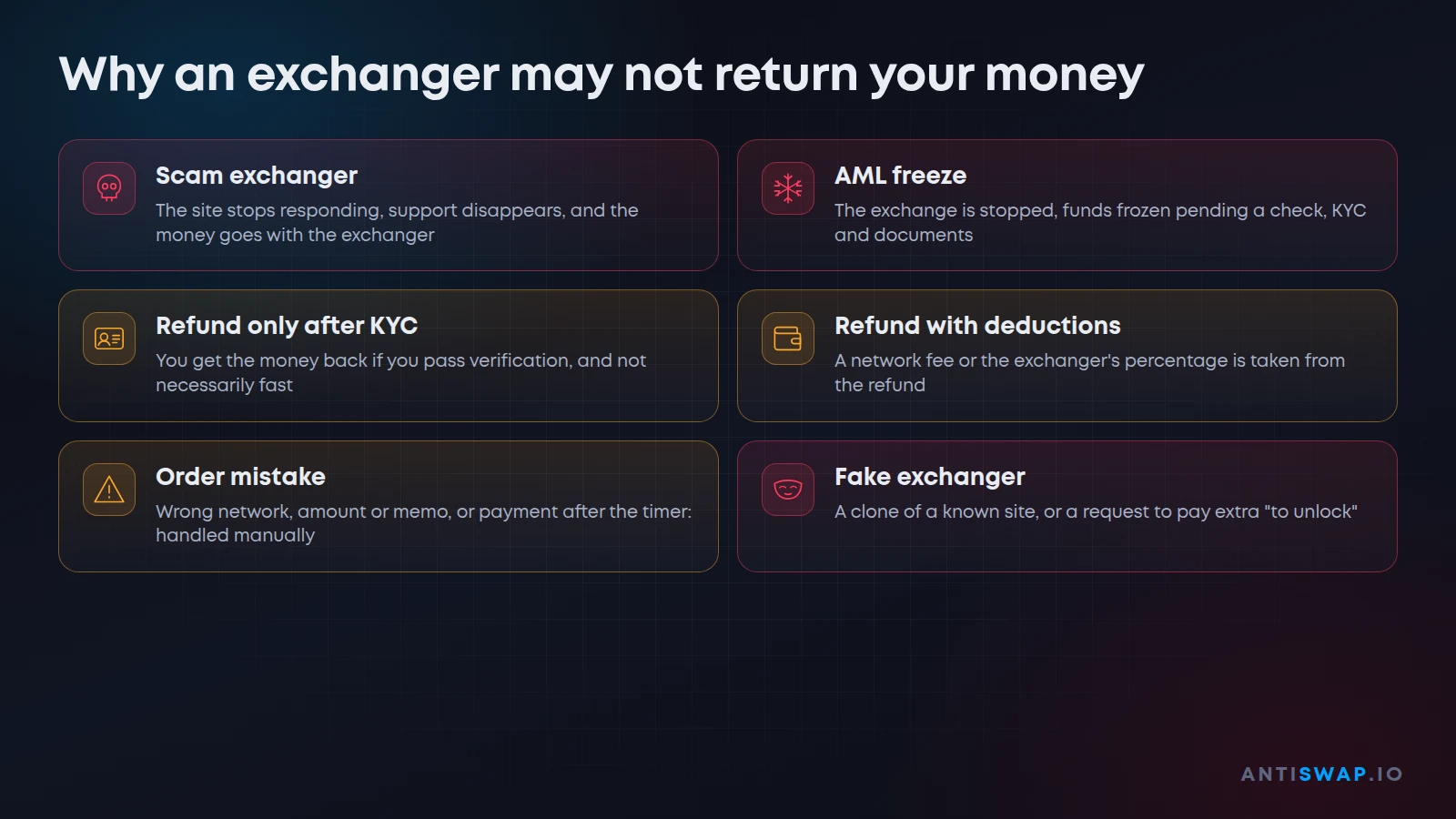
The simplest scenario: the service takes the money and doesn't complete the exchange. The site "hangs", support stops replying, and after a while the exchanger disappears or changes its name. Sometimes the disappearance is covered by a "hack". For example, the sanctioned exchange Grinex halted operations in April 2026, claiming a cyberattack and the loss of about 1 billion rubles of users' funds, and Chainalysis analysts suggested the "hack" may have been cover for draining liquidity.
An AML freeze
The most common reason. The exchanger checks incoming crypto with an AML service, sees a high risk score, stops the exchange and demands KYC: passport, selfie, video, documents on the source of funds. The exchanger sets the "high risk" threshold itself. More on how this works in "AML vs KYC: what is the difference" and "What an AML Risk Score means".
Refund only after KYC
Many exchangers promise to return the money, but only after verification and only to the original address. If you're not prepared to send documents to an unknown service, the funds stay with it. And passing verification, unfortunately, doesn't guarantee a quick refund.
Refund with deductions
Even when the money is returned, a network fee or a "processing" percentage may be deducted. This is usually written in small print in the service's rules.
An order mistake
A transfer on the wrong network, a wrong amount, a forgotten memo or payment after the timer expired: in such cases the automation doesn't recognise the payment and the order is handled manually. Exchangers' rules usually make the client responsible for wrong details.
A fake exchanger and "unlock fees"
Scammers make copies of well-known exchangers' sites, and sometimes ask you to pay a "commission", "tax" or "verification deposit" to get your money back. The rule here is simple, and Russian outlet T—Zh put it well: if they ask you for money to give you money, it's always a scam.
What exchangers' rules say
We studied the AML policies and rules of several Russian-speaking exchangers. Here are typical wordings, without names, because such clauses appear at many services, including exchangers with a good reputation.
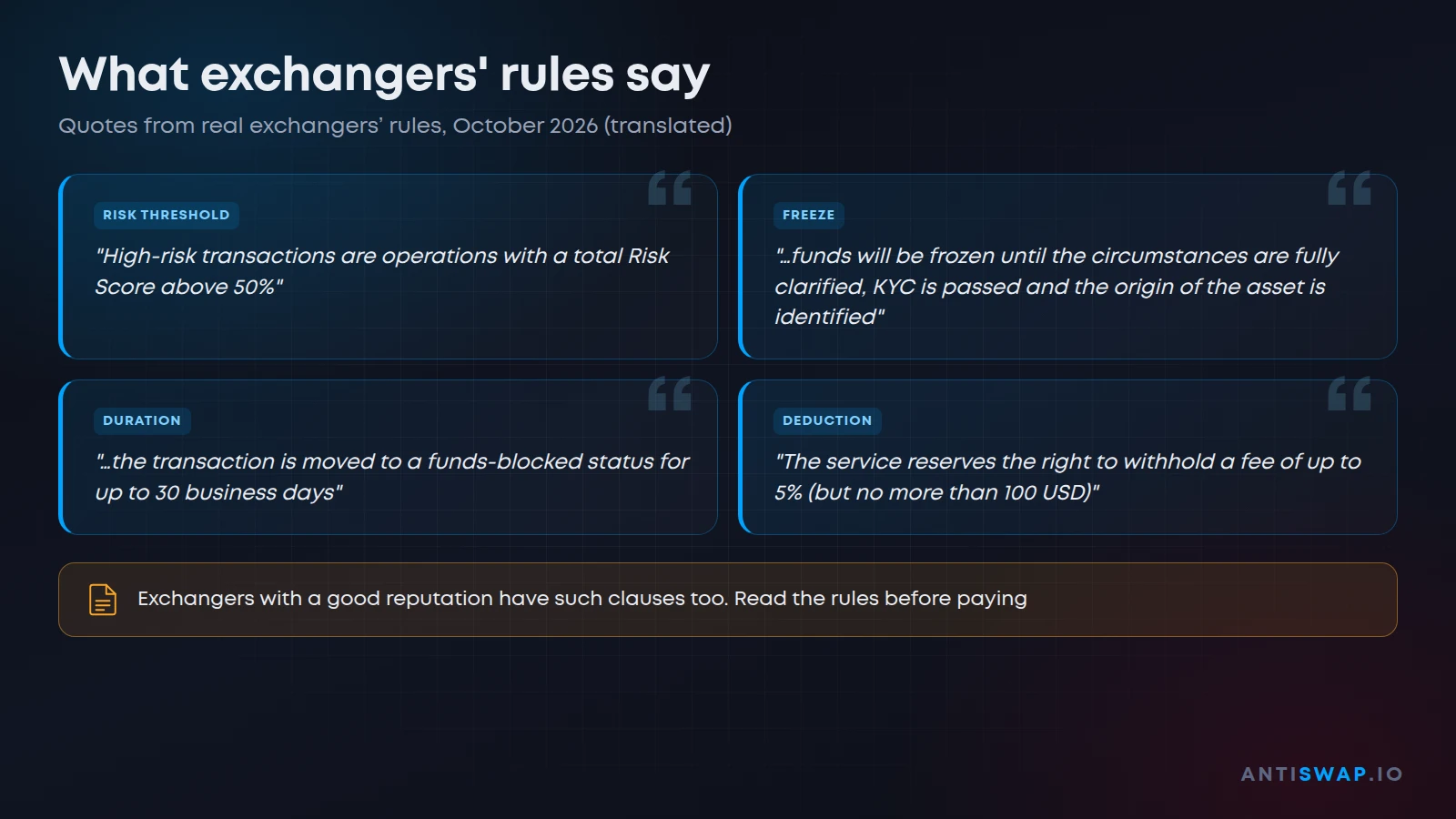
- Risk threshold: "High-risk transactions are operations with a total Risk Score above 50%". At other exchangers the threshold is 60%, 65% or 70%.
- Freeze: "…funds will be frozen until the circumstances are fully clarified, KYC is passed and the origin of the asset is identified".
- Duration: "The user is given up to 7 business days to provide documents", otherwise "the transaction is moved to a funds-blocked status for up to 30 business days".
- Where it goes back: "Refunds are, as a rule, made only to the sender's original address".
- Deduction: "The service reserves the right to withhold a fee of up to 5% (but no more than 100 USD)".
The takeaway is simple: read the refund rules before paying, not after. And it's better to choose exchangers that commit in advance not to block money on AML pretexts.
How common it is: AntiSwap numbers
We check exchanger reviews every day and move exchangers caught withholding client funds to SCAM status. Here's what our data shows as of 7 October 2026:
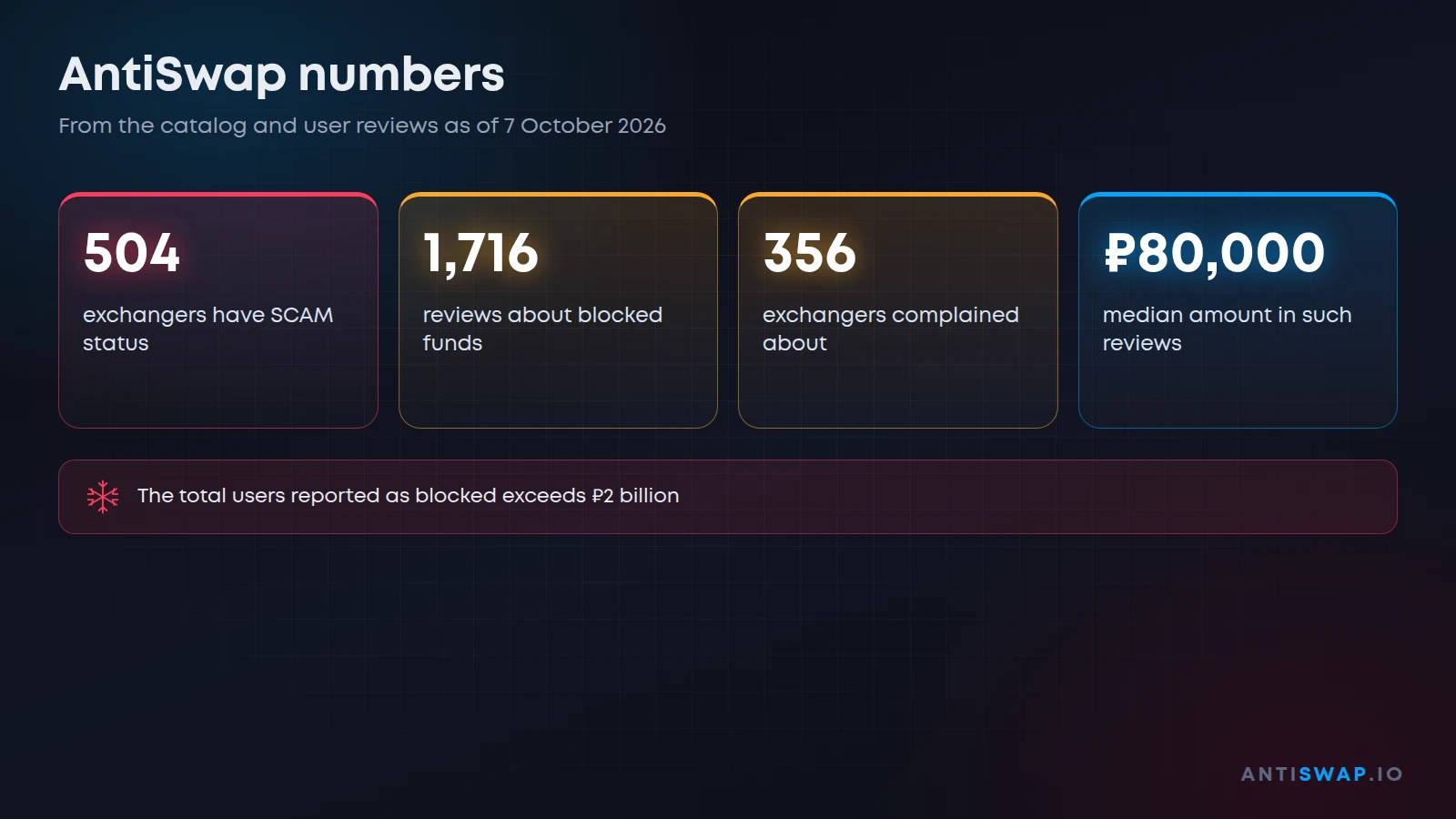
- 504 exchangers in the AntiSwap catalog have SCAM status;
- in 1,716 reviews users described an exchanger blocking their funds, and 619 of those reviews were left since the start of 2025;
- the complaints concern 356 exchangers;
- the median amount in such reviews is ₽80,000, and the total users reported as blocked exceeds ₽2 billion.
Amounts in reviews are stated by users themselves, so the total is best treated as a guideline. But the scale is clear: these aren't isolated cases. On SCAM exchangers' pages we show how much users say was blocked there.
Another example is Garantex: in March 2025 Tether froze about $27 million in its wallets, and customers lost access to their funds. That wasn't the exchanger's decision but a freeze of the USDT itself; more in "Can Tether freeze USDT?".
What the law says
The situation in Russia is changing, and 2026 brought several important developments for victims.
- Court without declaring. Previously, the law on digital financial assets granted court protection to crypto-related claims only if the owner had reported the crypto to the tax authority. On 20 January 2026 the Constitutional Court found this requirement unconstitutional for everyone except miners. Crypto rights can now be defended in court without such a report, though you still have to prove you obtained it lawfully.
- Crypto can be stolen. In June 2026 the Supreme Court Plenum explicitly added digital currency to the list of things that can be the object of theft and fraud.
- A register of exchangers. Since 1 September 2026 Law No. 282-FZ "On Digital Currencies and Digital Rights" has been in force. Exchangers must join the Bank of Russia register, and on 6 October 2026 the first four organisations were added. The main bans for unlicensed operators take effect in 2027. More about the law in "Exchanger vs P2P: which is safer".
But let's be honest: if the exchanger is anonymous and operates from abroad, even a won case doesn't guarantee getting your money back. So the main protection is still choosing the right exchanger before the deal.
What to do if an exchanger won't return your money
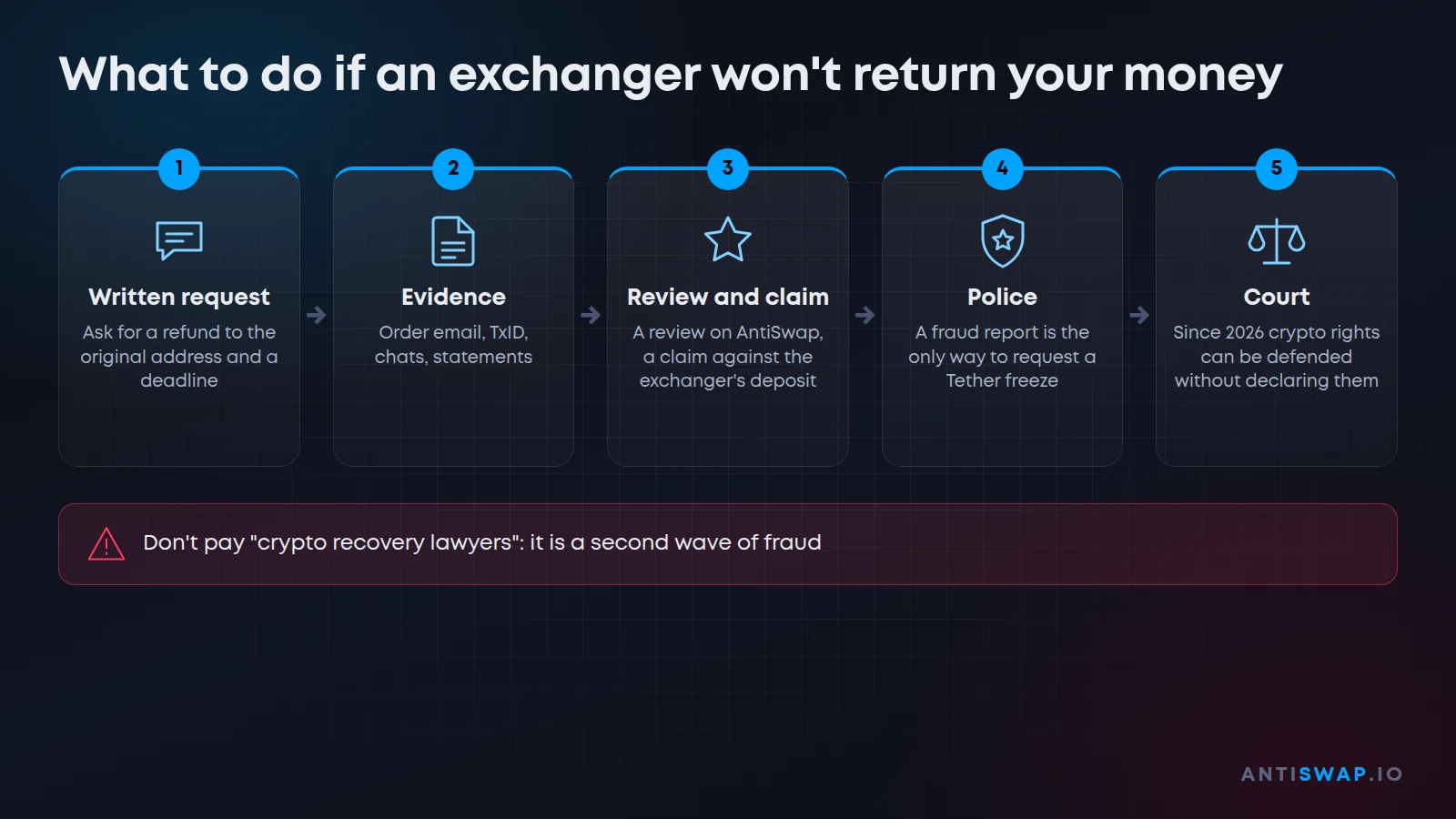
- Write to support in writing. Ask for a refund to the original address or details, and for the reason for the delay, the AML service, the risk score and a specific deadline. Cite the exchanger's own rules.
- Collect evidence. The order confirmation email, order number, transaction hash, chat screenshots, bank statements. Verify the email with our email check service: a genuine email with order details is the main evidence in a dispute.
- Leave a review on AntiSwap. We check every review, and publicity often speeds things up. If the exchanger has an insurance deposit on AntiSwap, you can file a claim: if non-payment is proven, the administration pays compensation from the deposit up to the amount of the claim.
- Go to the police. If it's clear fraud, file a report. Only through law enforcement can a Tether freeze of USDT on the scammers' addresses be requested; Tether doesn't accept requests directly from victims.
- Consider court. For a large amount and a known exchanger owner, it makes sense to see a lawyer and file an unjust enrichment claim.
Beware of "crypto recovery services". Victims are often approached by "lawyers" and "hackers" who promise to recover the money for an upfront fee. It's almost always a second wave of fraud.
How not to be left without your money
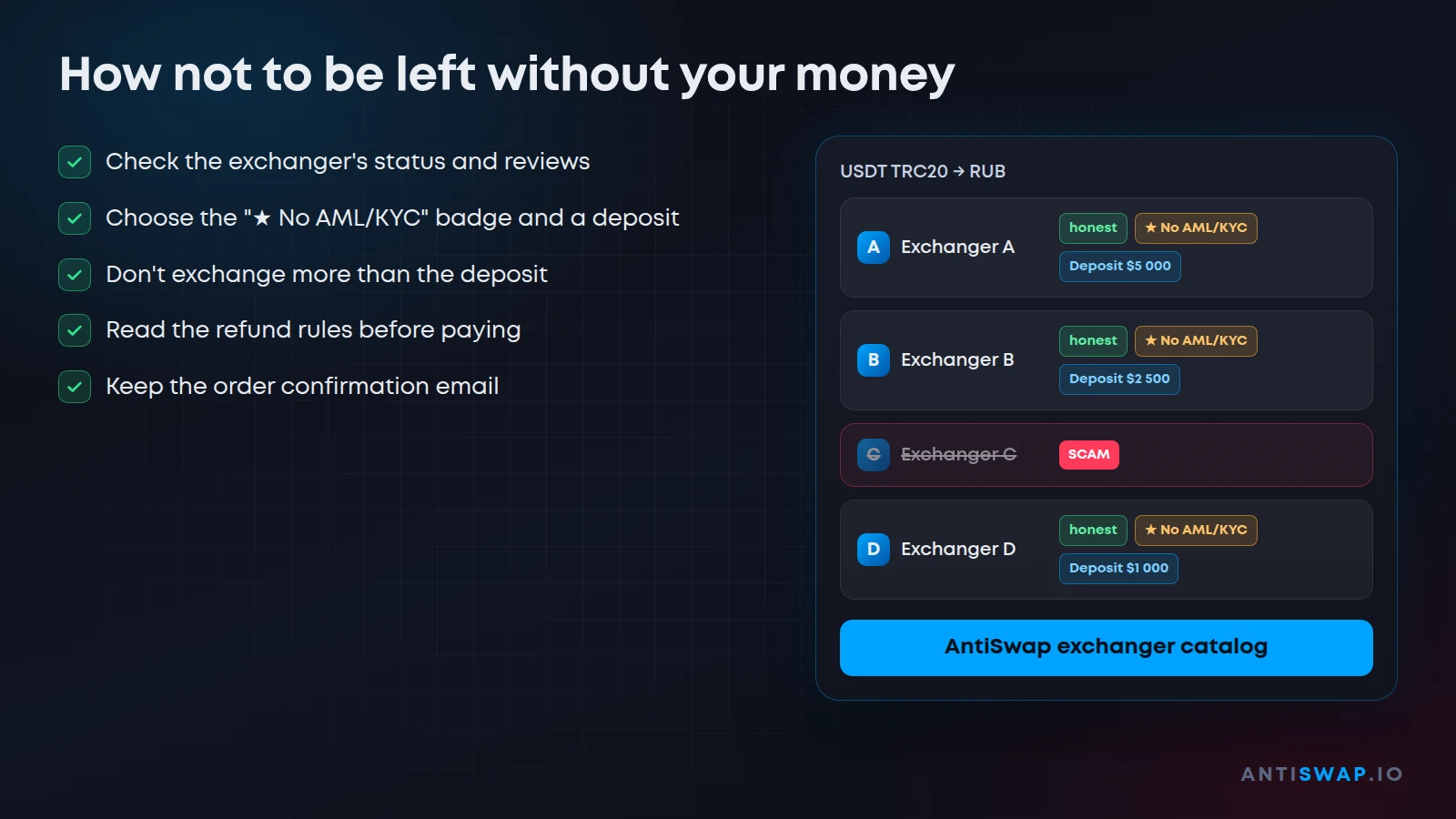
- Check the exchanger's status in the AntiSwap catalog. Exchangers caught withholding funds get SCAM status. But "honest" status isn't a guarantee either: it only means there have been no withholding complaints so far.
- Read reviews, especially recent negative ones. Some reviews are hidden due to legal restrictions; you can see them in the AntiSwap Chrome extension.
- Choose exchangers with the "★ No AML/KYC" badge: they commit not to block money on AML pretexts and have posted an insurance deposit of at least $1,000. Turn on the "Only without AML/KYC" filter, for example on the USDT TRC20 → Sberbank RUB direction.
- Don't exchange more than the exchanger's deposit. Then the deal is fully covered. Split a large amount into several exchanges.
- Ask about the refund rules before exchanging: what happens to your crypto if the exchanger considers it risky, and where and when it will be returned.
- Check USDT against the blacklist with our Blacklist Check to make sure the coins aren't blocked by Tether itself.
The full list of tips is on the "Recommendations for users" page, and we covered normal exchange times in "How long a crypto exchange usually takes".
FAQ
Does an exchanger have the right to freeze my money?
Formally, an exchanger acts under its own rules, and many explicitly include the right to freeze funds pending a check. By accepting the rules when creating an order, you agree to them.
But a "right" under a service's rules isn't the same as legality. If an exchanger withholds money without grounds and doesn't return it, that may be fraud. That's why keeping all the evidence matters.
The exchanger wants my passport and a video. Should I send them?
It's your call, but consider the risks: documents often go to an anonymous service, demands can grow, and a refund after verification isn't guaranteed.
Before sending anything, ask in writing for the AML service, the risk score and the review deadline. And read reviews of the exchanger: if other clients passed KYC and still didn't get their money, that's a warning sign.
The exchanger asks me to pay extra to unlock my funds. Is that normal?
No. Real services don't ask you to pay to get your own money back. A request for a "deposit", "insurance" or "tax" is a classic sign of fraud.
Don't pay, keep the chat and leave a review on AntiSwap to warn others.
Can I get my money back through the courts?
You can try. Since January 2026 the Constitutional Court has removed the requirement to declare crypto in order to defend it in court, and the Supreme Court has recognised it as an object of theft.
In practice, though, it all depends on whether the exchanger's owner is known and where they are. With an anonymous service abroad, even a won case may achieve nothing. So it's more reliable to choose an exchanger with a deposit in advance.
How does compensation from a deposit on AntiSwap work?
Exchangers with the "★ No AML/KYC" badge post an insurance deposit of at least $1,000, held by the AntiSwap administration. If a client proves they transferred funds and received nothing in return, the administration pays compensation from the deposit.
Compensation doesn't exceed the amount of the claim, and with several simultaneous claims the deposit may be split among the victims. The main evidence is a genuine email with the order details.
Bottom line
Yes, an exchanger can refuse to return your crypto: disappear, freeze the funds on an AML pretext, return them only after KYC, or with deductions. In the AntiSwap catalog alone, 504 exchangers have SCAM status, and users have left more than 1,700 reviews about blocked funds. It's easier to protect yourself in advance: choose exchangers in the AntiSwap catalog with the "★ No AML/KYC" badge and a deposit, read reviews and refund rules, and don't exchange more than the deposit. And share this article with anyone else who exchanges crypto.