Can an Exchange Block Withdrawals Without KYC?
You've used an exchange for years, then one day you press "Withdraw" and see: "Withdrawals temporarily unavailable. Complete advanced verification." Or the exchange has already checked your passport, but after another deposit it still blocks your funds "for review". Can an exchange do this? Yes. And in 2026 it happens more often than ever.
Let's look at why exchanges require KYC, when they block withdrawals, how long such a block can last, what to do if your money is already "stuck", and how not to depend on exchange verification.
The short answer: yes, it can
A centralized exchange keeps your crypto in its own wallets, and what you see in your account is only a balance record. So the exchange can restrict withdrawals at any moment, and that right is written directly into its user agreement. A KYC demand is the most common reason for such a block, but not the only one: withdrawals can be stopped even for a fully verified user.
We explained how this differs from a block at an exchanger and from a freeze of the USDT itself in "Can an exchanger refuse to return your crypto?" and "Can Tether freeze USDT?".
How exchanges arrived at mandatory KYC
A few years ago you could trade and withdraw on major exchanges without a passport. Now verification is mandatory almost everywhere, and unverified users are mostly left with one option: withdrawing what's already in the account.
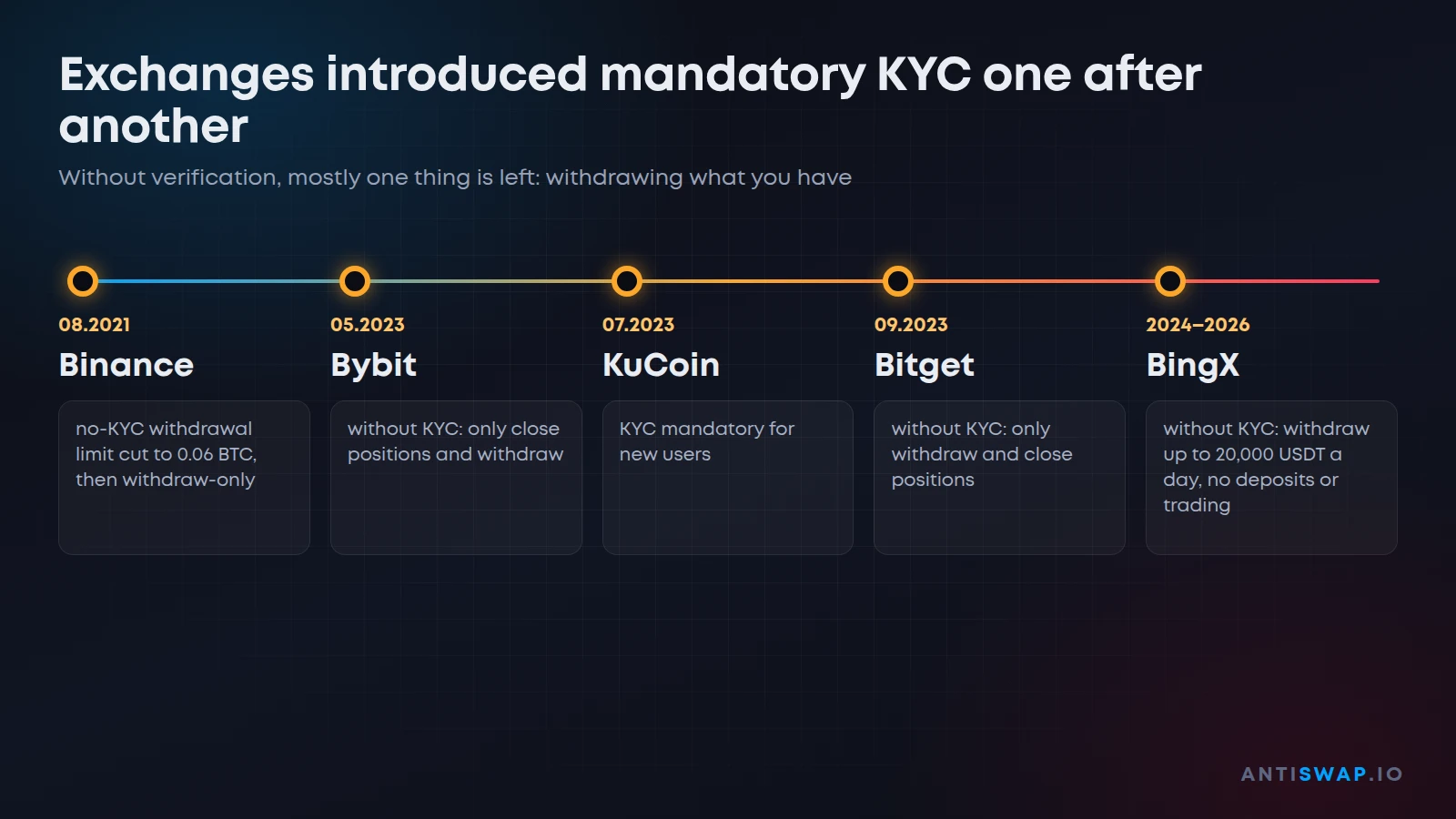
- Binance in August 2021 cut the withdrawal limit for unverified accounts to 0.06 BTC a day and put them in withdraw-only mode.
- Bybit introduced mandatory KYC on 8 May 2023: without verification you can only close positions, repay loans and withdraw.
- KuCoin has required KYC from new users since July 2023, and Bitget from all users since September–October 2023.
- BingX still lets unverified users withdraw up to 20,000 USDT a day, but without deposits or trading.
The reason is regulation. FATF international standards require crypto services to know their customers, and since late 2024 the EU has applied MiCA rules and the Travel Rule, under which sender and recipient data are passed on for transfers of any amount.
When an exchange blocks withdrawals
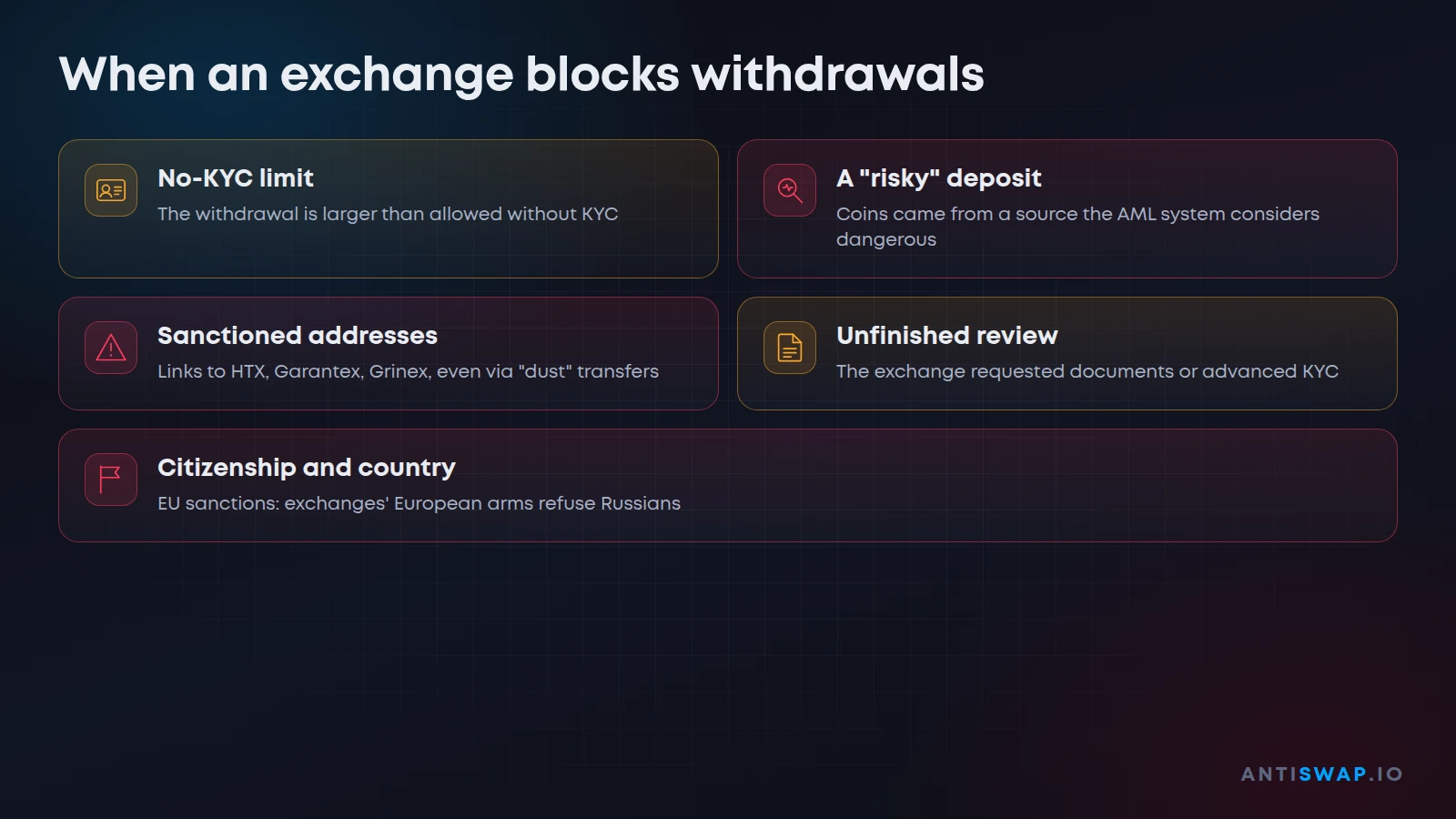
An amount above the no-KYC limit
If an exchange still allows use without KYC, it does so with limits. As soon as a withdrawal exceeds the limit, the system demands verification.
A "risky" deposit
Exchanges screen incoming transfers with AML systems. If coins came from a source considered high-risk, withdrawals can be blocked even for a verified user. In September 2026 OKX CEO Star Xu warned that the exchange may restrict funds for 15 days or longer for deposits from such sources, and admitted the system sometimes wrongly flags honest users. We explained what the risk percentages in such checks mean in "What an AML Risk Score means".
Links to sanctioned addresses
Exchanges are especially strict about coins linked to sanctioned platforms: HTX, Garantex, Grinex. And you can get "tainted" without doing anything. In August 2026, Kraken customer addresses received about 12,000 small transfers from HTX-linked wallets, and the exchange temporarily restricted some accounts.
An unfinished review
An exchange can request advanced KYC, source-of-funds documents or statements at any time. Until you provide them, withdrawals stay blocked. MEXC explicitly names incomplete advanced verification as one of the reasons for restrictions.
Citizenship and country
Russians face a separate risk. The EU's 19th sanctions package banned European crypto services from serving Russian citizens and residents. After that, Bybit EU refused re-verification even to a Russian with an EU residence permit who had previously passed KYC with the same documents.
What exchange rules say
Exchanges secure the right to block withdrawals in their user agreements. For example, OKX's terms (version of 17 September 2026) say:
- the user agrees to provide the information the exchange requires, and if they refuse or don't do so in time, OKX may suspend or terminate access to the account without notice (clause 4.16);
- the exchange may freeze assets in the account and suspend access to the platform if it suspects a violation "at our sole discretion" (clause 7.6);
- OKX may terminate an account at any time and for any reason (clause 7.8).
Similar clauses appear in the agreements of Bitget, KuCoin, MEXC and other exchanges. By accepting the rules at sign-up, you agree to them.
How long a block can last
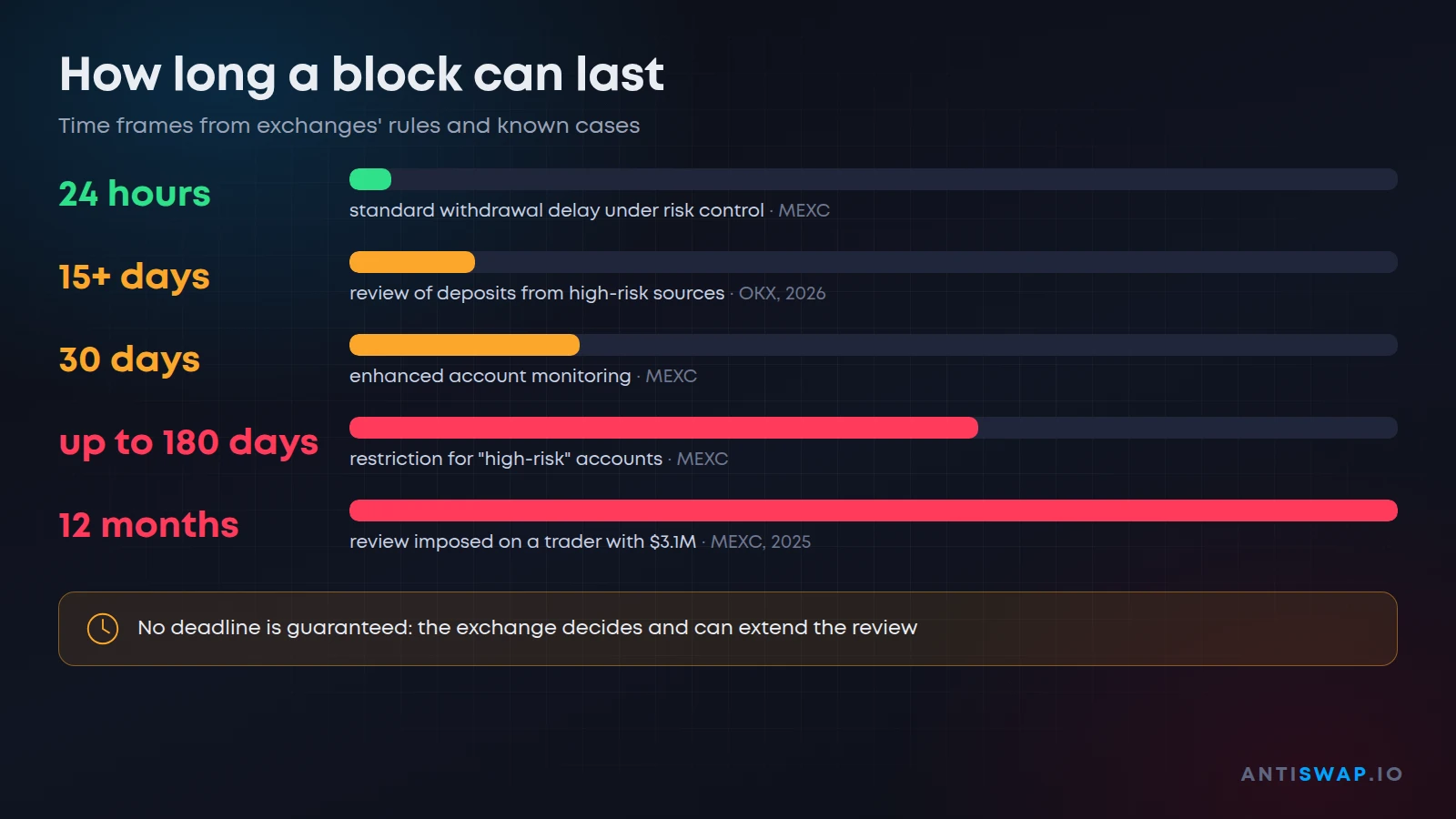
Exchanges don't guarantee clear deadlines. Here are guidelines from rules and known cases:
- 24 hours: the standard withdrawal delay when MEXC's risk control is triggered;
- 15 days or more: OKX's review of deposits from high-risk sources;
- 30 days of enhanced account monitoring and up to 180 days of restrictions for "high-risk" accounts under MEXC's risk control rules;
- 12 months: the review period MEXC set in 2025 for a trader whose $3.1 million was frozen, along with a demand to verify in person in Malaysia.
Should you pass KYC
If a withdrawal is blocked for lack of verification, passing KYC is usually the fastest way to regain access to your money. But the decision has a cost.
- Data leaks. Even big exchanges lose customer data. In 2025 Coinbase reported that attackers bribed support staff and obtained data of 69,461 users: names, addresses, emails.
- New demands. After the passport they may ask for a selfie, a video, statements and an explanation of where the funds came from.
- No guarantee. Passing KYC doesn't protect you from a block over a "risky" deposit or sanctions.
It's your decision. But it's better not to keep more on an exchange than you're prepared to leave there for an indefinite time.
What to do if your withdrawal is blocked
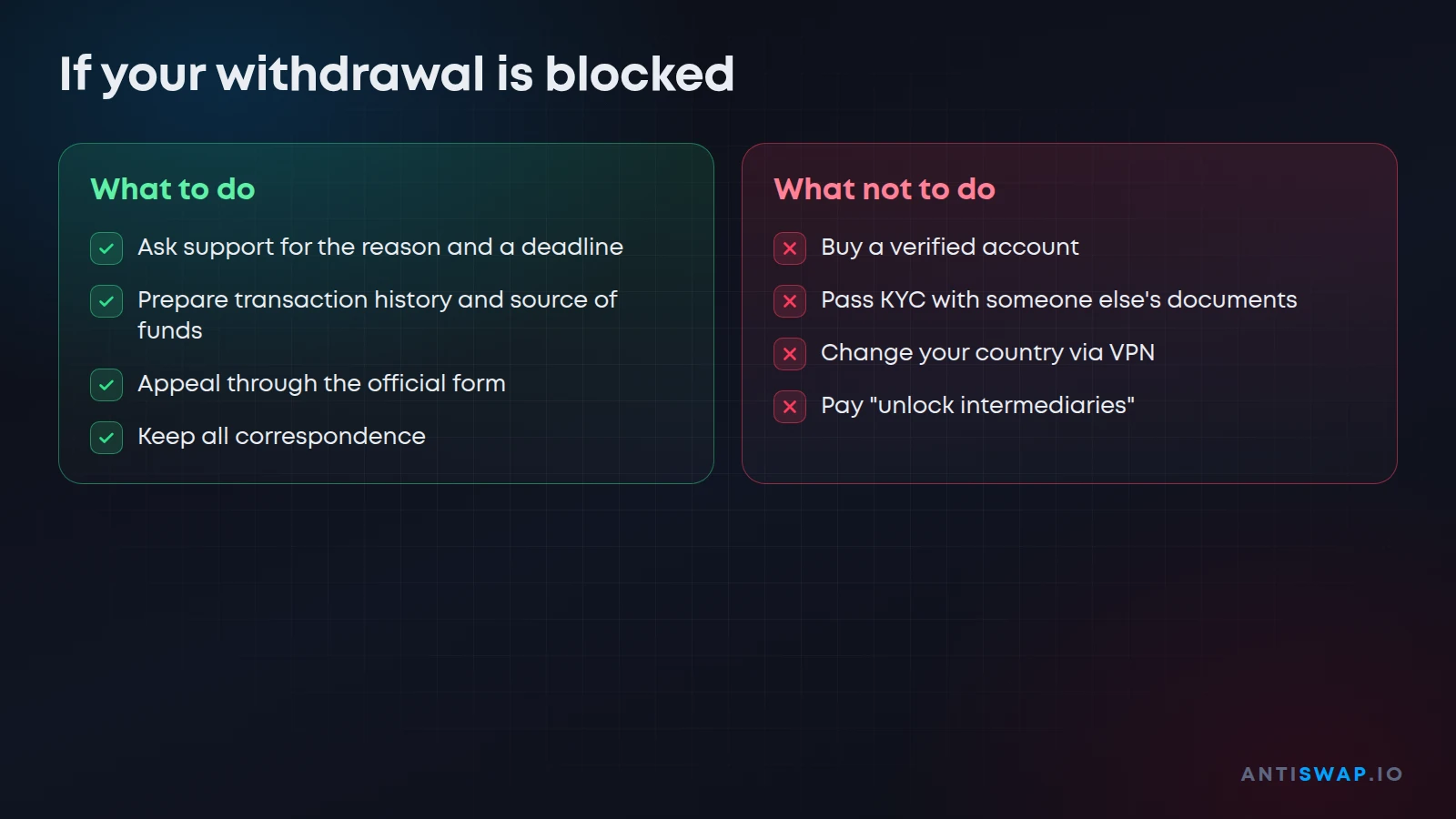
- Find out the reason. Contact support and ask for the specific reason for the block, the list of required documents and the review deadline.
- Prepare documents. Transaction history, statements, crypto purchase receipts, chats: anything that proves the lawful origin of the funds.
- Appeal through the official form. Many exchanges have a dedicated account review section, such as MEXC's "Account Risk Review".
- Keep the correspondence and don't delete the account: it's your evidence.
What not to do:
- buy a "verified" account: it will be blocked, and you may become an accomplice in money laundering;
- pass KYC with someone else's documents: it's a direct violation of exchange rules;
- change your country via VPN: that alone can trigger risk control;
- pay "unlock intermediaries": they are almost always scammers.
How not to depend on exchange KYC
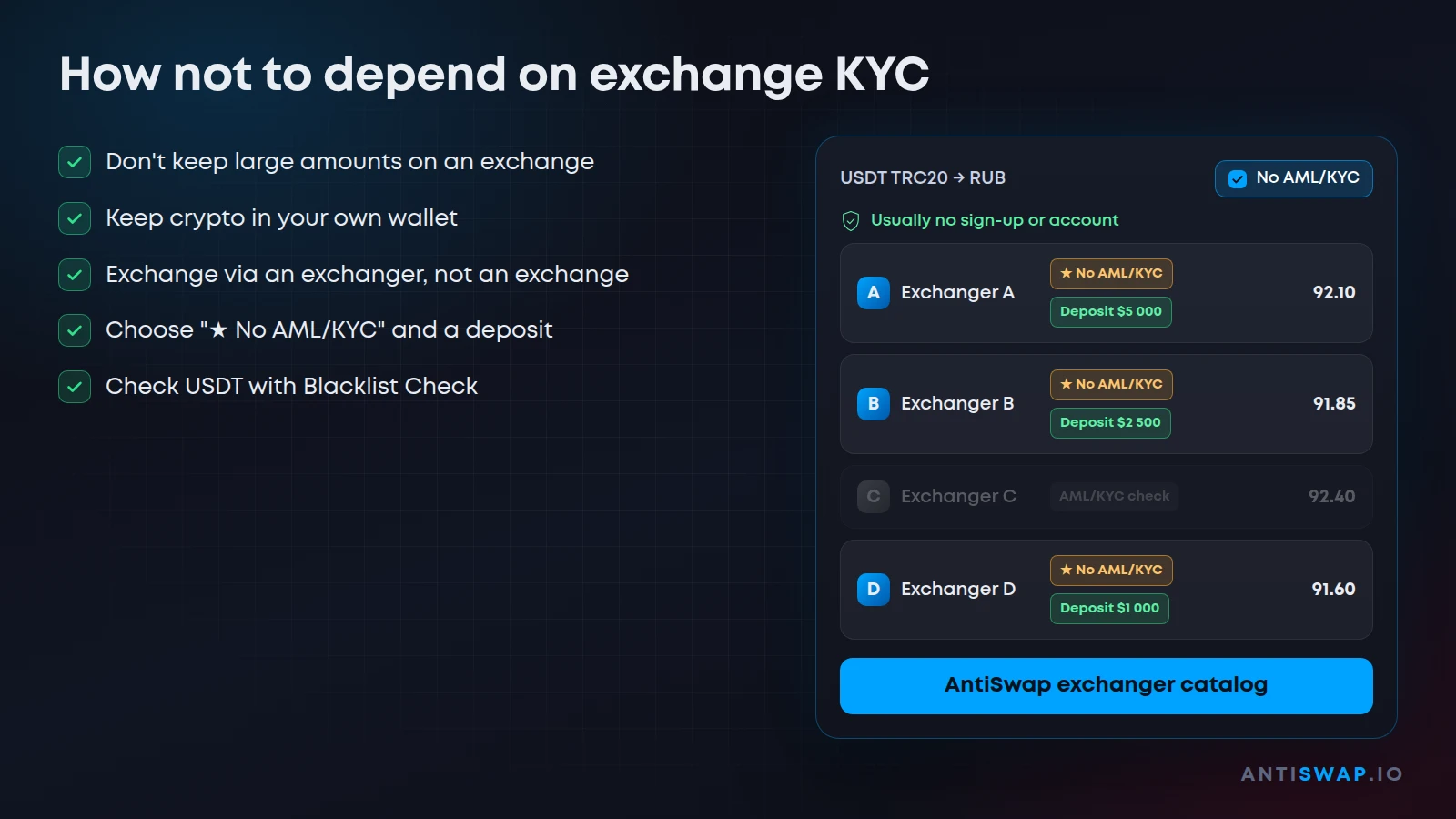
- Don't keep large amounts on an exchange. While the coins sit in its wallets, the exchange controls them. We explained why this is dangerous in "Why you shouldn't keep USDT on an exchange".
- Keep crypto in your own wallet, with keys only you hold.
- Exchange through an online exchanger rather than an exchange. An exchanger usually doesn't require an account, and an order is completed in minutes. But exchangers can also run AML checks, so choose carefully: the AntiSwap catalog lists exchangers with the "★ No AML/KYC" badge that commit not to block money on check pretexts and have posted an insurance deposit of at least $1,000. Turn on the "Only without AML/KYC" filter, for example on the USDT TRC20 → Sberbank RUB direction, and keep the amount within the deposit.
- Check where coins come from. Don't accept crypto from strangers, and check USDT with our Blacklist Check. Why deals with strangers are dangerous is covered in "Exchanger vs P2P: which is safer".
FAQ
Can an exchange block withdrawals if I've already passed KYC?
Yes. Verification confirms your identity, not the origin of every coin. If funds arrive that the AML system considers risky, or that are linked to sanctioned addresses, withdrawals can be restricted for a verified user too.
In that case the exchange usually asks for source-of-funds documents. Prepare your transaction history and receipts in advance.
Are there exchanges where you can withdraw without KYC?
Some exchanges still allow limited withdrawals without verification. For example, BingX lets unverified users withdraw up to 20,000 USDT a day, but without deposits or trading.
The rules keep getting stricter, and limits change without warning. So don't rely on them for large amounts.
How long until the block is lifted?
It depends on the exchange and the reason. It can be a day, two weeks, half a year, and in some cases a year. Exchanges aren't bound by a specific deadline and can extend the review.
The faster and more completely you provide documents, the better your chance of a quick unblock.
Can an exchange close a Russian user's account?
Exchanges' European arms must comply with EU sanctions and refuse Russian citizens and residents, even those with an EU residence permit. Global versions of exchanges work under their own rules, and those can change too.
That's why it's especially important for Russians not to keep large amounts on exchanges and to have a backup way to exchange.
Can I buy a verified account to avoid KYC?
Don't. It violates every exchange's rules: such an account will be blocked along with all funds, and the real owner of the documents can regain access at any time.
Besides, accounts in other people's names are often used for money laundering, and you risk becoming part of a criminal case.
Bottom line
Yes, an exchange can block withdrawals without KYC, and even after it. Almost all major exchanges have made verification mandatory, and withdrawals are stopped over limits, "risky" deposits, sanctions or citizenship, sometimes for months. It's easier to protect yourself in advance: don't keep large amounts on an exchange, hold crypto in your own wallet, and for exchanges choose exchangers in the AntiSwap catalog with the "★ No AML/KYC" badge and a deposit. And share this article with anyone else who keeps crypto on an exchange.