How Long a Crypto Exchange Usually Takes
You've sent USDT to an exchanger and you're waiting for rubles. Ten minutes pass, then thirty, then an hour. Is that normal, or time to worry? The answer depends on the network you pay on, the exchanger's operating mode, the bank, and whether the exchanger decides to check your coins.
Let's look at what a crypto exchange's timing is made of, how long confirmations take on different networks, which delays are normal and which should worry you. And we'll show how to use AntiSwap to pick an exchanger that won't drag out the payout.
How long an exchange usually takes
In short: with an automatic exchanger, exchanging USDT TRC20 for rubles usually takes from a few minutes to half an hour. Bitcoin takes longer, most often from half an hour to an hour, because the Bitcoin network confirms transfers more slowly. Manual mode, night hours and an AML check can stretch an exchange to hours, and in the worst case to days or weeks.
These are guidelines, not guarantees: every exchanger has its own rules. So before creating an order, it's worth checking the service's terms and other customers' reviews.
What an exchange time is made of
Every exchange through an online exchanger goes through several stages, each with its own speed.
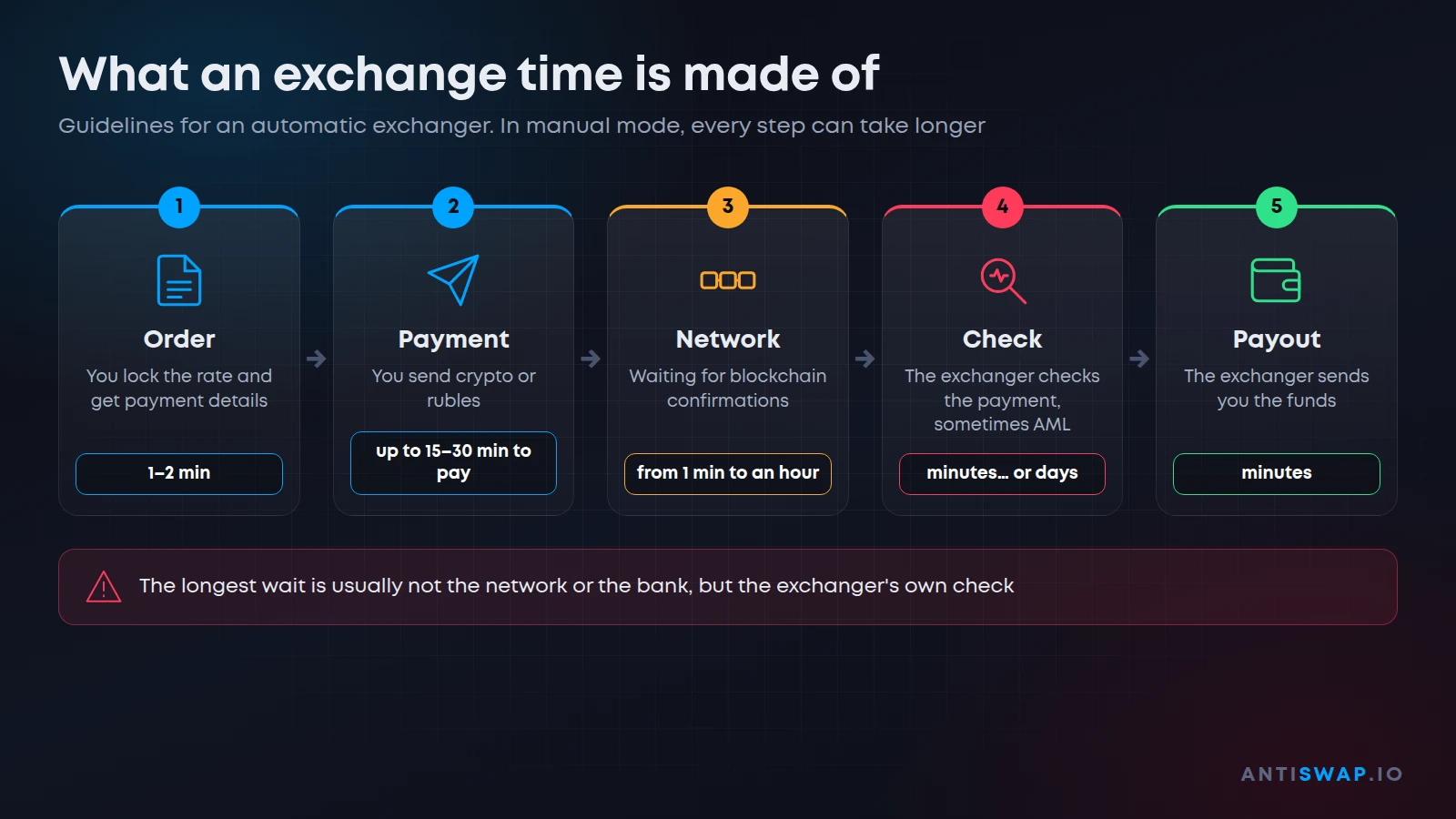
- Order. You choose a direction and enter the amount and your details. Exchangers often lock the rate for a limited time, for example 20–30 minutes, and you need to pay within it.
- Payment. You send crypto to the exchanger's address or rubles to its details.
- Network confirmations. If you pay in crypto, the exchanger waits until the blockchain confirms the transfer the required number of times. This depends entirely on the network; more below.
- The exchanger's check. In automatic mode it takes seconds. In manual mode an operator checks the payment. And if the exchanger runs an AML check and it "finds" something, this stage can stretch to days.
- Payout. The exchanger sends you rubles or crypto. An SBP transfer usually arrives instantly; crypto arrives after network confirmations.
Exchangers work in automatic, semi-automatic or manual mode. In automatic mode software handles the order end to end; in manual mode an operator does. Manual exchangers may not work at night or on weekends, so an order created at 3 a.m. may wait until morning.
How long to wait for confirmations on different networks
A blockchain doesn't credit a transfer instantly. First the transaction goes into a block, then new blocks are added on top: these are confirmations. The more there are, the more reliable the transfer, and exchangers and exchanges wait for a certain number of them.
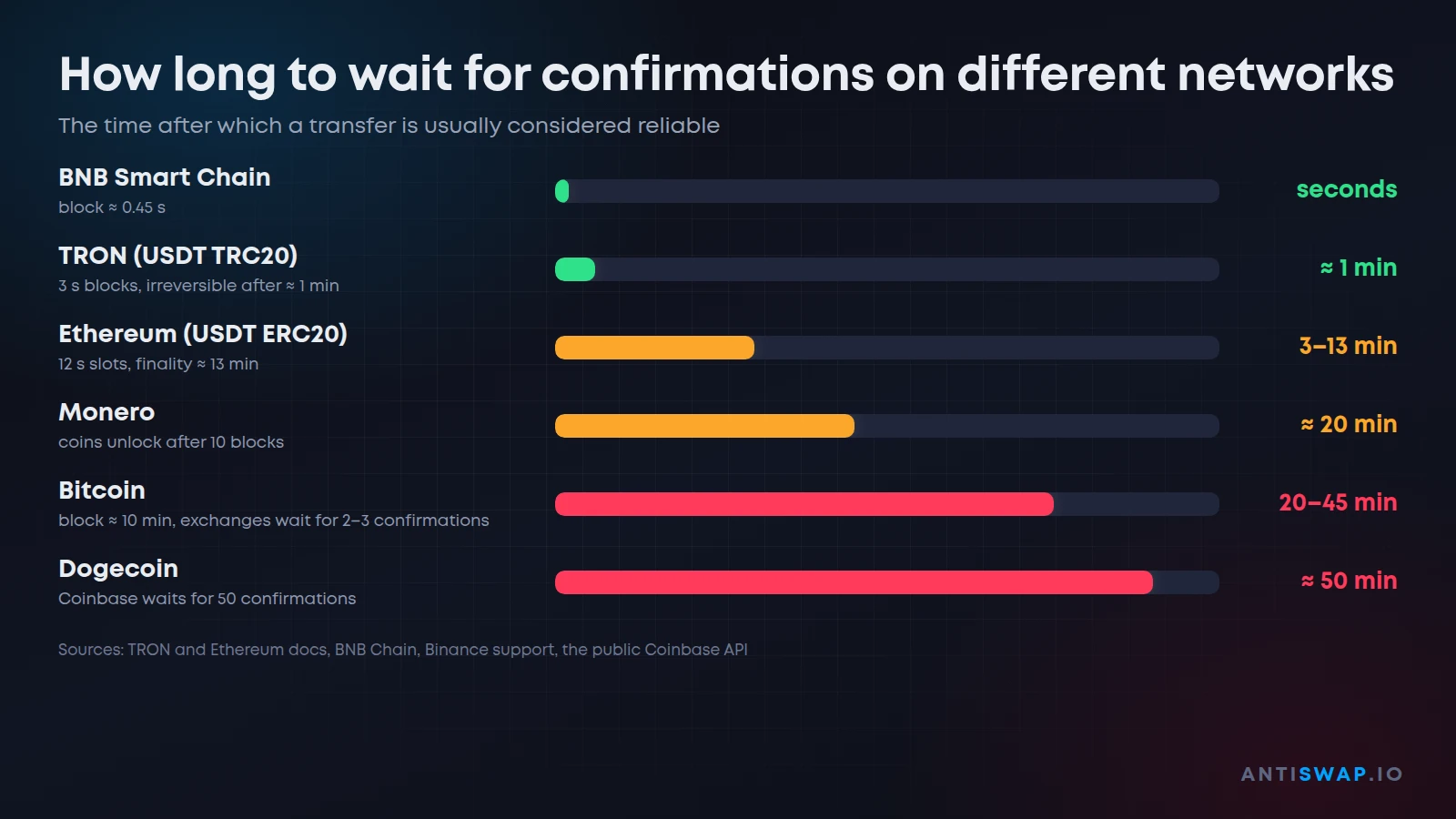
- TRON (USDT TRC20). A new block appears every 3 seconds, and a transfer becomes irreversible after about a minute. That makes USDT TRC20 one of the fastest ways to pay an exchanger. More about this network in "Tether TRC20: what it is and how to use it".
- BNB Smart Chain (USDT BEP20). Since January 2026, blocks come roughly every 0.45 seconds, so the network confirms a transfer in seconds. But platforms still wait for a few dozen confirmations: Coinbase, for example, waits for 25.
- Ethereum (USDT ERC20). A slot lasts 12 seconds, and full finality comes after about 13 minutes. Coinbase, for example, credits USDT on Ethereum after 14 confirmations, about three minutes.
- Bitcoin. A block comes on average every 10 minutes (about 9.5 minutes right now, according to mempool.space). Binance unlocks a BTC deposit after 2 confirmations, Coinbase also waits for 2, Kraken for 3. In practice that's 20–45 minutes, and longer if you're unlucky.
- Monero. A block takes about 2 minutes, but received coins can only be spent after 10 blocks, so about 20 minutes.
- Dogecoin. Blocks are fast, about a minute, but Coinbase, according to its public API, waits for 50 confirmations, about 50 minutes.
If speed matters, pay on a fast network. We covered the differences between USDT networks in "Tether USDT: TRC20, ERC20 and BEP20, what's the difference", and how a Bitcoin exchange works in "How a Bitcoin exchange works".
The bank: when rubles arrive instantly and when they don't
If the exchanger pays out rubles via SBP, the money usually arrives in seconds: the system works around the clock. But banks have their own mechanisms that can delay a transfer.
- A 2-day hold. Since 25 July 2024, banks must suspend for two days transfers to recipients in the Bank of Russia fraud database. If the client repeats the transfer afterwards, the bank executes it.
- Up to 6 hours from March 2027. Under new rules, banks will be allowed to hold a suspicious transfer for up to six hours if the client confirms it after a risk warning.
- Delayed crypto withdrawals. Under Law No. 282-FZ, from 1 September 2027 withdrawals over ₽100,000 to an external wallet will be held for 48 hours.
A separate issue is card blocks caused by "dirty" rubles in deals with strangers. That's one reason we recommend exchanging through verified exchangers rather than P2P. More in "Exchanger vs P2P: which is safer for buying and selling USDT".
What delays an exchange
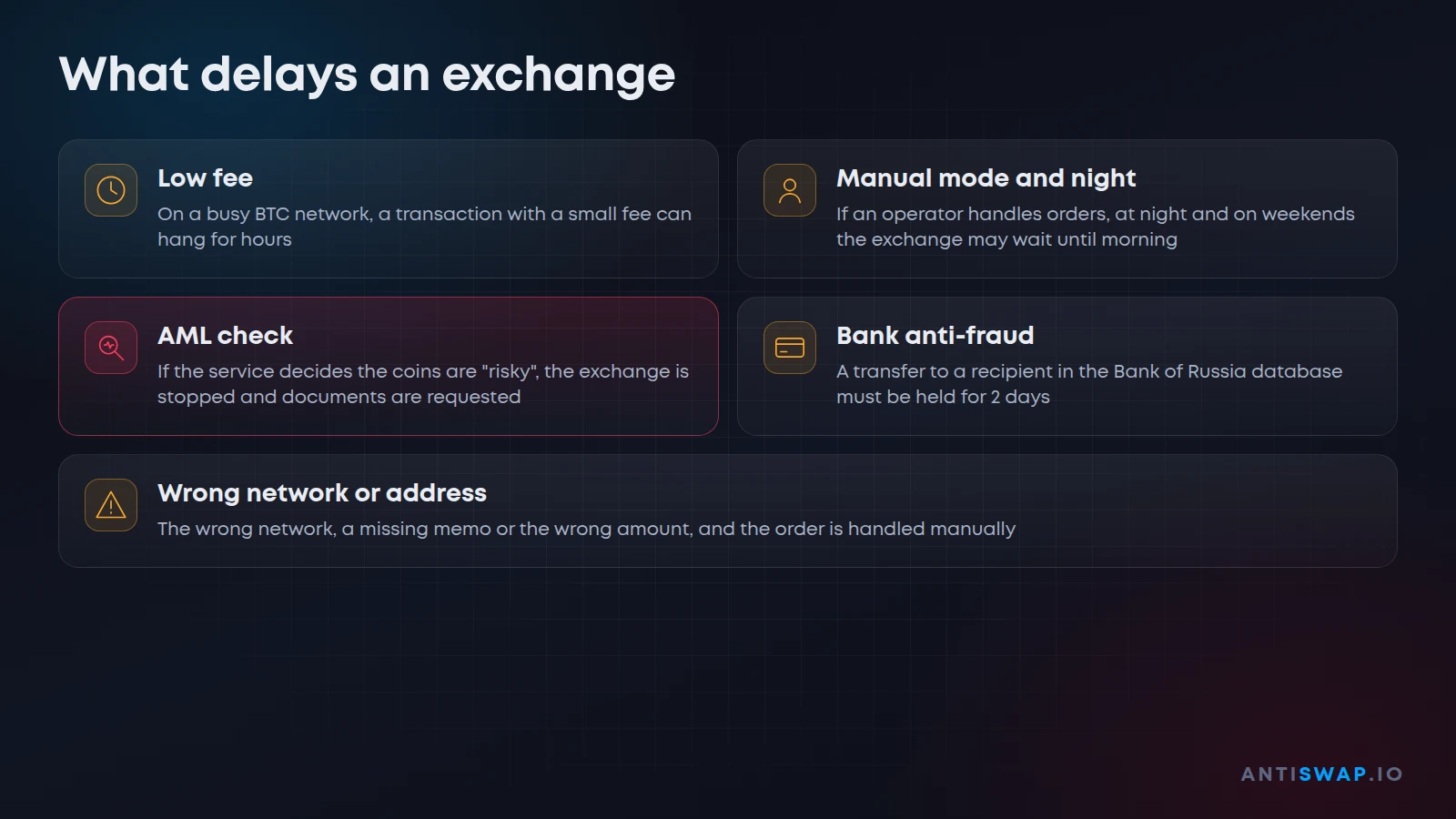
A low fee and a busy network
On the Bitcoin network, miners include higher-fee transactions first. Usually the network isn't congested, but at peak moments, such as halving day in April 2024, the average fee briefly exceeded $100, and low-fee transactions hung for hours. A stuck BTC transaction can be sped up by replacing it with the same one at a higher fee (Replace-by-Fee, enabled by default since Bitcoin Core 28.0).
Manual mode and off-hours
If an operator handles orders, speed depends on their workload and schedule. Before exchanging at night or on a weekend, check the exchanger's working hours.
An AML check
This is the nastiest and least predictable delay. If an AML service shows your coins are "risky", the exchange is stopped, the funds are frozen and documents are requested. Such a check can last days or weeks. We explained what the percentages in AML reports mean in "What an AML Risk Score means", and how an AML check turns into a KYC demand in "AML vs KYC: what is the difference".
Payment mistakes
A transfer on the wrong network, a forgotten memo or tag, an amount different from the order, payment after the timer expired: in all these cases the automation doesn't recognise the payment and the order is handled manually. Double-check the details before sending.
A normal delay or a reason to worry
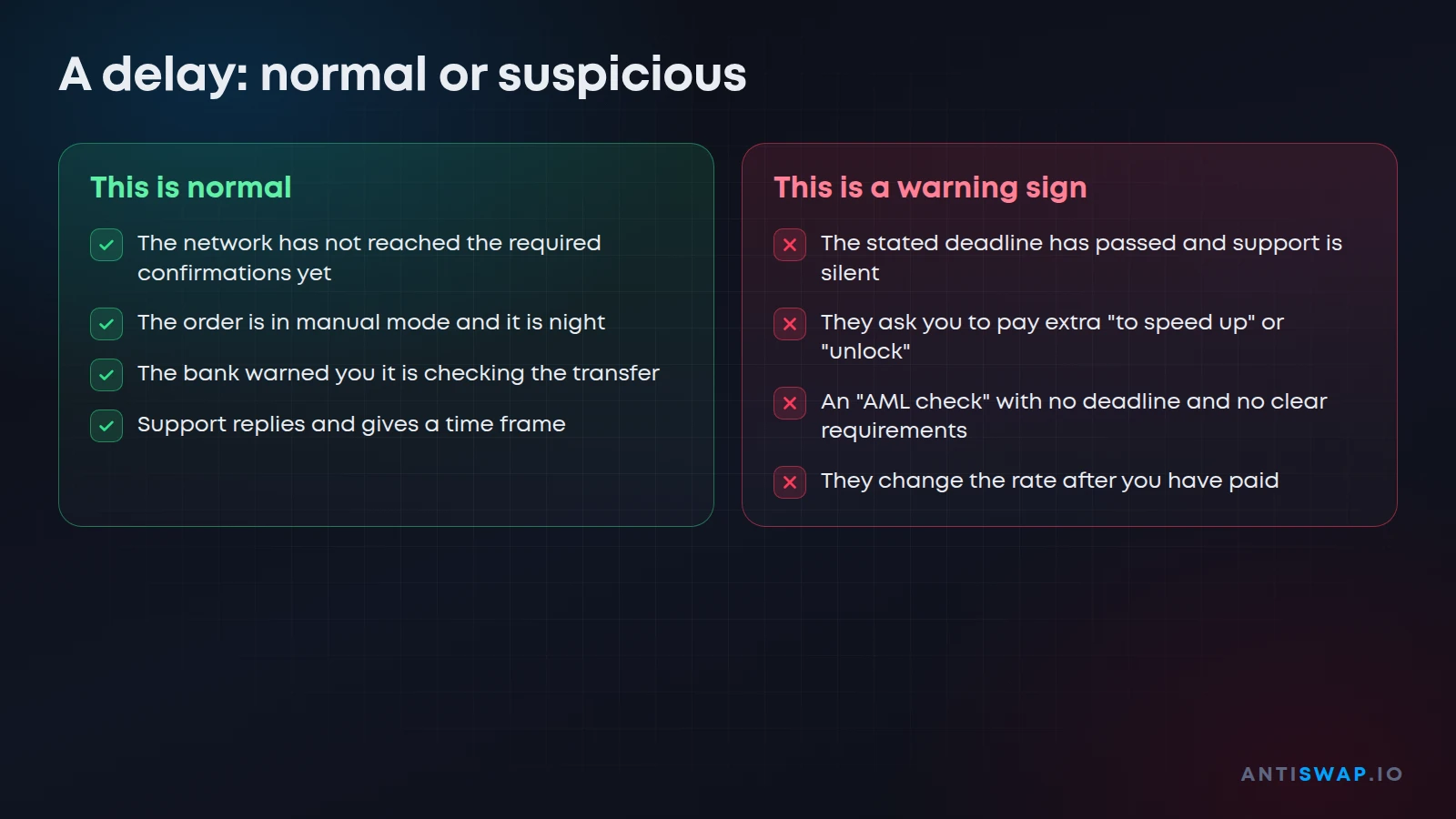
A delay is usually normal if:
- the network hasn't reached the required confirmations yet, which you can see in a block explorer by the transaction hash;
- the exchanger works in manual mode and it's night or a weekend;
- your bank has said it is checking the transfer;
- support replies, explains the reason and gives a specific time frame.
Be on guard if:
- the exchanger's stated deadline has passed and support is silent or replies with templates;
- you're asked to pay extra "to speed up", for "insurance" or to "unlock": real services don't do this;
- the exchanger cites an "AML check" but gives no deadline, service or risk score, and doesn't say which documents it needs;
- the rate is changed after you've paid the order.
In such cases, keep the chat, the order confirmation email and the transaction hash, and leave a review on AntiSwap. We check new reviews every day, and exchangers caught withholding funds get SCAM status.
How to exchange quickly through AntiSwap
An exchange goes fastest with an exchanger that works automatically, doesn't freeze funds over AML and values its reputation. AntiSwap helps you find one.
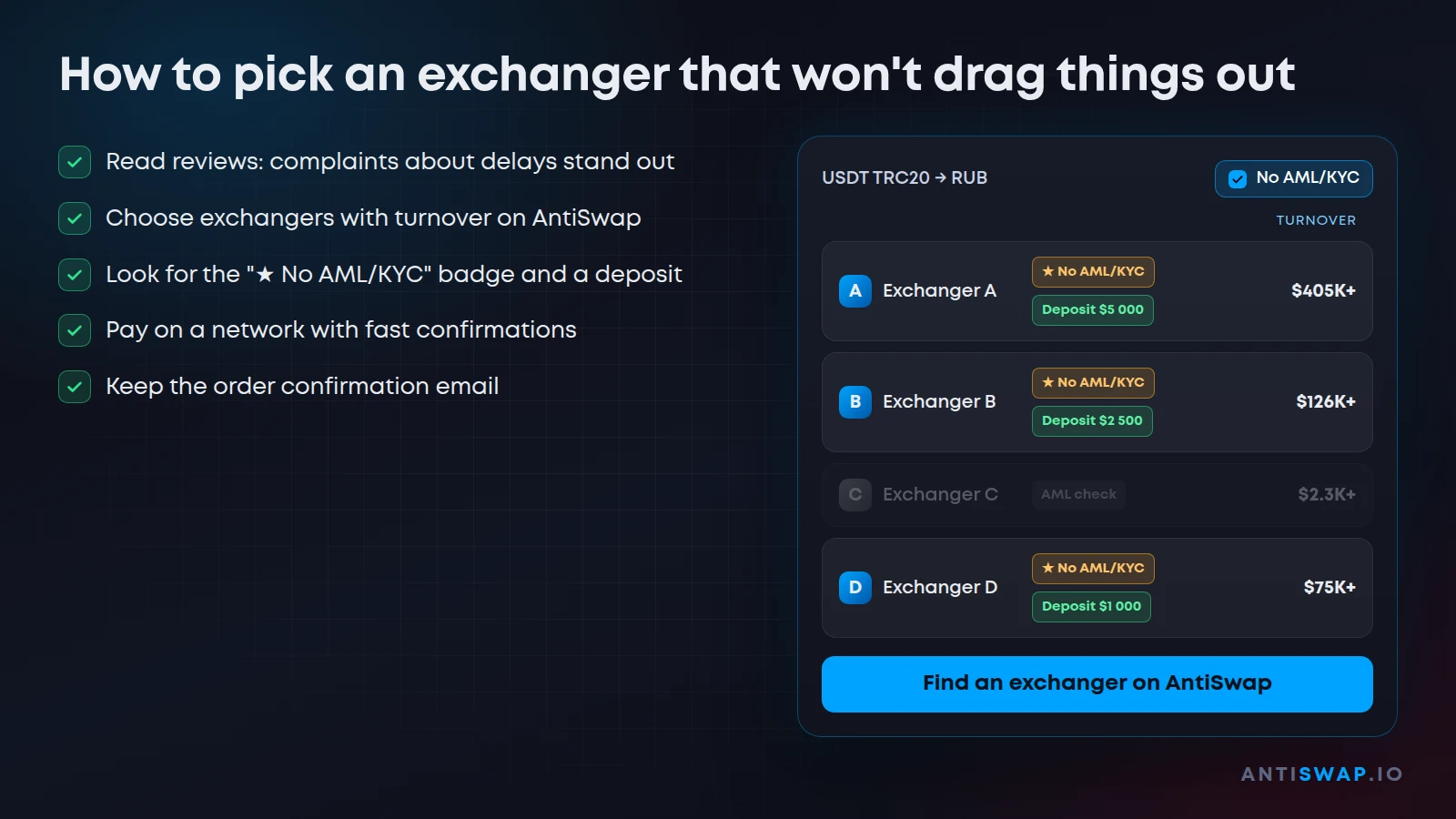
- Open the direction you need in the AntiSwap catalog, for example USDT TRC20 → Sberbank RUB, Sberbank RUB → USDT TRC20 or BTC → Sberbank RUB.
- Turn on the "Only without AML/KYC" filter. The "★ No AML/KYC" badge goes to exchangers that commit not to block money on AML pretexts and have posted an insurance deposit of at least $1,000. That removes the longest and least predictable delay.
- Look at the "Turnover" column. It's the total of exchanges AntiSwap users have already made with that exchanger. High turnover means the service really works and completes orders.
- Read the reviews. Complaints about slow exchanges and silent support stand out right away. Some reviews are hidden due to legal restrictions; you can see them in the AntiSwap Chrome extension.
- Keep the amount within the exchanger's deposit. Then, if the exchanger doesn't fulfil its side of the deal, you can be compensated from the deposit.
- Keep the order confirmation email and verify the sender with our email check service. It's your main evidence if something goes wrong.
More tips are on the "Recommendations for users" page.
FAQ
How long does exchanging USDT for rubles take?
With an automatic exchanger and USDT TRC20 payment, usually from a few minutes to half an hour: the TRON network confirms a transfer in about a minute, and an SBP payout arrives instantly.
It takes longer if you pay on Ethereum, if the exchanger works manually, or if it decides to run an AML check. To avoid the last one, choose exchangers with the "★ No AML/KYC" badge on AntiSwap.
Why does a Bitcoin exchange take so long?
A Bitcoin block comes on average every 10 minutes, and exchangers and exchanges usually wait for 2–3 confirmations. That's 20–45 minutes for the network alone.
If you sent BTC with a low fee while the network was busy, the wait can stretch to hours. In that case you can speed up the transaction with Replace-by-Fee if your wallet supports it.
The exchanger hasn't paid out for several hours. What should I do?
First check the transaction hash in a block explorer: if there are enough confirmations, the problem is on the exchanger's side. Contact support and ask for the reason and a specific deadline.
If the deadline passes with no answer, keep the chat and the order email and leave a review on AntiSwap. If the exchanger has a deposit on AntiSwap, you can file a compensation claim.
Can I speed up an exchange?
Yes. Pay on a fast network such as USDT TRC20, send the exact amount with the correct memo, pay right away while the rate is locked, and check the exchanger's working hours.
Most importantly, choose an exchanger that works automatically and doesn't freeze funds over AML. The easiest way to find one is the AntiSwap catalog with the "Only without AML/KYC" filter.
What happens if I pay after the order timer runs out?
Usually the exchanger either recalculates the exchange at the current rate or asks you to contact support for a refund. Rules differ, so check them on the exchanger's site in advance.
To avoid this, only create an order when you're ready to pay it immediately.
Bottom line
A crypto exchange with an automatic exchanger usually takes from a few minutes to an hour: USDT TRC20 is faster, Bitcoin slower. What drags an exchange out the most isn't the network or the bank but manual mode and AML checks on the exchanger's side. So the simplest way to exchange quickly and without stress is to pick an exchanger in the AntiSwap catalog with the "★ No AML/KYC" badge, a deposit, turnover and good reviews. And share this article with anyone else who exchanges crypto.