How to Send Money from Russia to the US in 2026
Sending money from Russia to the US in 2026 is probably the hardest of all transfers abroad. The largest Russian banks are under US blocking sanctions, Western Union and MoneyGram left the country back in 2022, and dollars disappeared from the Moscow Exchange in 2024. Yet relatives, students and Russians who have moved still need money.
This guide covers what changed, why bank transfers are nearly impossible, what legal alternatives exist, and how to get dollars in cash or via Zelle through an exchanger.
Quick answer: what works
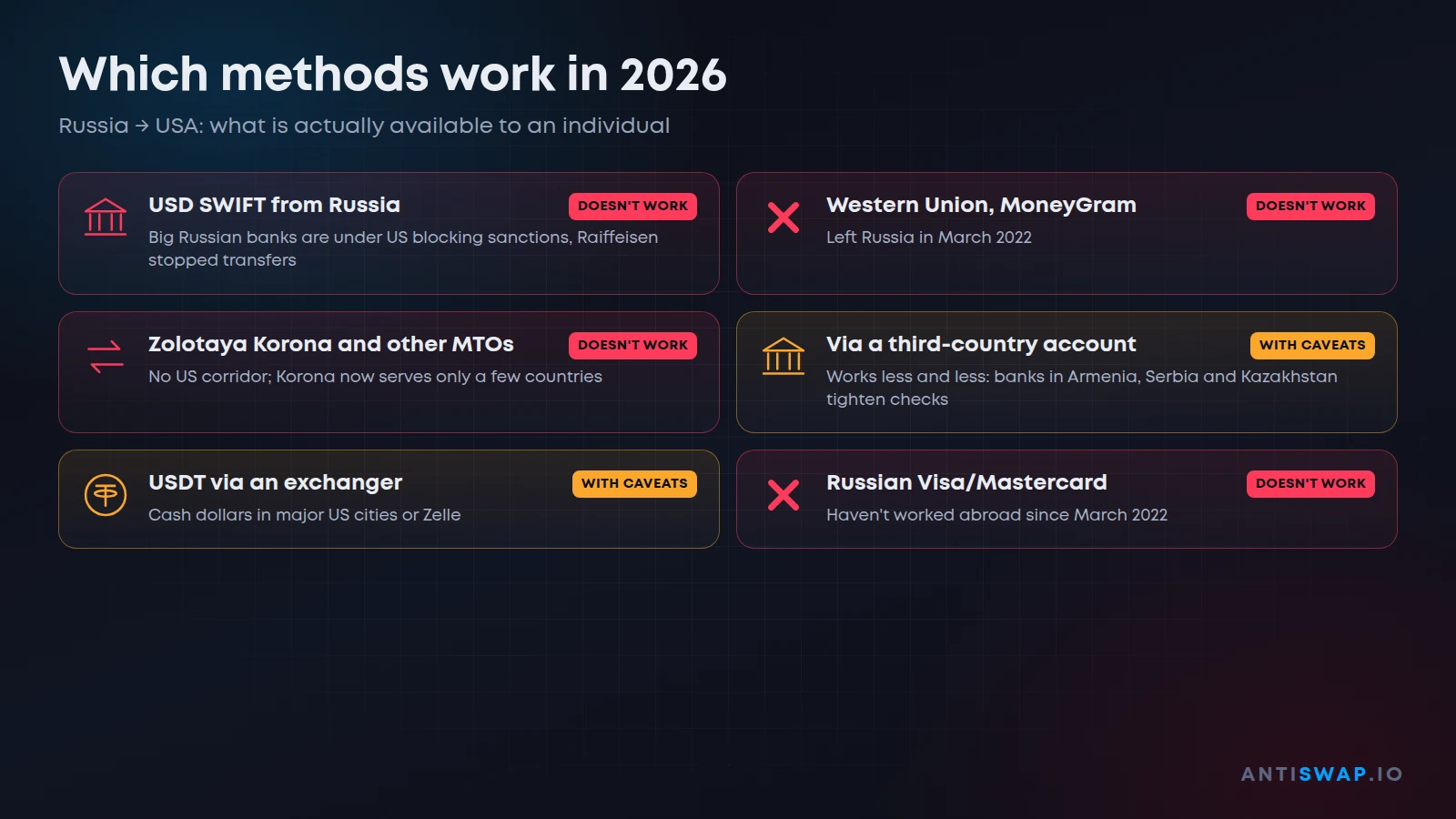
As of autumn 2026, there are few options:
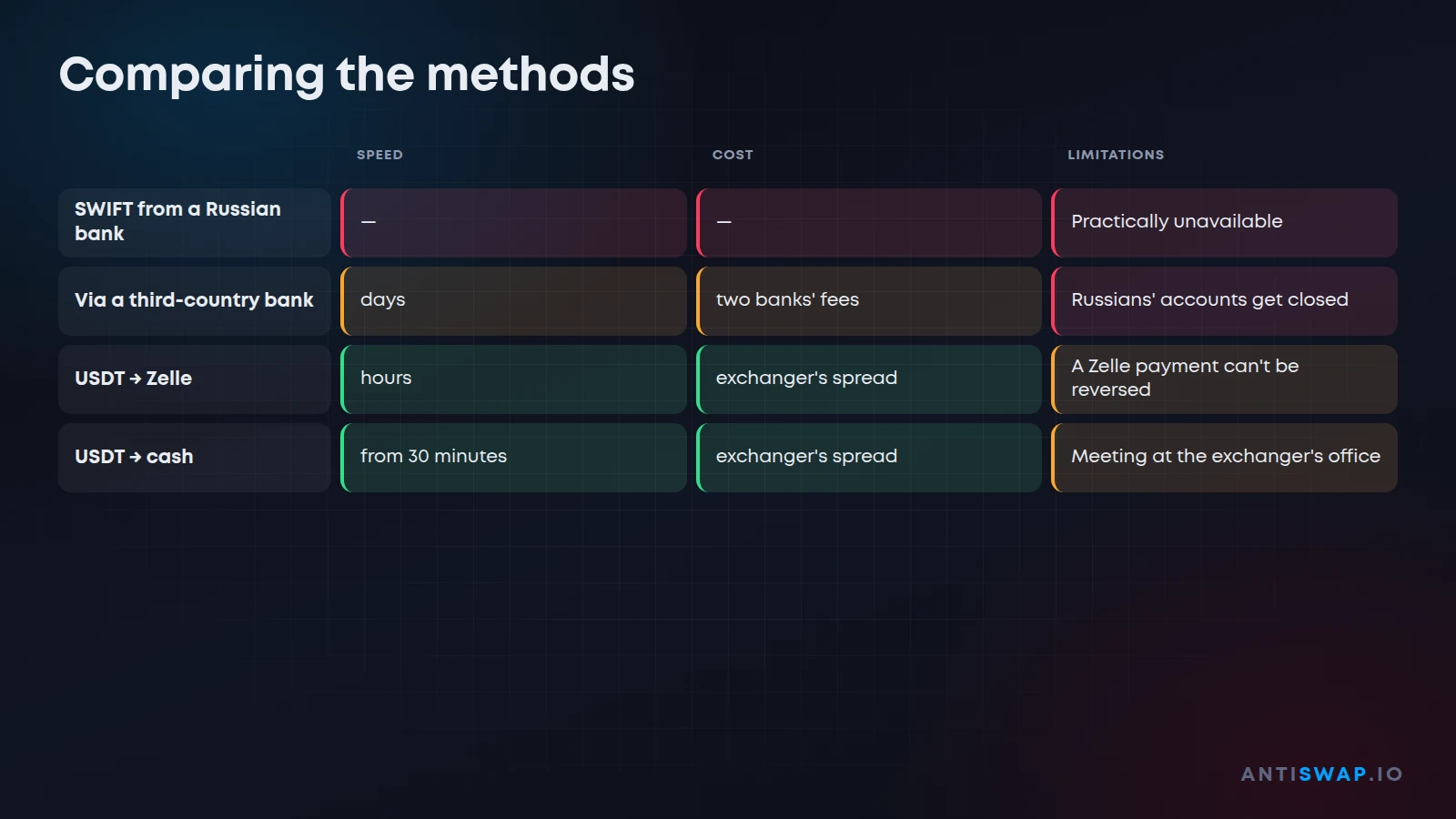
- a bank in a third country: but accounts of Russians there are being closed more and more often;
- USDT through an exchanger: cash dollars in major US cities or a Zelle transfer;
- the recipient sells USDT themselves on a US exchange, with taxes and source-of-funds checks.
What changed by 2026
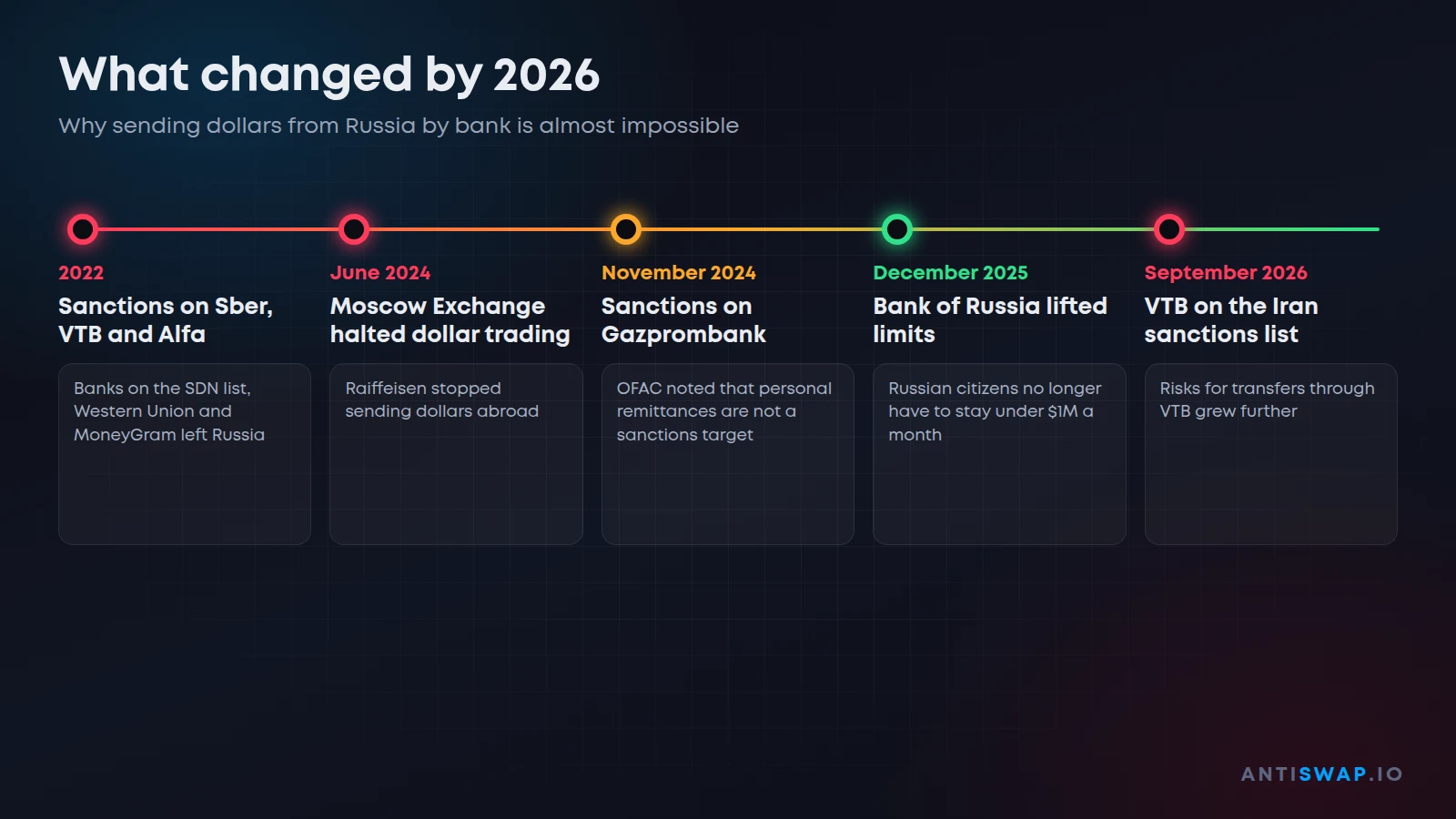
- Sanctions on major banks. VTB was added to the SDN list in February 2022, Sber and Alfa-Bank in April 2022, and Gazprombank in November 2024. US banks must reject payments routed through such banks.
- Transfer services left. Western Union suspended operations in Russia in March 2022, and MoneyGram did the same.
- No dollars on the exchange. Since 13 June 2024, the Moscow Exchange hasn't traded the dollar.
- The Bank of Russia lifted its limits. Since 8 December 2025, Russian citizens no longer have to stay under $1 million a month, but that doesn't help when there's simply no one to send the dollars.
- VTB on the Iran list. On 14 September 2026, the US added VTB to its Iran sanctions list as well.
Why bank transfers are nearly impossible
Any dollar transfer passes through US correspondent banks. If a sanctioned bank is in the chain, the payment is blocked rather than returned. Raiffeisenbank stopped dollar transfers in June 2024, and later all foreign-currency transfers for individuals.
Personal transfers as such aren't prohibited, though. The US Treasury explicitly states that personal non-commercial remittances to and from Russia aren't a target of sanctions as long as no sanctioned persons are involved. The problem is that finding a non-sanctioned bank in Russia that will actually send dollars to the US is almost impossible.
Via a bank in a third country
The "rubles → bank in Kazakhstan, Armenia or Georgia → dollars in the US" route still exists, but it works worse and worse. After Russia was added to the EU AML list, banks in Armenia and Serbia began turning Russians away and closing their accounts, and Kazakh banks stepped up their checks. Besides, the dollars still go through US correspondents, which look closely at the source of funds.
Via USDT and an exchanger
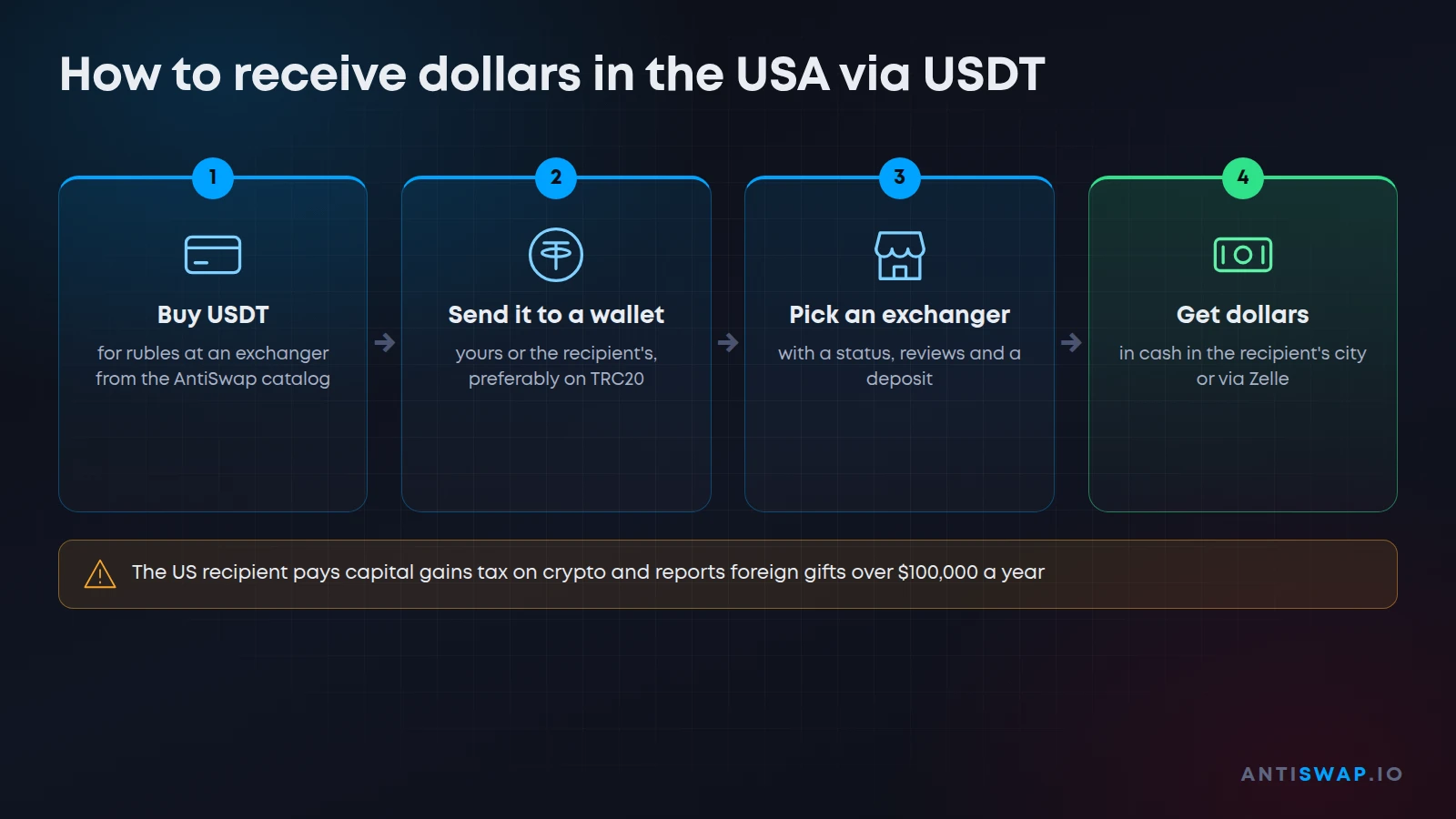
Exchangers pay out cash dollars in major US cities or send them via Zelle. It works like this:
- Buy USDT for rubles at an exchanger from the AntiSwap catalog.
- Send the USDT to a wallet, yours or the recipient's. The TRC20 network is the most convenient.
- Choose an exchanger with a status, good reviews, a deposit and the "★ No AML/KYC" badge.
- Get dollars in cash in the recipient's city or via Zelle.
Step 1: buy USDT for rubles.
| Exchanger | I give | I get | Turnover | Deals | Reviews | |
|---|---|---|---|---|---|---|
≈ 91.74 RUB from 12000 | 1 USDT | 195K+ $ | 189 | |||
≈ 113.4 RUB from 1119 | 1 USDT | 2.9M+ $ | 1835 | |||
≈ 90.96 RUB from 15000 | 1 USDT | 469K+ $ | 26734 | |||
≈ 88 RUB from 50000 | 1 USDT | 1.1M+ $ | 129 | |||
≈ 88.22 RUB from 17644.76 | 1 USDT | 18.3K+ $ | 69 |
Step 2: get dollars in cash in New York or via Zelle.
| Exchanger | I give | I get | Turnover | Deals | Reviews | |
|---|---|---|---|---|---|---|
1 USDT from 10000 | 1.02 USD | - $ | 0 | |||
1 USDT from 10000 | 1.01 USD | - $ | 0 | |||
≈ 1.08 USDT from 10010.47 | 1 USD | 454 $ | 4 | |||
1 USDT from 10000 | 1.02 USD | 15.3K+ $ | 8 | |||
≈ 1.02 USDT from 10000 | 1 USD | 6.3K+ $ | 6 |
| Exchanger | I give | I get | Turnover | Deals | Reviews | |
|---|---|---|---|---|---|---|
≈ 1 USDT from 250.5 | 1 USD | 17.2K+ $ | 0 | |||
≈ 1.02 USDT from 1020 | 1 USD | 142K+ $ | 0 | |||
≈ 1.07 USDT from 240 | 1 USD | 12.1K+ $ | 8 | |||
1 USDT from 10000 | 1.01 USD | 15.3K+ $ | 8 | |||
≈ 1.03 USDT from 514.45 | 1 USD | 444K+ $ | 142 |
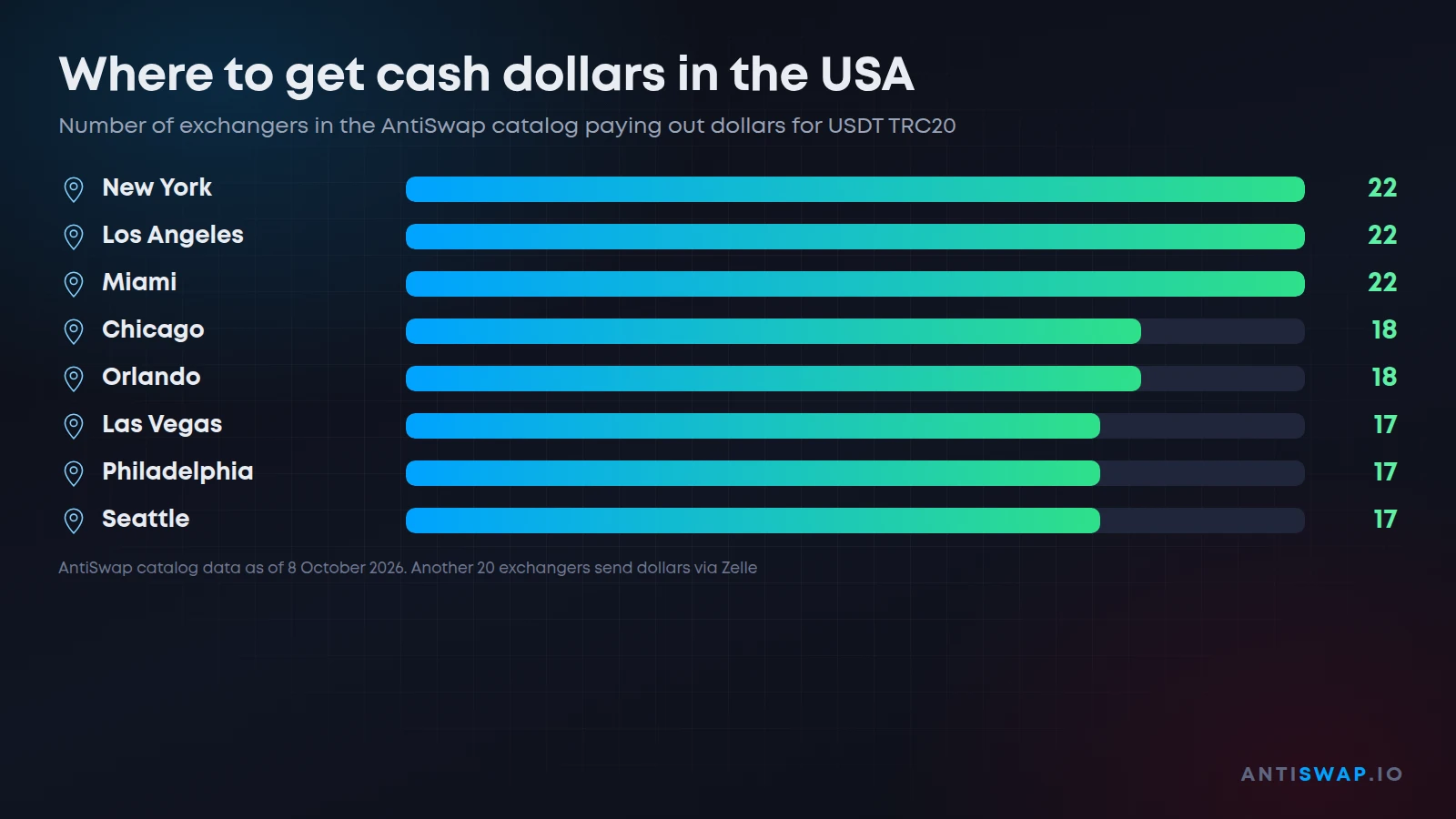
A note on Zelle: a payment can't be cancelled, and banks don't reimburse authorized payments to scammers. So only work with an exchanger that has good reviews and a deposit. More on this direction in "Overview of Zelle USD exchange options".
What the recipient in the US needs to know
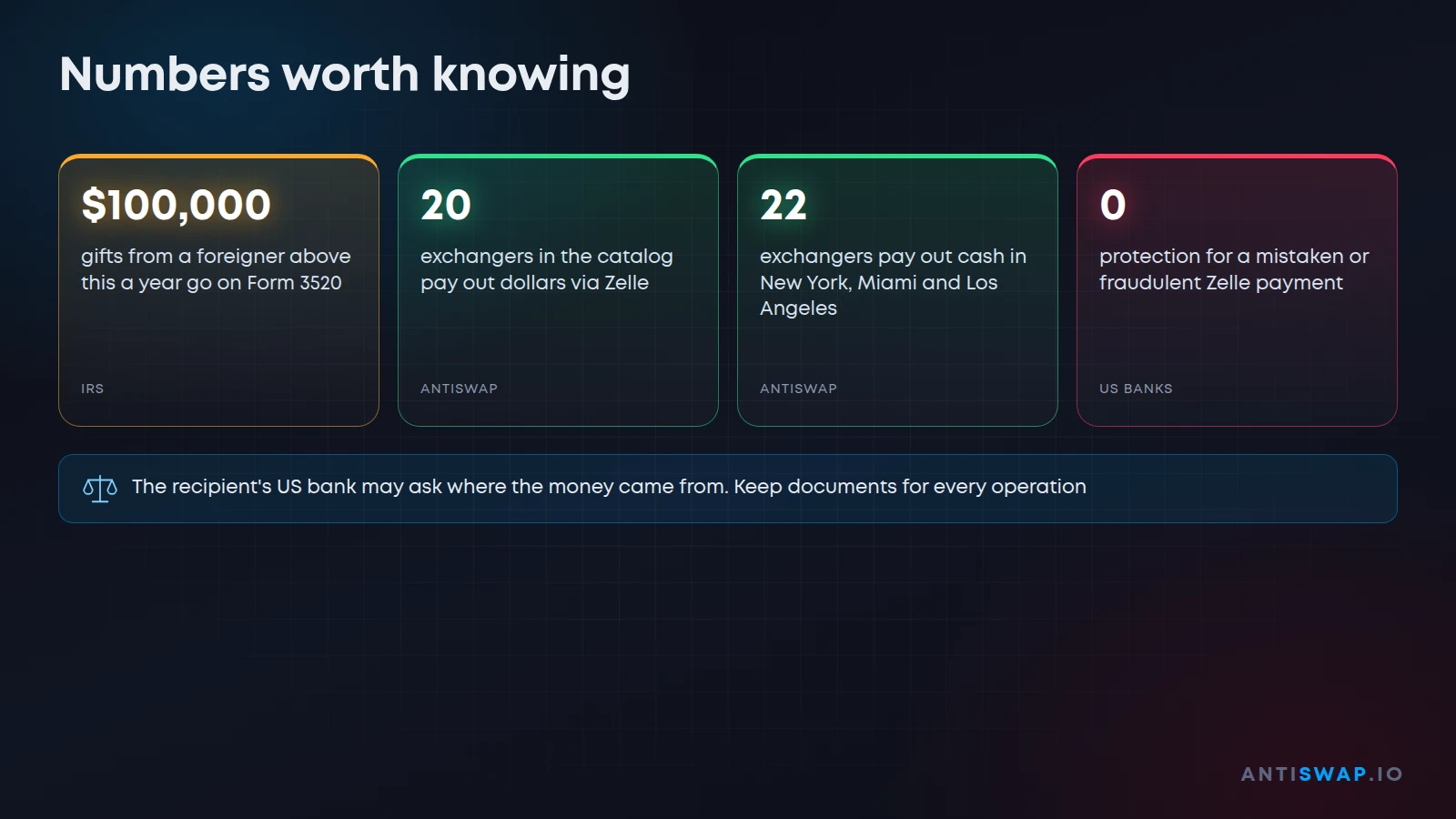
- Crypto tax. The IRS treats crypto as property: a sale produces a gain or loss that must be reported on the tax return.
- Large gifts. If the recipient gets more than $100,000 from a foreign person in a year, they must report it on Form 3520. The gift itself usually isn't taxed, but failing to file is penalized.
- Source-of-funds checks. The recipient's bank may ask where the money came from. Funds linked to sanctioned services like Garantex, Grinex or A7A5 may be frozen.
Risks and how to avoid them
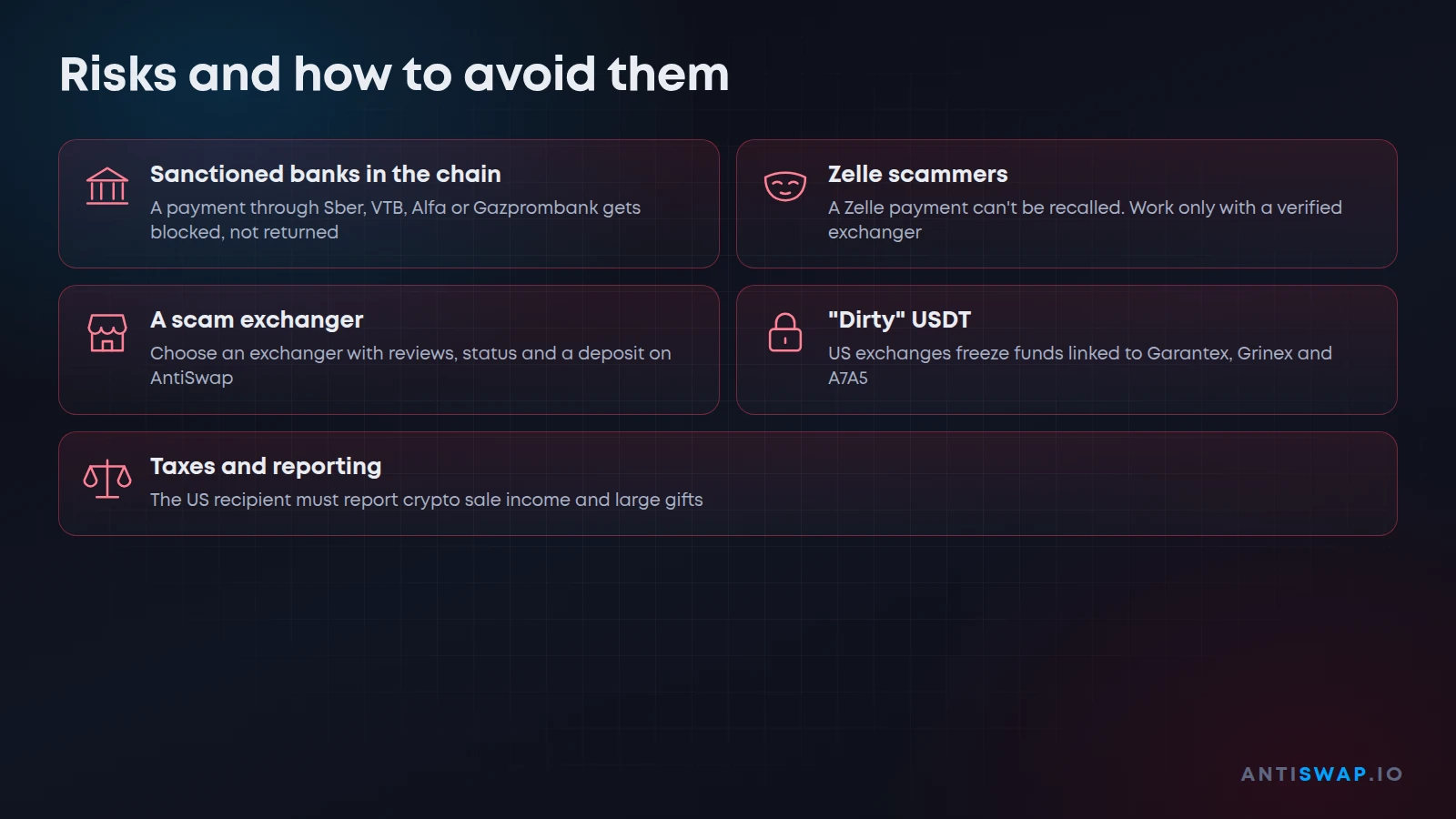
- A scam exchanger. Check the status, reviews and deposit on AntiSwap. More in "Can an exchanger fail to return your crypto?".
- "Dirty" and frozen USDT. Check addresses with our Blacklist Check and read whether Tether can freeze USDT.
- Your card gets blocked in Russia. Buying USDT from strangers on P2P can end with a card block. More in "P2P card blocks under 115-FZ and 161-FZ".
Checklist before you send
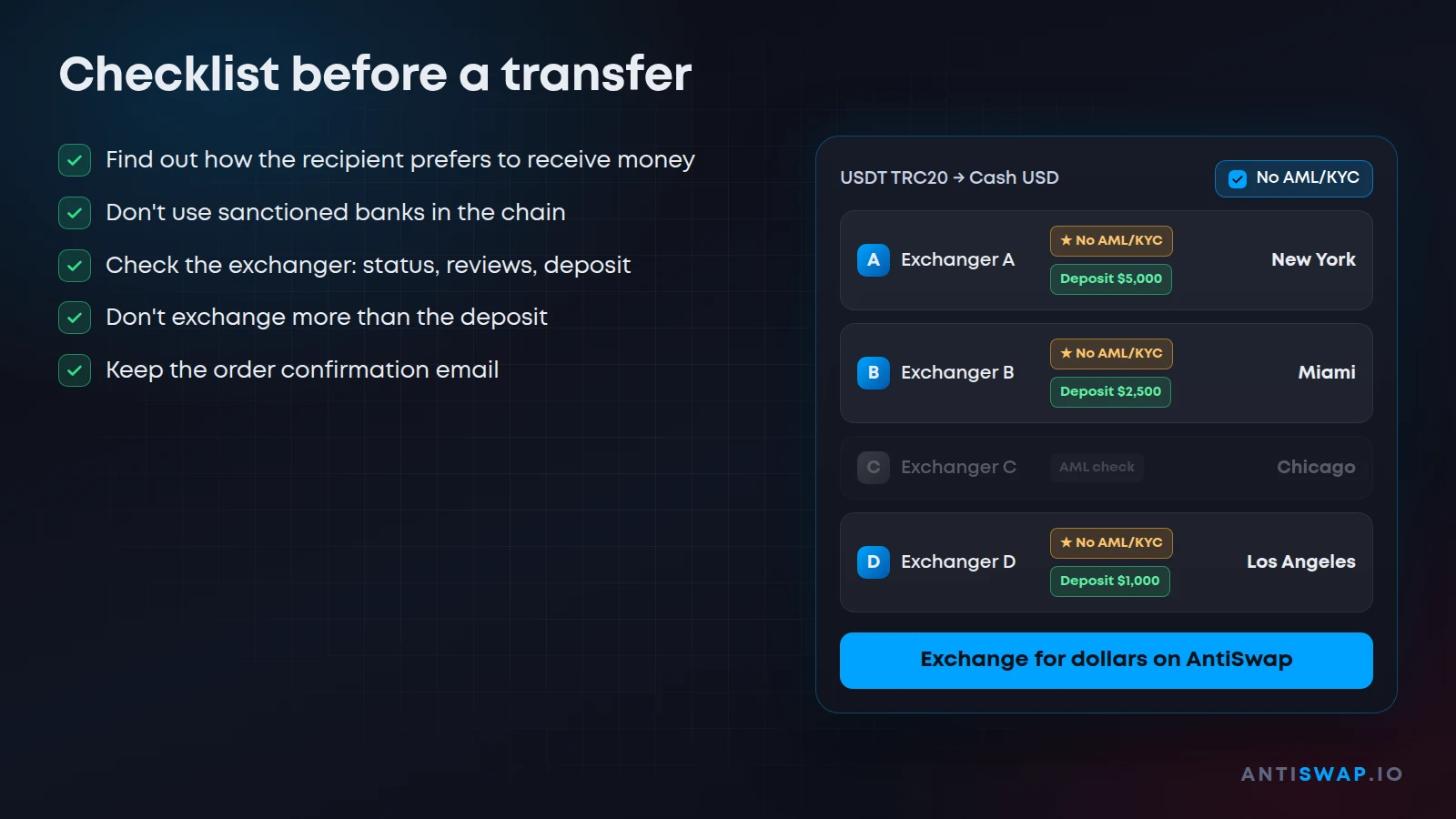
- Ask the recipient how they'd prefer to receive the money: cash or Zelle.
- Don't use sanctioned banks anywhere in the transfer chain.
- Choose an exchanger with the "★ No AML/KYC" badge and a deposit: such exchangers don't freeze crypto on AML grounds, and if they can't complete the exchange, they return it.
- Don't exchange more than the exchanger's deposit.
- Save the order confirmation email and verify it with our email check service.
FAQ
Can I send dollars from a Russian bank to a US one?
Practically not. Major Russian banks are under US blocking sanctions, and the rest hardly send dollars: transfers go through US correspondents, which block suspicious payments.
Personal transfers as such aren't prohibited, but finding a bank that will actually process one is very hard.
Can I send money to the US through Western Union?
No. Western Union and MoneyGram stopped operating in Russia in March 2022. Zolotaya Korona doesn't send to the US either.
How do I get cash dollars in the US for USDT?
Open the USDT TRC20 → cash USD direction on AntiSwap and pick a city. The catalog has exchangers in New York, Los Angeles, Miami, Chicago, Orlando, Las Vegas, Philadelphia and Seattle.
Choose an exchanger with a status, good reviews and a deposit, and meet only at its office.
Do I have to pay tax in the US?
If the recipient sells crypto, they report the gain or loss on their tax return. If they receive gifts from a foreign person worth more than $100,000 a year, they must file Form 3520.
For large sums, it's worth consulting a US tax advisor.
Are there limits on transfers from Russia?
The Bank of Russia's limits for Russian citizens were lifted on 8 December 2025. The main constraints are US sanctions on Russian banks and checks on the US banks' side.
Transfers to other countries
- How to send money to Turkey
- How to send money to Europe and Germany
- How to send money to Thailand
- How to send money to China
- How to send money to Uzbekistan
- How to send money to Kyrgyzstan
- How to send money to Tajikistan
- How to send money to Armenia
- How to send money to Georgia
- How to send money to the UAE
Bottom line
Sending money from Russia to the US through a bank is nearly impossible in 2026: major banks are sanctioned, transfer services are gone, and third-country routes work worse and worse. The realistic option is to exchange USDT for dollars through a trusted exchanger: cash in a major US city or via Zelle. Compare rates and pick an exchanger with a star and a deposit on the USDT TRC20 → cash dollars page in the AntiSwap catalog.