How to Send Money to an Individual in China in 2026
Many people need to send money to China: to pay a supplier, send yuan to a relative or friend, or cover tuition or a trip. But since 2024, transfers to China have been unreliable: Chinese banks return payments from Russia, and intermediaries charge hefty fees.
This guide covers how to send money to an individual in China in 2026: through a bank by card number or account details, to Alipay and WeChat wallets, through a payment agent or an exchanger, and what risks the sender and recipient face.
Quick answer: what works
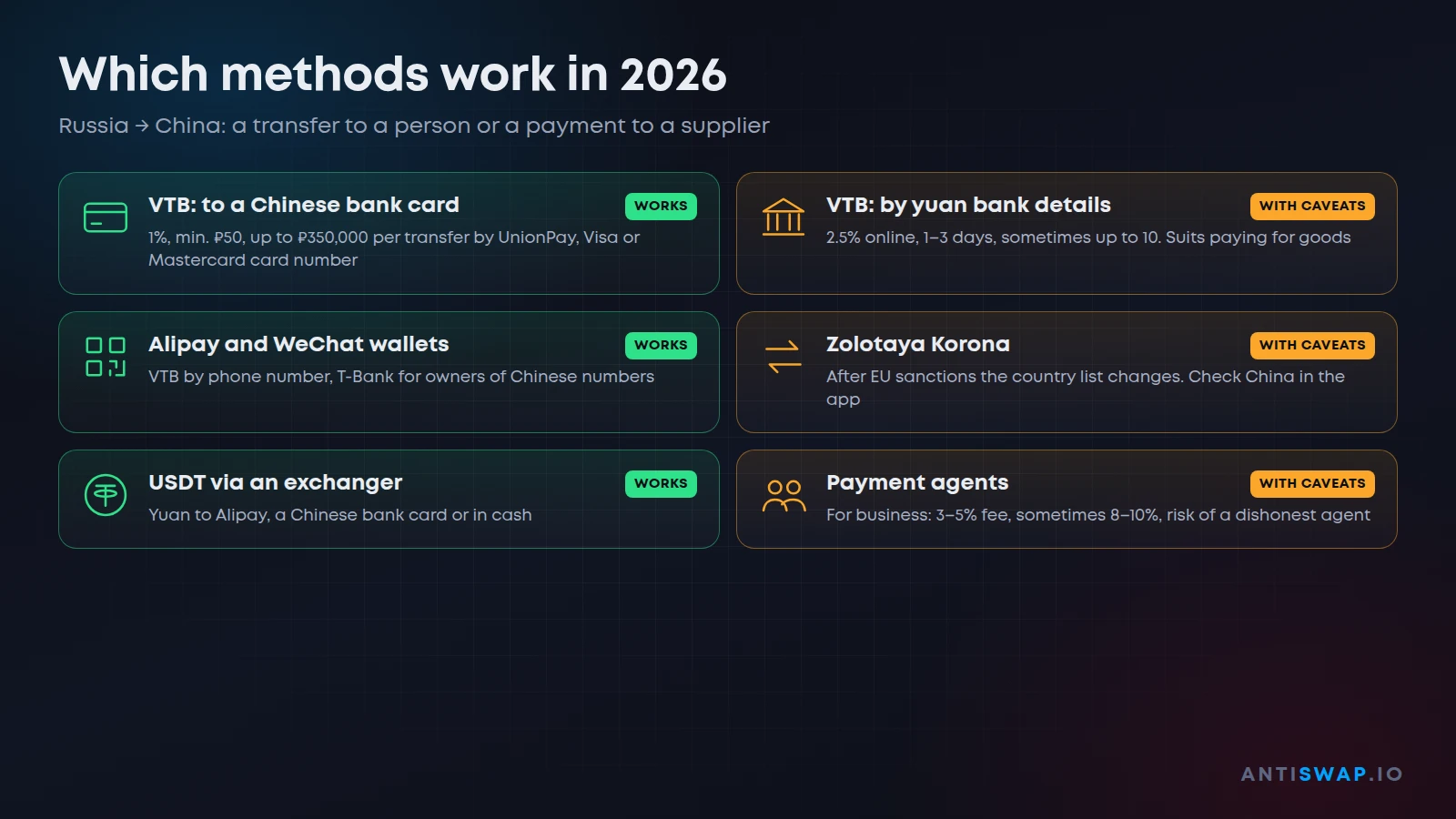
- VTB to a Chinese bank card: fast, 1%, up to 350,000 rubles per transfer;
- VTB by account details in yuan: for paying for goods and large sums;
- Alipay and WeChat wallets: by phone number;
- a payment agent: for business, but with fees and risk;
- an exchanger: yuan to Alipay, a Chinese bank card or in cash.
What changed by 2026
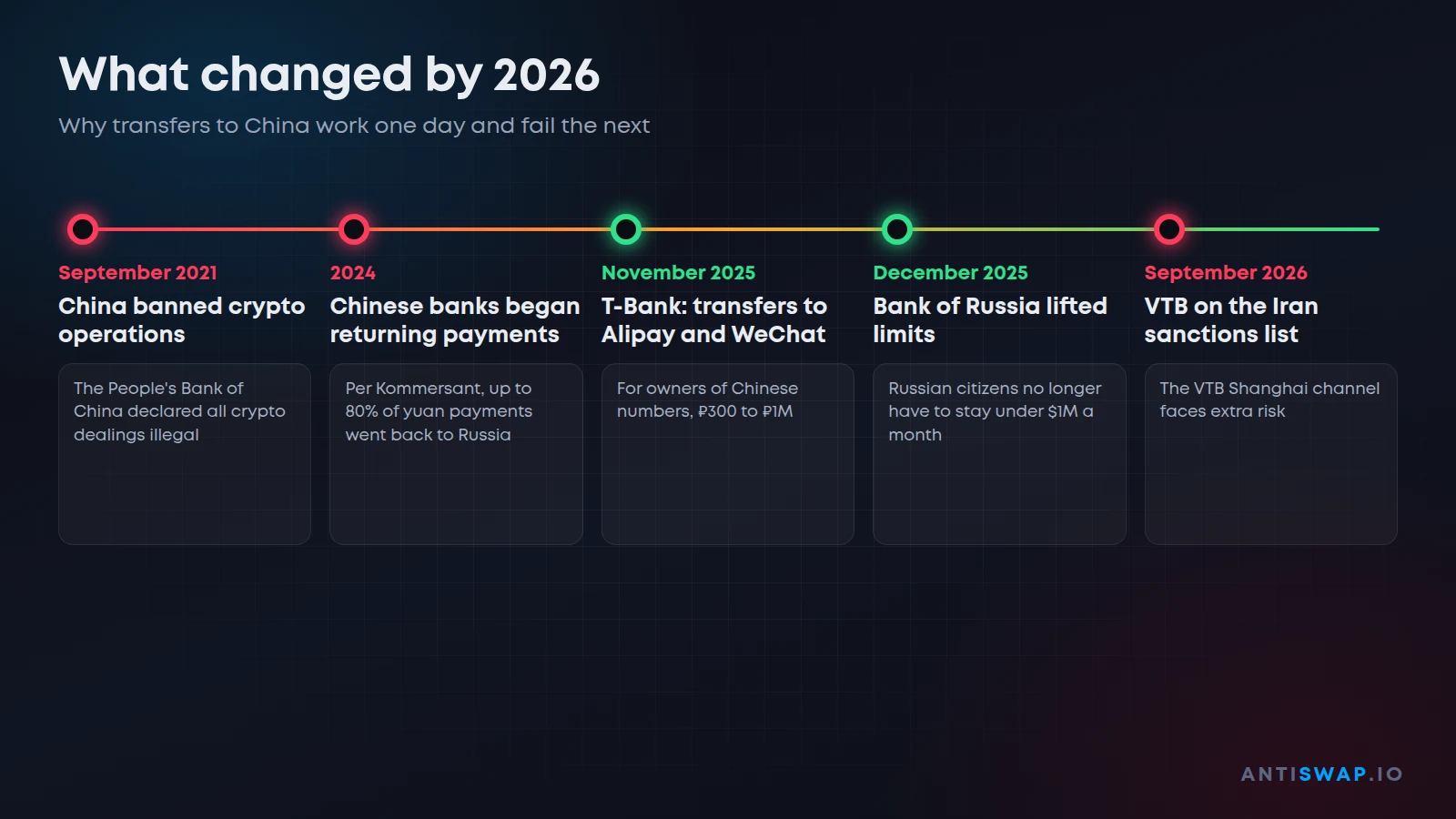
- Chinese banks started returning payments. According to Kommersant, in summer 2024 up to 80% of yuan payments were returned to Russia: money hung for weeks, and banks kept their fees even for failed payments.
- The Bank of Russia lifted its limits. Since 8 December 2025, Russian citizens no longer have to stay under $1 million a month.
- Wallet transfers appeared. Since November 2025, T-Bank sends money to Alipay and WeChat, and VTB sends to popular Chinese wallets by phone number.
- VTB under new sanctions. On 14 September 2026, the US added VTB to its Iran sanctions list. How this will affect transfers to China is not yet clear.
VTB: to a card or by account details
VTB offers three ways to send money to China:
- to a Chinese bank card (UnionPay, Visa or Mastercard) by card number: 1% fee, minimum 50 rubles, up to 350,000 rubles per transfer, credited instantly;
- by account details in yuan to an account at a Chinese bank: 2.5% fee in the app and 3% at a branch, credited in 1 to 3 days. The bank warns that a transfer sometimes takes up to 10 business days. The money is debited from a yuan account;
- by phone number to popular Chinese wallets: from 0%.
The overall limit is 20 million rubles a day. For paying for goods, electronics and cars, a transfer by account details is the right choice.
Alipay and WeChat wallets
Many people in China use Alipay and WeChat Pay wallets rather than bank cards. You can send money there through VTB by phone number, and since November 2025 through T-Bank as well: 300 rubles to 1 million rubles per transfer, but so far only to owners of Chinese phone numbers. More on the options in "How to top up Alipay from Russia" and "How to top up WeChat from Russia", and what Sber, Alfa-Bank and VTB offer is covered in "How to top up Alipay via Sber, Alfa-Bank and VTB".
Paying a supplier through an agent
When a bank won't process a payment, businesses and private buyers often turn to payment agents: you pay rubles to a Russian company, and it pays the supplier through its own infrastructure. According to Kommersant, about 30% of payments went through agents, whose fee is usually 3–5% and sometimes reaches 8–10%. The main risk is a dishonest agent: nominee directors and demands for a large prepayment are red flags.
Via USDT and an exchanger
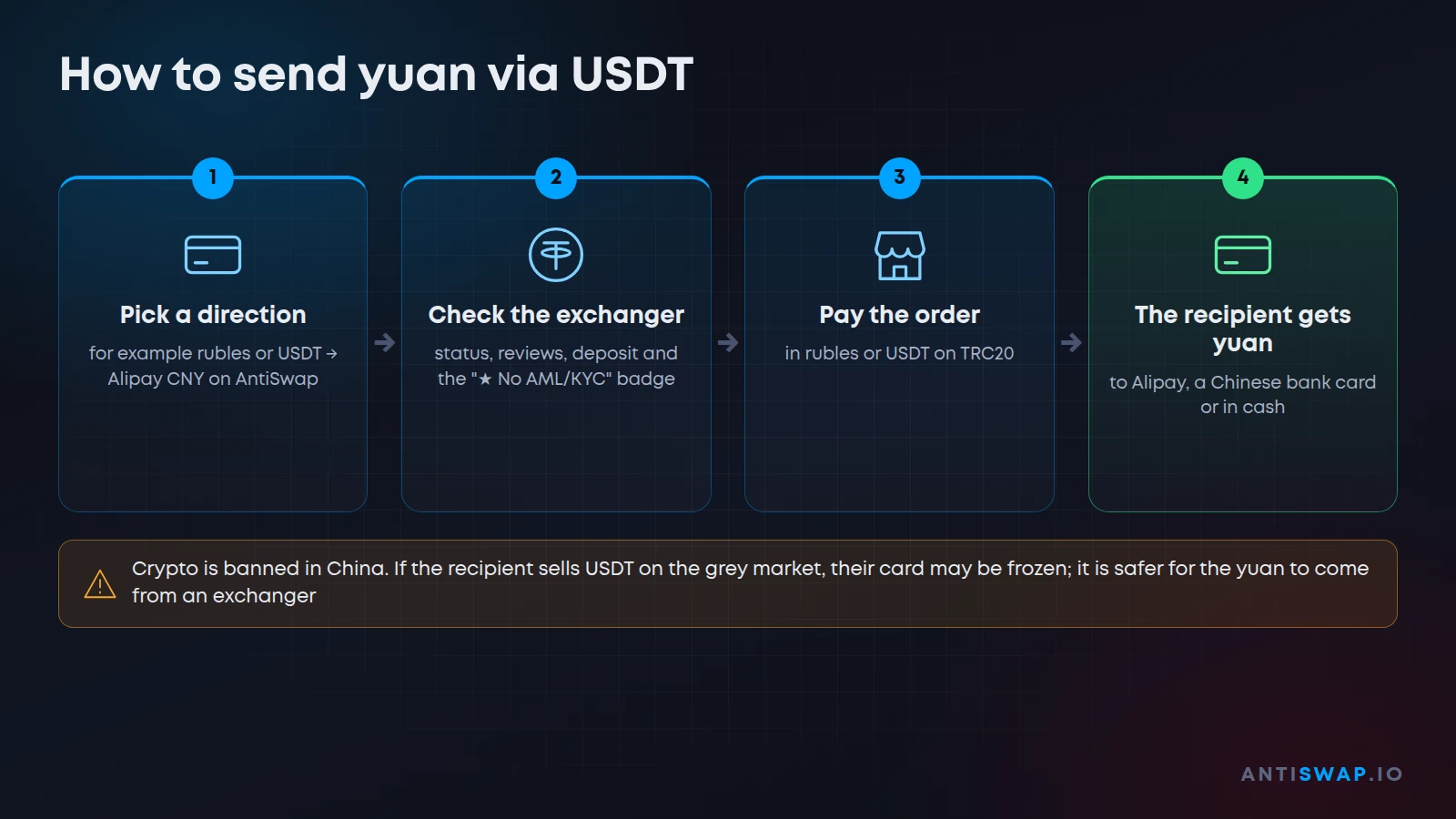
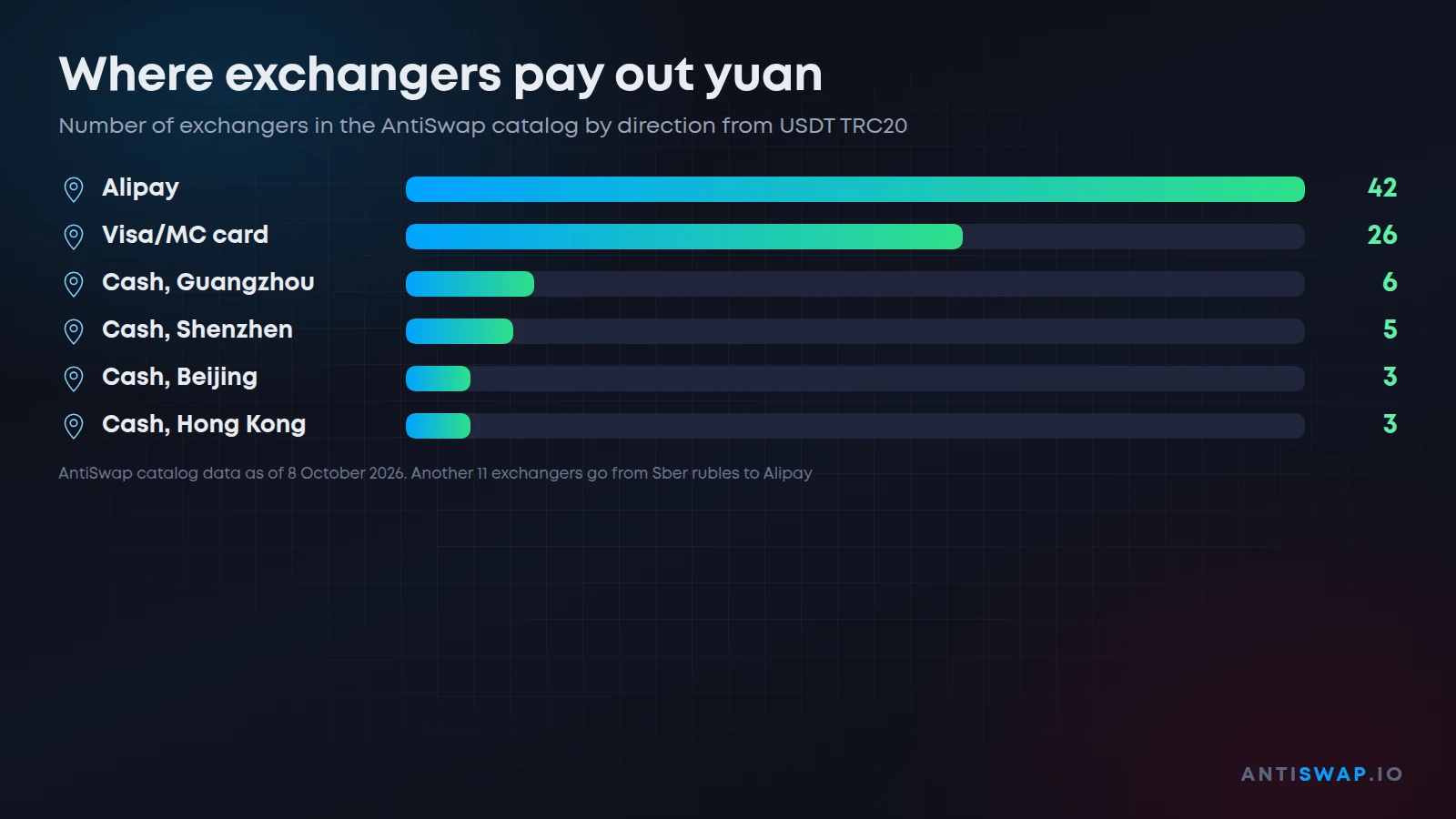
Exchangers in the AntiSwap catalog pay out yuan to Alipay, to Chinese bank cards or in cash in major Chinese cities. The recipient doesn't have to touch crypto at all; they simply receive yuan.
You can exchange Sberbank rubles straight for yuan on Alipay:
| Exchanger | I give | I get | Turnover | Deals | Reviews | |
|---|---|---|---|---|---|---|
≈ 13.14 RUB from 50000 | 1 CNY | 1.1M+ $ | 129 | |||
≈ 13.14 RUB from 15000 | 1 CNY | 135K+ $ | 8 | |||
≈ 13.31 RUB from 30000 | 1 CNY | 9.2K+ $ | 4 | |||
≈ 13.78 RUB from 13917.96 | 1 CNY | 1.6K+ $ | 8 | |||
≈ 13.06 RUB from 40000 | 1 CNY | 444K+ $ | 142 | |||
≈ 13.06 RUB from 30000 | 1 CNY | 1.4K+ $ | 1 |
Or, if you already have USDT, exchange it for yuan on Alipay or a Chinese bank card:
| Exchanger | I give | I get | Turnover | Deals | Reviews | |
|---|---|---|---|---|---|---|
1 USDT from 748 | 6.68 CNY | 1.1M+ $ | 129 | |||
1 USDT from 618.05136 | 6.47 CNY | 34.2K+ $ | 60 | |||
1 USDT from 454.1606 | 6.61 CNY | 135K+ $ | 8 | |||
1 USDT from 0 | 6.69 CNY | - $ | 0 | |||
1 USDT from 226.4263 | 6.62 CNY | 9.2K+ $ | 4 | |||
1 USDT from 500 | 6.49 CNY | 8.6K+ $ | 9 |
| Exchanger | I give | I get | Turnover | Deals | Reviews | |
|---|---|---|---|---|---|---|
1 USDT from 605.5474 | 6.61 CNY | 135K+ $ | 8 | |||
1 USDT from 96 | 6.14 CNY | 12.1K+ $ | 8 | |||
1 USDT from 10000 | 6.68 CNY | 15.3K+ $ | 8 | |||
1 USDT from 244.21819 | 6.35 CNY | 11.5K+ $ | 0 |
An important note about crypto in China. Since September 2021, the People's Bank of China has treated all crypto transactions as illegal. If the recipient sells USDT on the gray market themselves, their bank card can be frozen: that's how China fights "underground banks". In 2024 police dismantled an underground bank that had moved $1.9 billion through USDT. So it's safer for the recipient's yuan to come from an exchanger than from a random crypto seller.
Comparing methods and costs
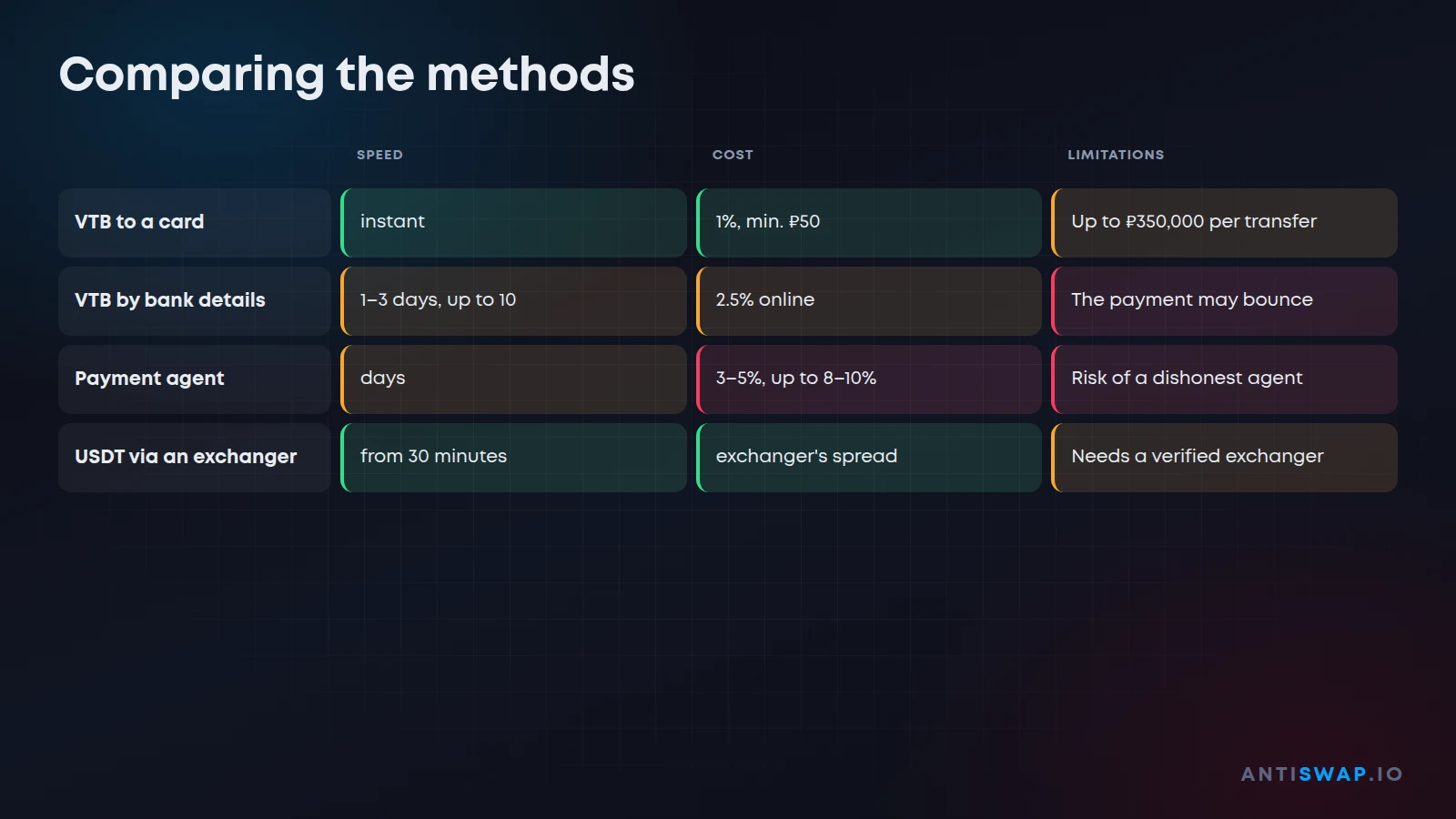
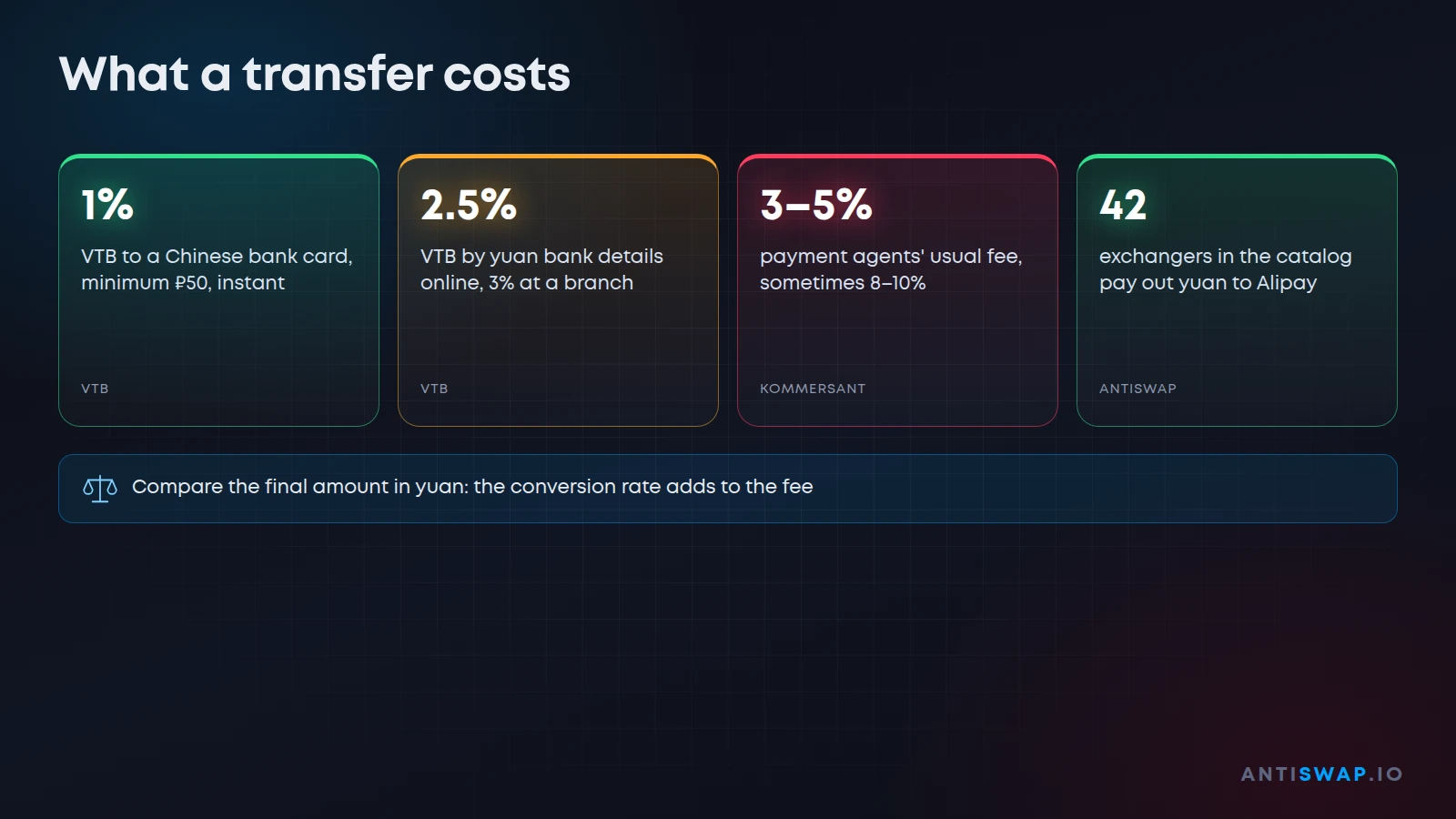
Compare the final amount in yuan: the conversion rate comes on top of the fee. For small sums, VTB to a card or Alipay is usually the cheapest, and an AntiSwap direction page shows how many yuan you'll get at each exchanger.
Risks and how to avoid them
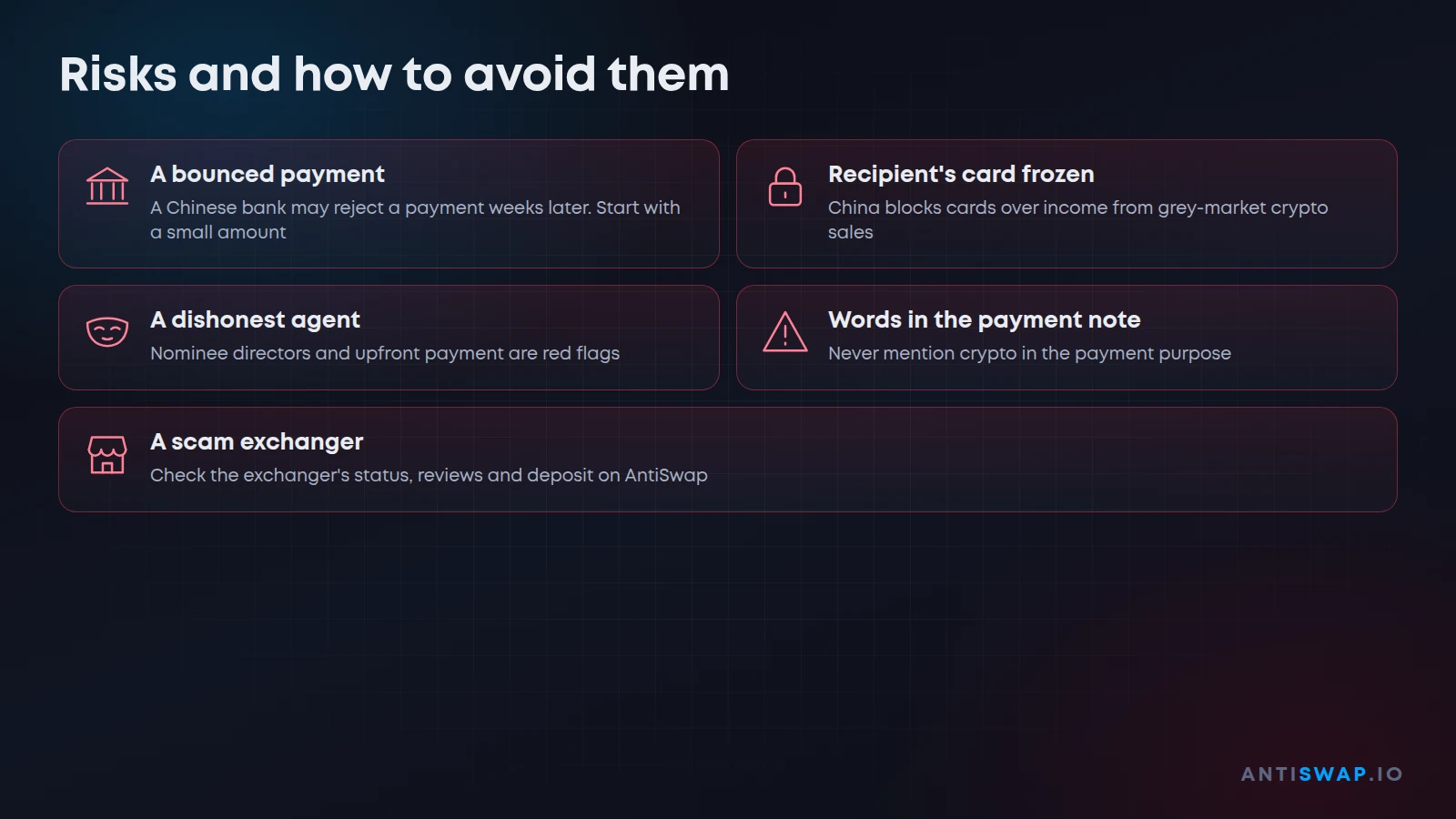
- The payment bounces. A Chinese bank may reject a transfer weeks later. Start with a small amount and ask the recipient which bank they use: regional banks are more willing to accept payments from Russia.
- Payment purpose. State the exact purpose, such as payment for goods or a transfer to a relative, and never mention crypto.
- A scam exchanger. Check the status, reviews and deposit on AntiSwap. More in "Can an exchanger fail to return your crypto?".
- "Dirty" USDT. Check addresses with our Blacklist Check and read "Dirty crypto: what it is, how to check it and what to do".
Checklist before you send
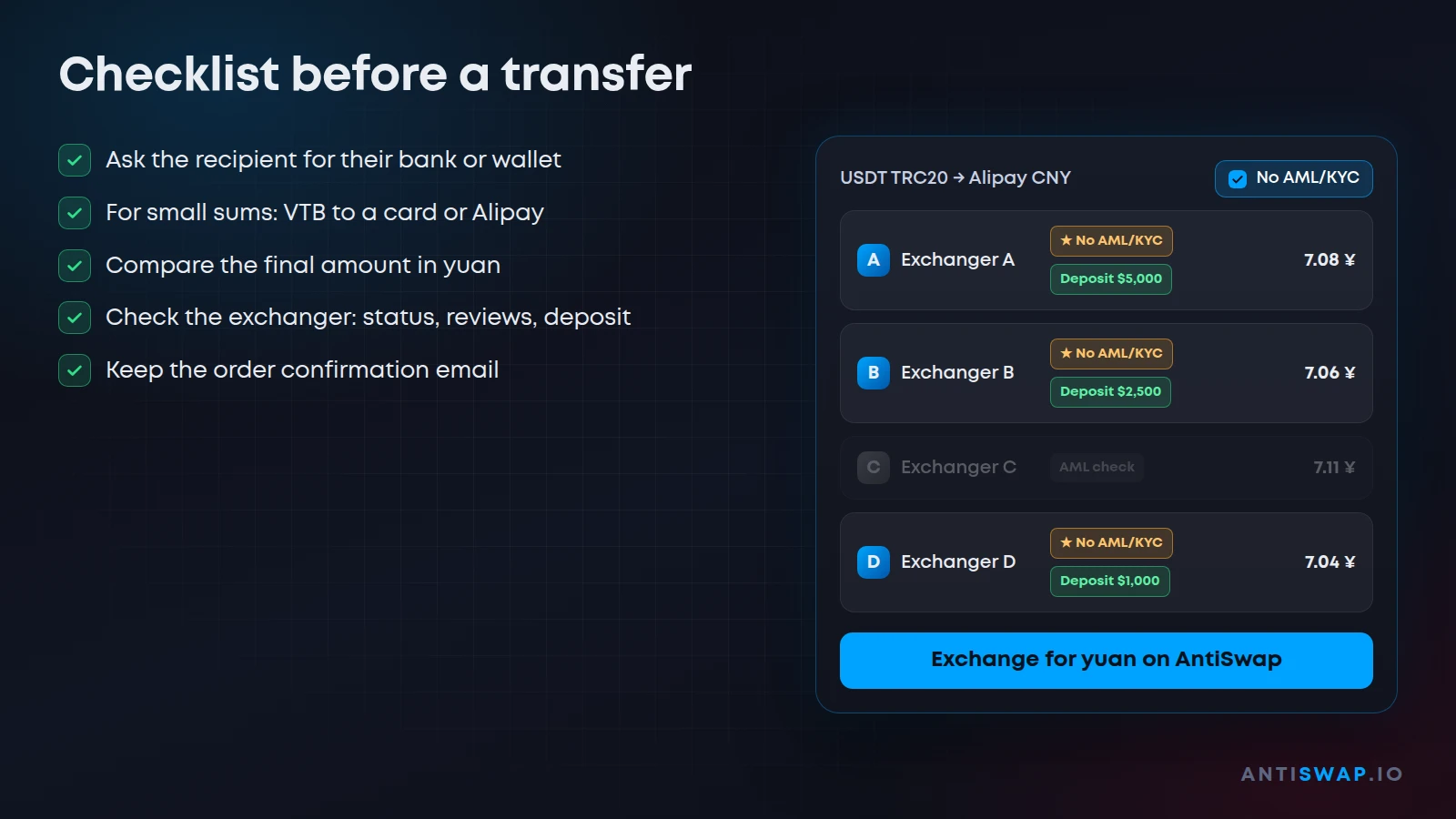
- Get the recipient's bank and card number, or the phone number linked to their Alipay or WeChat.
- For small sums, use VTB to a card or a wallet.
- Compare the final amount in yuan across all methods.
- Choose an exchanger with the "★ No AML/KYC" badge and a deposit: such exchangers don't freeze crypto on AML grounds, and if they can't complete the exchange, they return it.
- Save the order confirmation email and verify it with our email check service.
FAQ
How do I send money to China by card number?
Through VTB: a transfer to a Chinese UnionPay, Visa or Mastercard card by card number costs 1%, minimum 50 rubles, up to 350,000 rubles per transfer, and arrives instantly.
Another option is an exchanger with a payout to a Chinese bank card in the AntiSwap catalog.
Why was my transfer to China returned?
Since 2024, many Chinese banks have feared US secondary sanctions and reject payments from Russia. Sometimes a transfer hangs for weeks and then comes back.
Ask the recipient which bank they use, state the exact payment purpose and start with a small amount.
Can I send money to Alipay?
Yes. VTB sends to popular Chinese wallets by phone number, and T-Bank sends to owners of Chinese numbers. And more than 40 exchangers in the AntiSwap catalog pay out yuan to Alipay for USDT or rubles.
Can I pay a supplier in crypto?
Many suppliers accept USDT, but crypto transactions are banned in China, and the recipient risks a card freeze when selling. It's safer for the supplier to receive yuan from an exchanger or a bank.
Russia has an experimental legal regime for crypto settlements in foreign trade, but it isn't available to private individuals.
Are there limits on transfers to China?
The Bank of Russia's limits for Russian citizens were lifted on 8 December 2025. Banks have their own limits, though: VTB, for example, allows up to 350,000 rubles per card transfer and 20 million rubles a day.
Transfers to other countries
- How to send money to Turkey
- How to send money to Europe and Germany
- How to send money to the US
- How to send money to Thailand
- How to send money to Uzbekistan
- How to send money to Kyrgyzstan
- How to send money to Tajikistan
- How to send money to Armenia
- How to send money to Georgia
- How to send money to the UAE
Bottom line
In 2026 there are several ways to send money to an individual in China. For small sums, VTB to a Chinese bank card or Alipay and WeChat wallets are the most convenient; for paying for goods, a transfer by account details in yuan or a payment agent. And if the bank returns the payment, you can get yuan to the recipient through a trusted exchanger: to Alipay, a card or in cash. Compare rates and pick an exchanger with a star and a deposit on the Sberbank RUB → Alipay CNY page in the AntiSwap catalog.